Jump to
S1C2
Energy calculated at HF/cc-pVQZ
| | hartrees |
|---|
| Energy at 0K | -113.845650 |
| Energy at 298.15K | -113.847083 |
| HF Energy | -113.845650 |
| Nuclear repulsion energy | 31.248978 |
The energy at 298.15K was derived from the energy at 0K
and an integrated heat capacity that used the calculated vibrational frequencies.
Vibrational Frequencies calculated at HF/cc-pVQZ
| Mode Number |
Symmetry |
Frequency
(cm-1) |
Scaled Frequency
(cm-1) |
IR Intensities
(km mol-1) |
Raman Act
(Å4/u) |
Dep P |
Dep U |
|---|
| 1 |
A' |
4098 |
3723 |
125.43 |
|
|
|
| 2 |
A' |
3056 |
2776 |
131.96 |
|
|
|
| 3 |
A' |
1610 |
1463 |
41.79 |
|
|
|
| 4 |
A' |
1439 |
1307 |
135.93 |
|
|
|
| 5 |
A' |
1318 |
1197 |
145.43 |
|
|
|
| 6 |
A" |
1117 |
1015 |
139.09 |
|
|
|
Unscaled Zero Point Vibrational Energy (zpe) 6319.1 cm
-1
Scaled (by 0.9084) Zero Point Vibrational Energy (zpe) 5740.3 cm
-1
See section
III.C.1 List or set vibrational scaling factors
to change the scale factors used here.
See section
III.C.2
Calculate a vibrational scaling factor for a given set of molecules
to determine the least squares best scaling factor.
Geometric Data calculated at HF/cc-pVQZ
Point Group is Cs
Cartesians (Å)
| Atom |
x (Å) |
y (Å) |
z (Å) |
|---|
| C1 |
0.011 |
0.729 |
0.000 |
| O2 |
0.011 |
-0.560 |
0.000 |
| H3 |
-1.054 |
0.994 |
0.000 |
| H4 |
0.897 |
-0.884 |
0.000 |
Atom - Atom Distances (Å)
| |
C1 |
O2 |
H3 |
H4 |
| C1 | | 1.2895 | 1.0974 | 1.8404 |
O2 | 1.2895 | | 1.8843 | 0.9428 | H3 | 1.0974 | 1.8843 | | 2.7078 | H4 | 1.8404 | 0.9428 | 2.7078 | |
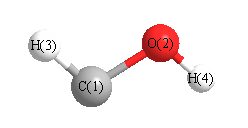 More geometry information
Calculated Bond Angles
| atom1 |
atom2 |
atom3 |
angle |
|
atom1 |
atom2 |
atom3 |
angle |
| C1 |
O2 |
H4 |
110.092 |
|
O2 |
C1 |
H3 |
103.978 |
Electronic energy levels
Charges, Dipole, Quadrupole and Polarizability
Charges from optimized geometry at HF/cc-pVQZ
Charges (e)
| Number |
Element |
Mulliken |
CHELPG |
AIM |
ESP |
| 1 |
C |
-0.045 |
|
|
|
| 2 |
O |
-0.277 |
|
|
|
| 3 |
H |
0.045 |
|
|
|
| 4 |
H |
0.277 |
|
|
|
Electric dipole moments
Electric dipole components in Debye
(What's a Debye? See section
VII.A.3)
| |
x |
y |
z |
Total |
| |
0.081 |
-1.402 |
0.000 |
1.405 |
| CHELPG |
|
|
|
|
| AIM |
|
|
|
|
| ESP |
|
|
|
|
Electric Quadrupole moment
Quadrupole components in D Å
| Primitive |
|---|
| | x | y | z |
|---|
| x |
-11.195 |
-3.928 |
0.000 |
| y |
-3.928 |
-13.695 |
0.000 |
| z |
0.000 |
0.000 |
-11.948 |
|
| Traceless |
|---|
| | x | y | z |
|---|
| x |
1.626 |
-3.928 |
0.000 |
| y |
-3.928 |
-2.123 |
0.000 |
| z |
0.000 |
0.000 |
0.497 |
|
| Polar |
|---|
| 3z2-r2 | 0.995 |
|---|
| x2-y2 | 2.499 |
|---|
| xy | -3.928 |
|---|
| xz | 0.000 |
|---|
| yz | 0.000 |
|---|
|
Polarizabilities
Components of the polarizability tensor.
Units are
Å
3 (Angstrom cubed)
Change units.
| |
x |
y |
z |
| x |
2.690 |
-0.338 |
0.000 |
| y |
-0.338 |
2.738 |
0.000 |
| z |
0.000 |
0.000 |
2.052 |
<r2> (average value of r
2) Å
2
| <r2> |
17.057 |
| (<r2>)1/2 |
4.130 |
Jump to
S1C1
Energy calculated at HF/cc-pVQZ
| | hartrees |
|---|
| Energy at 0K | -113.837364 |
| Energy at 298.15K | -113.838787 |
| HF Energy | -113.837364 |
| Nuclear repulsion energy | 31.137851 |
The energy at 298.15K was derived from the energy at 0K
and an integrated heat capacity that used the calculated vibrational frequencies.
Vibrational Frequencies calculated at HF/cc-pVQZ
| Mode Number |
Symmetry |
Frequency
(cm-1) |
Scaled Frequency
(cm-1) |
IR Intensities
(km mol-1) |
Raman Act
(Å4/u) |
Dep P |
Dep U |
|---|
| 1 |
A' |
4038 |
3668 |
53.39 |
|
|
|
| 2 |
A' |
2963 |
2692 |
189.96 |
|
|
|
| 3 |
A' |
1584 |
1439 |
52.40 |
|
|
|
| 4 |
A' |
1431 |
1300 |
189.57 |
|
|
|
| 5 |
A' |
1348 |
1224 |
18.89 |
|
|
|
| 6 |
A" |
1035 |
940 |
34.08 |
|
|
|
Unscaled Zero Point Vibrational Energy (zpe) 6199.0 cm
-1
Scaled (by 0.9084) Zero Point Vibrational Energy (zpe) 5631.2 cm
-1
See section
III.C.1 List or set vibrational scaling factors
to change the scale factors used here.
See section
III.C.2
Calculate a vibrational scaling factor for a given set of molecules
to determine the least squares best scaling factor.
Geometric Data calculated at HF/cc-pVQZ
Point Group is Cs
Cartesians (Å)
| Atom |
x (Å) |
y (Å) |
z (Å) |
|---|
| C1 |
0.119 |
0.731 |
0.000 |
| O2 |
0.119 |
-0.560 |
0.000 |
| H3 |
-0.933 |
1.068 |
0.000 |
| H4 |
-0.733 |
-0.969 |
0.000 |
Atom - Atom Distances (Å)
| |
C1 |
O2 |
H3 |
H4 |
| C1 | | 1.2912 | 1.1045 | 1.9015 |
O2 | 1.2912 | | 1.9385 | 0.9453 | H3 | 1.1045 | 1.9385 | | 2.0467 | H4 | 1.9015 | 0.9453 | 2.0467 | |
More geometry information
Calculated Bond Angles
| atom1 |
atom2 |
atom3 |
angle |
|
atom1 |
atom2 |
atom3 |
angle |
| C1 |
O2 |
H4 |
115.606 |
|
O2 |
C1 |
H3 |
107.778 |
Electronic energy levels
Charges, Dipole, Quadrupole and Polarizability
Charges from optimized geometry at HF/cc-pVQZ
Charges (e)
| Number |
Element |
Mulliken |
CHELPG |
AIM |
ESP |
| 1 |
C |
0.064 |
|
|
|
| 2 |
O |
-0.318 |
|
|
|
| 3 |
H |
-0.006 |
|
|
|
| 4 |
H |
0.260 |
|
|
|
Electric dipole moments
Electric dipole components in Debye
(What's a Debye? See section
VII.A.3)
| |
x |
y |
z |
Total |
| |
-3.089 |
-1.446 |
0.000 |
3.411 |
| CHELPG |
|
|
|
|
| AIM |
|
|
|
|
| ESP |
|
|
|
|
Electric Quadrupole moment
Quadrupole components in D Å
| Primitive |
|---|
| | x | y | z |
|---|
| x |
-12.354 |
-0.265 |
0.000 |
| y |
-0.265 |
-13.240 |
0.000 |
| z |
0.000 |
0.000 |
-11.900 |
|
| Traceless |
|---|
| | x | y | z |
|---|
| x |
0.215 |
-0.265 |
0.000 |
| y |
-0.265 |
-1.113 |
0.000 |
| z |
0.000 |
0.000 |
0.897 |
|
| Polar |
|---|
| 3z2-r2 | 1.794 |
|---|
| x2-y2 | 0.885 |
|---|
| xy | -0.265 |
|---|
| xz | 0.000 |
|---|
| yz | 0.000 |
|---|
|
Polarizabilities
Components of the polarizability tensor.
Units are
Å
3 (Angstrom cubed)
Change units.
| |
x |
y |
z |
| x |
2.668 |
-0.033 |
0.000 |
| y |
-0.033 |
2.914 |
0.000 |
| z |
0.000 |
0.000 |
2.045 |
<r2> (average value of r
2) Å
2
| <r2> |
17.208 |
| (<r2>)1/2 |
4.148 |
