Jump to
S1C2
Vibrational Frequencies calculated at CCSD/6-311G*
Geometric Data calculated at CCSD/6-311G*
Electronic energy levels
Charges, Dipole, Quadrupole and Polarizability
Jump to
S1C1
Energy calculated at CCSD/6-311G*
| | hartrees |
|---|
| Energy at 0K | -1071.556949 |
| Energy at 298.15K | |
| HF Energy | -1070.782574 |
| Nuclear repulsion energy | 266.080472 |
The energy at 298.15K was derived from the energy at 0K
and an integrated heat capacity that used the calculated vibrational frequencies.
Vibrational Frequencies calculated at CCSD/6-311G*
| Mode Number |
Symmetry |
Frequency
(cm-1) |
Scaled Frequency
(cm-1) |
IR Intensities
(km mol-1) |
Raman Act
(Å4/u) |
Dep P |
Dep U |
|---|
| 1 |
A |
3132 |
2986 |
6.27 |
|
|
|
| 2 |
A |
2996 |
2857 |
53.93 |
|
|
|
| 3 |
A |
1860 |
1773 |
115.13 |
|
|
|
| 4 |
A |
1433 |
1366 |
16.67 |
|
|
|
| 5 |
A |
1318 |
1257 |
18.12 |
|
|
|
| 6 |
A |
1288 |
1228 |
10.37 |
|
|
|
| 7 |
A |
1057 |
1008 |
15.90 |
|
|
|
| 8 |
A |
963 |
918 |
6.48 |
|
|
|
| 9 |
A |
858 |
818 |
74.66 |
|
|
|
| 10 |
A |
666 |
635 |
31.19 |
|
|
|
| 11 |
A |
636 |
606 |
30.61 |
|
|
|
| 12 |
A |
357 |
340 |
1.15 |
|
|
|
| 13 |
A |
289 |
275 |
2.75 |
|
|
|
| 14 |
A |
229 |
219 |
2.82 |
|
|
|
| 15 |
A |
85 |
81 |
10.84 |
|
|
|
Unscaled Zero Point Vibrational Energy (zpe) 8582.9 cm
-1
Scaled (by 0.9535) Zero Point Vibrational Energy (zpe) 8183.8 cm
-1
See section
III.C.1 List or set vibrational scaling factors
to change the scale factors used here.
See section
III.C.2
Calculate a vibrational scaling factor for a given set of molecules
to determine the least squares best scaling factor.
Geometric Data calculated at CCSD/6-311G*
Point Group is C1
Cartesians (Å)
| Atom |
x (Å) |
y (Å) |
z (Å) |
|---|
| C1 |
0.102 |
-0.025 |
0.516 |
| C2 |
-0.727 |
-1.276 |
0.193 |
| H3 |
0.224 |
0.051 |
1.599 |
| Cl4 |
1.732 |
-0.273 |
-0.168 |
| Cl5 |
-0.659 |
1.455 |
-0.057 |
| O6 |
-1.811 |
-1.264 |
-0.316 |
| H7 |
-0.220 |
-2.215 |
0.491 |
Atom - Atom Distances (Å)
| |
C1 |
C2 |
H3 |
Cl4 |
Cl5 |
O6 |
H7 |
| C1 | | 1.5351 | 1.0924 | 1.7848 | 1.7597 | 2.4262 | 2.2135 |
C2 | 1.5351 | | 2.1545 | 2.6793 | 2.7426 | 1.1976 | 1.1075 | H3 | 1.0924 | 2.1545 | | 2.3450 | 2.3441 | 3.0882 | 2.5609 | Cl4 | 1.7848 | 2.6793 | 2.3450 | | 2.9522 | 3.6813 | 2.8303 | Cl5 | 1.7597 | 2.7426 | 2.3441 | 2.9522 | | 2.9635 | 3.7357 | O6 | 2.4262 | 1.1976 | 3.0882 | 3.6813 | 2.9635 | | 2.0211 | H7 | 2.2135 | 1.1075 | 2.5609 | 2.8303 | 3.7357 | 2.0211 | |
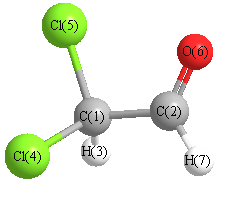 More geometry information
Calculated Bond Angles
| atom1 |
atom2 |
atom3 |
angle |
|
atom1 |
atom2 |
atom3 |
angle |
| C1 |
C2 |
O6 |
124.747 |
|
C1 |
C2 |
H7 |
112.781 |
| C2 |
C1 |
H3 |
109.000 |
|
C2 |
C1 |
Cl4 |
107.376 |
| C2 |
C1 |
Cl5 |
112.515 |
|
H3 |
C1 |
Cl4 |
106.691 |
| H3 |
C1 |
Cl5 |
108.258 |
|
Cl4 |
C1 |
Cl5 |
112.793 |
| O6 |
C2 |
H7 |
122.470 |
|
Electronic energy levels
Charges, Dipole, Quadrupole and Polarizability
