return to home page Computational Chemistry Comparison and Benchmark DataBase Release 22 (May 2022) Standard Reference Database 101 National Institute of Standards and Technology
You are here: Calculated > Energy > Optimized > Energy

All results from a given calculation for C3H2N2 (Malononitrile)

using model chemistry: CISD/3-21G*

19 10 17 12 22

States and conformations

State Conformation minimum conformation conformer description state description
1 1 yes C2V 1A1
Energy calculated at CISD/3-21G*
 hartrees
Energy at 0K-222.821741
Energy at 298.15K-222.823744
Nuclear repulsion energy124.586197
The energy at 298.15K was derived from the energy at 0K and an integrated heat capacity that used the calculated vibrational frequencies.
Vibrational Frequencies calculated at CISD/3-21G*
Mode Number Symmetry Frequency
(cm-1)
Scaled Frequency
(cm-1)
IR Intensities
(km mol-1)
Raman Act
(Å4/u)
Dep P Dep U
1 A1 3141 2935 0.22      
2 A1 2442 2282 0.05      
3 A1 1568 1465 19.12      
4 A1 927 866 9.37      
5 A1 634 592 0.33      
6 A1 176 164 8.14      
7 A2 1367 1278 0.00      
8 A2 452 423 0.00      
9 B1 3178 2970 1.92      
10 B1 1029 962 0.14      
11 B1 415 388 0.14      
12 B2 2435 2275 0.21      
13 B2 1448 1353 0.06      
14 B2 1005 939 14.83      
15 B2 449 420 0.13      

Unscaled Zero Point Vibrational Energy (zpe) 10333.0 cm-1
Scaled (by 0.9344) Zero Point Vibrational Energy (zpe) 9655.2 cm-1
See section III.C.1 List or set vibrational scaling factors to change the scale factors used here.
See section III.C.2 Calculate a vibrational scaling factor for a given set of molecules to determine the least squares best scaling factor.
Rotational Constants (cm-1) from geometry optimized at CISD/3-21G*
ABC
0.67463 0.09841 0.08728

See section I.F.4 to change rotational constant units
Geometric Data calculated at CISD/3-21G*

Point Group is C2v

Cartesians (Å)
Atom x (Å) y (Å) z (Å)
C1 0.000 0.000 0.854
C2 0.000 1.220 0.030
C3 0.000 -1.220 0.030
H4 0.884 0.000 1.497
H5 -0.884 0.000 1.497
N6 0.000 2.187 -0.605
N7 0.000 -2.187 -0.605

Atom - Atom Distances (Å)
  C1 C2 C3 H4 H5 N6 N7
C11.47201.47201.09351.09352.62942.6294
C21.47202.43982.10302.10301.15743.4661
C31.47202.43982.10302.10303.46611.1574
H41.09352.10302.10301.76883.16023.1602
H51.09352.10302.10301.76883.16023.1602
N62.62941.15743.46613.16023.16024.3750
N72.62943.46611.15743.16023.16024.3750

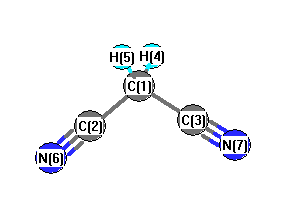
picture of Malononitrile state 1 conformation 1
More geometry information
Calculated Bond Angles
atom1 atom2 atom3 angle atom1 atom2 atom3 angle
C1 C2 N6 179.247 C1 C3 N7 179.247
C2 C1 C3 111.931 C2 C1 H4 109.220
C2 C1 H5 109.220 C3 C1 H4 109.220
C3 C1 H5 109.220 H4 C1 H5 107.944
Electronic energy levels
Charges, Dipole, Quadrupole and Polarizability
Charges from optimized geometry at CISD/3-21G* Charges (e)
Number Element Mulliken CHELPG AIM ESP
1 C -0.479      
2 C 0.371      
3 C 0.371      
4 H 0.336      
5 H 0.336      
6 N -0.468      
7 N -0.468      


Electric dipole moments


Electric Quadrupole moment
Quadrupole components in D Å


Polarizabilities
Components of the polarizability tensor.
Units are Å3 (Angstrom cubed)
Change units.
  x y z
x 0.000 0.000 0.000
y 0.000 0.000 0.000
z 0.000 0.000 0.000


<r2> (average value of r2) Å2
<r2> 0.000
(<r2>)1/2 0.000