Jump to
S1C2
Energy calculated at QCISD/6-31G
| | hartrees |
|---|
| Energy at 0K | -189.014859 |
| Energy at 298.15K | -189.017525 |
| HF Energy | -188.660349 |
| Nuclear repulsion energy | 68.159870 |
The energy at 298.15K was derived from the energy at 0K
and an integrated heat capacity that used the calculated vibrational frequencies.
Vibrational Frequencies calculated at QCISD/6-31G
| Mode Number |
Symmetry |
Frequency
(cm-1) |
Scaled Frequency
(cm-1) |
IR Intensities
(km mol-1) |
Raman Act
(Å4/u) |
Dep P |
Dep U |
|---|
| 1 |
A' |
3592 |
3461 |
30.31 |
|
|
|
| 2 |
A' |
3147 |
3033 |
32.10 |
|
|
|
| 3 |
A' |
1691 |
1630 |
234.47 |
|
|
|
| 4 |
A' |
1413 |
1362 |
6.15 |
|
|
|
| 5 |
A' |
1318 |
1270 |
6.27 |
|
|
|
| 6 |
A' |
1057 |
1019 |
268.15 |
|
|
|
| 7 |
A' |
599 |
577 |
49.85 |
|
|
|
| 8 |
A" |
1029 |
991 |
4.97 |
|
|
|
| 9 |
A" |
652 |
628 |
232.09 |
|
|
|
Unscaled Zero Point Vibrational Energy (zpe) 7248.7 cm
-1
Scaled (by 0.9636) Zero Point Vibrational Energy (zpe) 6984.9 cm
-1
See section
III.C.1 List or set vibrational scaling factors
to change the scale factors used here.
See section
III.C.2
Calculate a vibrational scaling factor for a given set of molecules
to determine the least squares best scaling factor.
Geometric Data calculated at QCISD/6-31G
Point Group is Cs
Cartesians (Å)
| Atom |
x (Å) |
y (Å) |
z (Å) |
|---|
| C1 |
0.000 |
0.440 |
0.000 |
| O2 |
-1.058 |
-0.461 |
0.000 |
| O3 |
1.198 |
0.122 |
0.000 |
| H4 |
-0.389 |
1.463 |
0.000 |
| H5 |
-0.733 |
-1.390 |
0.000 |
Atom - Atom Distances (Å)
| |
C1 |
O2 |
O3 |
H4 |
H5 |
| C1 | | 1.3891 | 1.2392 | 1.0947 | 1.9707 |
O2 | 1.3891 | | 2.3296 | 2.0368 | 0.9842 | O3 | 1.2392 | 2.3296 | | 2.0775 | 2.4520 | H4 | 1.0947 | 2.0368 | 2.0775 | | 2.8734 | H5 | 1.9707 | 0.9842 | 2.4520 | 2.8734 | |
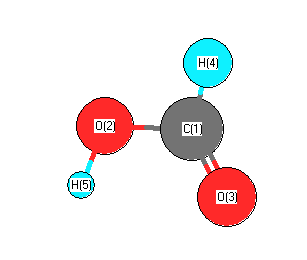 More geometry information
Calculated Bond Angles
| atom1 |
atom2 |
atom3 |
angle |
|
atom1 |
atom2 |
atom3 |
angle |
| C1 |
O2 |
H5 |
111.124 |
|
O2 |
C1 |
O3 |
124.739 |
| O2 |
C1 |
H4 |
109.599 |
|
O3 |
C1 |
H4 |
125.662 |
Electronic energy levels
Charges, Dipole, Quadrupole and Polarizability
Jump to
S1C1
Energy calculated at QCISD/6-31G
| | hartrees |
|---|
| Energy at 0K | -189.005186 |
| Energy at 298.15K | |
| HF Energy | -188.649524 |
| Nuclear repulsion energy | 68.037623 |
The energy at 298.15K was derived from the energy at 0K
and an integrated heat capacity that used the calculated vibrational frequencies.
Vibrational Frequencies calculated at QCISD/6-31G
| Mode Number |
Symmetry |
Frequency
(cm-1) |
Scaled Frequency
(cm-1) |
IR Intensities
(km mol-1) |
Raman Act
(Å4/u) |
Dep P |
Dep U |
|---|
| 1 |
A' |
3636 |
3503 |
29.56 |
|
|
|
| 2 |
A' |
3026 |
2915 |
68.16 |
|
|
|
| 3 |
A' |
1751 |
1688 |
175.71 |
|
|
|
| 4 |
A' |
1446 |
1393 |
1.87 |
|
|
|
| 5 |
A' |
1231 |
1186 |
266.67 |
|
|
|
| 6 |
A' |
1064 |
1025 |
101.14 |
|
|
|
| 7 |
A' |
630 |
607 |
11.11 |
|
|
|
| 8 |
A" |
1007 |
971 |
0.34 |
|
|
|
| 9 |
A" |
467 |
450 |
151.03 |
|
|
|
Unscaled Zero Point Vibrational Energy (zpe) 7128.5 cm
-1
Scaled (by 0.9636) Zero Point Vibrational Energy (zpe) 6869.0 cm
-1
See section
III.C.1 List or set vibrational scaling factors
to change the scale factors used here.
See section
III.C.2
Calculate a vibrational scaling factor for a given set of molecules
to determine the least squares best scaling factor.
Geometric Data calculated at QCISD/6-31G
Point Group is Cs
Cartesians (Å)
| Atom |
x (Å) |
y (Å) |
z (Å) |
|---|
| C1 |
0.000 |
0.406 |
0.000 |
| O2 |
-0.926 |
-0.637 |
0.000 |
| O3 |
1.213 |
0.195 |
0.000 |
| H4 |
-0.446 |
1.416 |
0.000 |
| H5 |
-1.853 |
-0.320 |
0.000 |
Atom - Atom Distances (Å)
| |
C1 |
O2 |
O3 |
H4 |
H5 |
| C1 | | 1.3952 | 1.2316 | 1.1039 | 1.9898 |
O2 | 1.3952 | | 2.2958 | 2.1085 | 0.9795 | O3 | 1.2316 | 2.2958 | | 2.0600 | 3.1090 | H4 | 1.1039 | 2.1085 | 2.0600 | | 2.2340 | H5 | 1.9898 | 0.9795 | 3.1090 | 2.2340 | |
More geometry information
Calculated Bond Angles
| atom1 |
atom2 |
atom3 |
angle |
|
atom1 |
atom2 |
atom3 |
angle |
| C1 |
O2 |
H5 |
112.669 |
|
O2 |
C1 |
O3 |
121.730 |
| O2 |
C1 |
H4 |
114.575 |
|
O3 |
C1 |
H4 |
123.695 |
Electronic energy levels
Charges, Dipole, Quadrupole and Polarizability
