Jump to
S1C2
S1C3
Energy calculated at LSDA/6-31G*
| | hartrees |
|---|
| Energy at 0K | -253.960203 |
| Energy at 298.15K | -253.959613 |
| HF Energy | -253.960203 |
| Nuclear repulsion energy | 47.019197 |
The energy at 298.15K was derived from the energy at 0K
and an integrated heat capacity that used the calculated vibrational frequencies.
Geometric Data calculated at LSDA/6-31G*
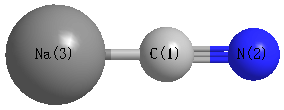
Point Group is C∞v
Cartesians (Å)
| Atom |
x (Å) |
y (Å) |
z (Å) |
|---|
| C1 |
0.000 |
0.000 |
-0.659 |
| N2 |
0.000 |
0.000 |
-1.834 |
| Na3 |
0.000 |
0.000 |
1.527 |
Atom - Atom Distances (Å)
| |
C1 |
N2 |
Na3 |
| C1 | | 1.1748 | 2.1860 |
N2 | 1.1748 | | 3.3608 | Na3 | 2.1860 | 3.3608 | |
 More geometry information
Calculated Bond Angles
| atom1 |
atom2 |
atom3 |
angle |
|
atom1 |
atom2 |
atom3 |
angle |
| C1 |
N2 |
Na3 |
0.000 |
|
C1 |
Na3 |
N2 |
0.000 |
| N2 |
C1 |
Na3 |
180.000 |
|
Electronic energy levels
Charges, Dipole, Quadrupole and Polarizability
Charges from optimized geometry at LSDA/6-31G*
Charges (e)
| Number |
Element |
Mulliken |
CHELPG |
AIM |
ESP |
| 1 |
C |
-0.093 |
|
|
|
| 2 |
N |
-0.430 |
|
|
|
| 3 |
Na |
0.523 |
|
|
|
Electric dipole moments
Electric dipole components in Debye
(What's a Debye? See section
VII.A.3)
| |
x |
y |
z |
Total |
| |
0.000 |
0.000 |
9.773 |
9.773 |
| CHELPG |
|
|
|
|
| AIM |
|
|
|
|
| ESP |
|
|
|
|
Electric Quadrupole moment
Quadrupole components in D Å
| Primitive |
|---|
| | x | y | z |
|---|
| x |
-17.262 |
0.000 |
0.000 |
| y |
0.000 |
-17.262 |
0.000 |
| z |
0.000 |
0.000 |
-13.009 |
|
| Traceless |
|---|
| | x | y | z |
|---|
| x |
-2.127 |
0.000 |
0.000 |
| y |
0.000 |
-2.127 |
0.000 |
| z |
0.000 |
0.000 |
4.254 |
|
| Polar |
|---|
| 3z2-r2 | 8.507 |
|---|
| x2-y2 | 0.000 |
|---|
| xy | 0.000 |
|---|
| xz | 0.000 |
|---|
| yz | 0.000 |
|---|
|
Polarizabilities
Components of the polarizability tensor.
Units are
Å
3 (Angstrom cubed)
Change units.
| |
x |
y |
z |
| x |
3.069 |
0.000 |
0.000 |
| y |
0.000 |
3.070 |
0.000 |
| z |
0.000 |
0.000 |
6.390 |
<r2> (average value of r
2) Å
2
| <r2> |
61.691 |
| (<r2>)1/2 |
7.854 |
Jump to
S1C1
S1C3
Energy calculated at LSDA/6-31G*
| | hartrees |
|---|
| Energy at 0K | -253.965357 |
| Energy at 298.15K | -253.965121 |
| HF Energy | -253.965357 |
| Nuclear repulsion energy | 52.368056 |
The energy at 298.15K was derived from the energy at 0K
and an integrated heat capacity that used the calculated vibrational frequencies.
Geometric Data calculated at LSDA/6-31G*
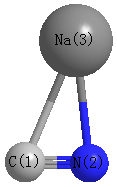
Point Group is Cs
Cartesians (Å)
| Atom |
x (Å) |
y (Å) |
z (Å) |
|---|
| C1 |
1.112 |
0.653 |
0.000 |
| N2 |
0.000 |
1.068 |
0.000 |
| Na3 |
-0.607 |
-1.036 |
0.000 |
Atom - Atom Distances (Å)
| |
C1 |
N2 |
Na3 |
| C1 | | 1.1872 | 2.4092 |
N2 | 1.1872 | | 2.1900 | Na3 | 2.4092 | 2.1900 | |
 More geometry information
Calculated Bond Angles
| atom1 |
atom2 |
atom3 |
angle |
|
atom1 |
atom2 |
atom3 |
angle |
| C1 |
N2 |
Na3 |
85.571 |
|
C1 |
Na3 |
N2 |
29.426 |
| N2 |
C1 |
Na3 |
65.003 |
|
Electronic energy levels
Charges, Dipole, Quadrupole and Polarizability
Charges from optimized geometry at LSDA/6-31G*
Charges (e)
| Number |
Element |
Mulliken |
CHELPG |
AIM |
ESP |
| 1 |
C |
-0.035 |
|
|
|
| 2 |
N |
-0.384 |
|
|
|
| 3 |
Na |
0.419 |
|
|
|
Electric dipole moments
Electric dipole components in Debye
(What's a Debye? See section
VII.A.3)
| |
x |
y |
z |
Total |
| |
-4.320 |
-6.702 |
0.000 |
7.974 |
| CHELPG |
|
|
|
|
| AIM |
|
|
|
|
| ESP |
|
|
|
|
Electric Quadrupole moment
Quadrupole components in D Å
| Primitive |
|---|
| | x | y | z |
|---|
| x |
-19.292 |
3.741 |
0.000 |
| y |
3.741 |
-14.344 |
0.000 |
| z |
0.000 |
0.000 |
-17.608 |
|
| Traceless |
|---|
| | x | y | z |
|---|
| x |
-3.316 |
3.741 |
0.000 |
| y |
3.741 |
4.106 |
0.000 |
| z |
0.000 |
0.000 |
-0.790 |
|
| Polar |
|---|
| 3z2-r2 | -1.580 |
|---|
| x2-y2 | -4.948 |
|---|
| xy | 3.741 |
|---|
| xz | 0.000 |
|---|
| yz | 0.000 |
|---|
|
Polarizabilities
Components of the polarizability tensor.
Units are
Å
3 (Angstrom cubed)
Change units.
| |
x |
y |
z |
| x |
4.153 |
-0.010 |
-0.000 |
| y |
-0.010 |
4.012 |
-0.000 |
| z |
-0.000 |
-0.000 |
3.178 |
<r2> (average value of r
2) Å
2
| <r2> |
43.375 |
| (<r2>)1/2 |
6.586 |
Jump to
S1C1
S1C2
Energy calculated at LSDA/6-31G*
| | hartrees |
|---|
| Energy at 0K | -253.957031 |
| Energy at 298.15K | |
| HF Energy | -253.957031 |
| Nuclear repulsion energy | 49.168370 |
The energy at 298.15K was derived from the energy at 0K
and an integrated heat capacity that used the calculated vibrational frequencies.
Geometric Data calculated at LSDA/6-31G*
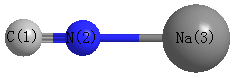
Point Group is C∞v
Cartesians (Å)
| Atom |
x (Å) |
y (Å) |
z (Å) |
|---|
| C1 |
0.000 |
0.000 |
-1.838 |
| N2 |
0.000 |
0.000 |
-0.653 |
| Na3 |
0.000 |
0.000 |
1.418 |
Atom - Atom Distances (Å)
| |
C1 |
N2 |
Na3 |
| C1 | | 1.1850 | 3.2551 |
N2 | 1.1850 | | 2.0701 | Na3 | 3.2551 | 2.0701 | |
 More geometry information
Calculated Bond Angles
| atom1 |
atom2 |
atom3 |
angle |
|
atom1 |
atom2 |
atom3 |
angle |
| C1 |
N2 |
Na3 |
180.000 |
|
C1 |
Na3 |
N2 |
0.000 |
| N2 |
C1 |
Na3 |
0.000 |
|
Electronic energy levels
Charges, Dipole, Quadrupole and Polarizability
Charges from optimized geometry at LSDA/6-31G*
Charges (e)
| Number |
Element |
Mulliken |
CHELPG |
AIM |
ESP |
| 1 |
C |
-0.148 |
|
|
|
| 2 |
N |
-0.445 |
|
|
|
| 3 |
Na |
0.593 |
|
|
|
Electric dipole moments
Electric dipole components in Debye
(What's a Debye? See section
VII.A.3)
| |
x |
y |
z |
Total |
| |
0.000 |
0.000 |
9.946 |
9.946 |
| CHELPG |
|
|
|
|
| AIM |
|
|
|
|
| ESP |
|
|
|
|
Electric Quadrupole moment
Quadrupole components in D Å
| Primitive |
|---|
| | x | y | z |
|---|
| x |
-17.270 |
0.000 |
0.000 |
| y |
0.000 |
-17.270 |
0.000 |
| z |
0.000 |
0.000 |
-15.165 |
|
| Traceless |
|---|
| | x | y | z |
|---|
| x |
-1.052 |
0.000 |
0.000 |
| y |
0.000 |
-1.052 |
0.000 |
| z |
0.000 |
0.000 |
2.105 |
|
| Polar |
|---|
| 3z2-r2 | 4.210 |
|---|
| x2-y2 | 0.000 |
|---|
| xy | 0.000 |
|---|
| xz | 0.000 |
|---|
| yz | 0.000 |
|---|
|
Polarizabilities
Components of the polarizability tensor.
Units are
Å
3 (Angstrom cubed)
Change units.
| |
x |
y |
z |
| x |
3.045 |
0.000 |
0.000 |
| y |
0.000 |
3.045 |
0.000 |
| z |
0.000 |
0.000 |
6.936 |
<r2> (average value of r
2) Å
2
| <r2> |
55.692 |
| (<r2>)1/2 |
7.463 |
