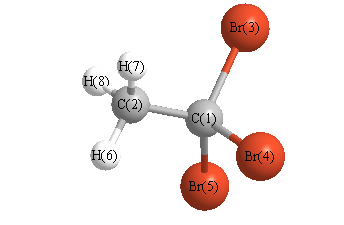
Vibrational Frequencies calculated at LSDA/6-31G
| Mode Number |
Symmetry |
Frequency
(cm-1) |
Scaled Frequency
(cm-1) |
IR Intensities
(km mol-1) |
Raman Act
(Å4/u) |
Dep P |
Dep U |
|---|
| 1 |
A1 |
3009 |
2948 |
0.24 |
|
|
|
| 2 |
A1 |
1415 |
1387 |
37.73 |
|
|
|
| 3 |
A1 |
1131 |
1108 |
20.14 |
|
|
|
| 4 |
A1 |
408 |
400 |
11.00 |
|
|
|
| 5 |
A1 |
218 |
213 |
0.16 |
|
|
|
| 6 |
A2 |
327 |
320 |
0.00 |
|
|
|
| 7 |
E |
3113 |
3049 |
0.68 |
|
|
|
| 7 |
E |
3113 |
3049 |
0.68 |
|
|
|
| 8 |
E |
1451 |
1422 |
8.48 |
|
|
|
| 8 |
E |
1451 |
1422 |
8.48 |
|
|
|
| 9 |
E |
1092 |
1070 |
72.07 |
|
|
|
| 9 |
E |
1092 |
1070 |
72.08 |
|
|
|
| 10 |
E |
601 |
589 |
125.19 |
|
|
|
| 10 |
E |
601 |
589 |
125.23 |
|
|
|
| 11 |
E |
283 |
278 |
1.91 |
|
|
|
| 11 |
E |
283 |
278 |
1.91 |
|
|
|
| 12 |
E |
146 |
143 |
0.09 |
|
|
|
| 12 |
E |
146 |
143 |
0.09 |
|
|
|
Unscaled Zero Point Vibrational Energy (zpe) 9939.5 cm
-1
Scaled (by 0.9797) Zero Point Vibrational Energy (zpe) 9737.7 cm
-1
See section
III.C.1 List or set vibrational scaling factors
to change the scale factors used here.
See section
III.C.2
Calculate a vibrational scaling factor for a given set of molecules
to determine the least squares best scaling factor.
Charges, Dipole, Quadrupole and Polarizability
Charges from optimized geometry at LSDA/6-31G
Charges (e)
| Number |
Element |
Mulliken |
CHELPG |
AIM |
ESP |
| 1 |
C |
-0.774 |
|
|
|
| 2 |
C |
-0.412 |
|
|
|
| 3 |
Br |
0.174 |
|
|
|
| 4 |
Br |
0.174 |
|
|
|
| 5 |
Br |
0.174 |
|
|
|
| 6 |
H |
0.221 |
|
|
|
| 7 |
H |
0.221 |
|
|
|
| 8 |
H |
0.221 |
|
|
|
Electric dipole moments
Electric dipole components in Debye
(What's a Debye? See section
VII.A.3)
| |
x |
y |
z |
Total |
| |
0.000 |
0.000 |
1.911 |
1.911 |
| CHELPG |
|
|
|
|
| AIM |
|
|
|
|
| ESP |
|
|
|
|
Electric Quadrupole moment
Quadrupole components in D Å
| Primitive |
|---|
| | x | y | z |
|---|
| x |
-67.494 |
0.000 |
0.000 |
| y |
0.000 |
-67.494 |
0.000 |
| z |
0.000 |
0.000 |
-63.869 |
|
| Traceless |
|---|
| | x | y | z |
|---|
| x |
-1.812 |
0.000 |
0.000 |
| y |
0.000 |
-1.812 |
0.000 |
| z |
0.000 |
0.000 |
3.625 |
|
| Polar |
|---|
| 3z2-r2 | 7.249 |
|---|
| x2-y2 | 0.000 |
|---|
| xy | 0.000 |
|---|
| xz | 0.000 |
|---|
| yz | 0.000 |
|---|
|
Polarizabilities
Components of the polarizability tensor.
Units are
Å
3 (Angstrom cubed)
Change units.
| |
x |
y |
z |
| x |
10.068 |
0.000 |
0.000 |
| y |
0.000 |
10.068 |
0.000 |
| z |
0.000 |
0.000 |
6.640 |
<r2> (average value of r
2) Å
2
| <r2> |
448.056 |
| (<r2>)1/2 |
21.167 |