Jump to
S1C2
Energy calculated at CCD/6-31G(2df,p)
| | hartrees |
|---|
| Energy at 0K | -187.603847 |
| Energy at 298.15K | -187.608008 |
| HF Energy | -186.900364 |
| Nuclear repulsion energy | 101.866084 |
The energy at 298.15K was derived from the energy at 0K
and an integrated heat capacity that used the calculated vibrational frequencies.
Vibrational Frequencies calculated at CCD/6-31G(2df,p)
| Mode Number |
Symmetry |
Frequency
(cm-1) |
Scaled Frequency
(cm-1) |
IR Intensities
(km mol-1) |
Raman Act
(Å4/u) |
Dep P |
Dep U |
|---|
| 1 |
A |
3692 |
3497 |
21.86 |
|
|
|
| 2 |
A |
3602 |
3412 |
4.06 |
|
|
|
| 3 |
A |
2460 |
2330 |
0.03 |
|
|
|
| 4 |
A |
1687 |
1598 |
12.49 |
|
|
|
| 5 |
A |
1237 |
1172 |
0.11 |
|
|
|
| 6 |
A |
833 |
789 |
14.64 |
|
|
|
| 7 |
A |
685 |
648 |
94.19 |
|
|
|
| 8 |
A |
426 |
404 |
2.17 |
|
|
|
| 9 |
A |
330 |
313 |
31.68 |
|
|
|
| 10 |
A |
224 |
213 |
14.48 |
|
|
|
| 11 |
B |
3692 |
3497 |
20.97 |
|
|
|
| 12 |
B |
3603 |
3413 |
16.95 |
|
|
|
| 13 |
B |
1686 |
1597 |
28.49 |
|
|
|
| 14 |
B |
1360 |
1288 |
77.88 |
|
|
|
| 15 |
B |
1237 |
1172 |
0.10 |
|
|
|
| 16 |
B |
743 |
704 |
338.88 |
|
|
|
| 17 |
B |
427 |
405 |
17.34 |
|
|
|
| 18 |
B |
225 |
213 |
16.77 |
|
|
|
Unscaled Zero Point Vibrational Energy (zpe) 14073.9 cm
-1
Scaled (by 0.9472) Zero Point Vibrational Energy (zpe) 13330.8 cm
-1
See section
III.C.1 List or set vibrational scaling factors
to change the scale factors used here.
See section
III.C.2
Calculate a vibrational scaling factor for a given set of molecules
to determine the least squares best scaling factor.
Geometric Data calculated at CCD/6-31G(2df,p)
Point Group is C2
Cartesians (Å)
| Atom |
x (Å) |
y (Å) |
z (Å) |
|---|
| C1 |
0.003 |
0.602 |
0.049 |
| C2 |
-0.003 |
-0.602 |
0.049 |
| N3 |
-0.003 |
1.955 |
-0.085 |
| N4 |
0.003 |
-1.955 |
-0.085 |
| H5 |
-0.316 |
2.449 |
0.735 |
| H6 |
0.861 |
2.340 |
-0.431 |
| H7 |
0.316 |
-2.449 |
0.735 |
| H8 |
-0.861 |
-2.340 |
-0.431 |
Atom - Atom Distances (Å)
| |
C1 |
C2 |
N3 |
N4 |
H5 |
H6 |
H7 |
H8 |
| C1 | | 1.2034 | 1.3603 | 2.5605 | 1.9965 | 1.9969 | 3.1428 | 3.1031 |
C2 | 1.2034 | | 2.5605 | 1.3603 | 3.1428 | 3.1031 | 1.9965 | 1.9969 | N3 | 1.3603 | 2.5605 | | 3.9105 | 1.0073 | 1.0074 | 4.4917 | 4.3934 | N4 | 2.5605 | 1.3603 | 3.9105 | | 4.4917 | 4.3934 | 1.0073 | 1.0074 | H5 | 1.9965 | 3.1428 | 1.0073 | 4.4917 | | 1.6610 | 4.9395 | 4.9589 | H6 | 1.9969 | 3.1031 | 1.0074 | 4.3934 | 1.6610 | | 4.9589 | 4.9862 | H7 | 3.1428 | 1.9965 | 4.4917 | 1.0073 | 4.9395 | 4.9589 | | 1.6610 | H8 | 3.1031 | 1.9969 | 4.3934 | 1.0074 | 4.9589 | 4.9862 | 1.6610 | |
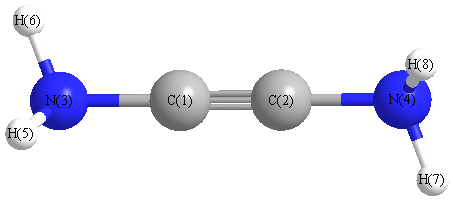 More geometry information
Calculated Bond Angles
| atom1 |
atom2 |
atom3 |
angle |
|
atom1 |
atom2 |
atom3 |
angle |
| C1 |
C2 |
N4 |
174.301 |
|
C1 |
N3 |
H5 |
114.151 |
| C1 |
N3 |
H6 |
114.178 |
|
C2 |
C1 |
N3 |
174.301 |
| C2 |
N4 |
H7 |
114.151 |
|
C2 |
N4 |
H8 |
114.178 |
| H5 |
N3 |
H6 |
111.066 |
|
H7 |
N4 |
H8 |
111.066 |
Electronic energy levels
Charges, Dipole, Quadrupole and Polarizability
Jump to
S1C1
Energy calculated at CCD/6-31G(2df,p)
| | hartrees |
|---|
| Energy at 0K | -187.598476 |
| Energy at 298.15K | |
| HF Energy | -186.897103 |
| Nuclear repulsion energy | 102.487373 |
The energy at 298.15K was derived from the energy at 0K
and an integrated heat capacity that used the calculated vibrational frequencies.
Vibrational Frequencies calculated at CCD/6-31G(2df,p)
| Mode Number |
Symmetry |
Frequency
(cm-1) |
Scaled Frequency
(cm-1) |
IR Intensities
(km mol-1) |
Raman Act
(Å4/u) |
Dep P |
Dep U |
|---|
| 1 |
A1 |
3702 |
3507 |
0.00 |
|
|
|
| 2 |
A1 |
2444 |
2315 |
0.00 |
|
|
|
| 3 |
A1 |
1669 |
1580 |
0.00 |
|
|
|
| 4 |
A1 |
852 |
807 |
0.00 |
|
|
|
| 5 |
B1 |
499 |
473 |
0.00 |
|
|
|
| 6 |
B2 |
3707 |
3511 |
61.35 |
|
|
|
| 7 |
B2 |
1676 |
1588 |
55.55 |
|
|
|
| 8 |
B2 |
1436 |
1360 |
146.02 |
|
|
|
| 9 |
E |
3819 |
3617 |
46.45 |
|
|
|
| 9 |
E |
3819 |
3617 |
46.45 |
|
|
|
| 10 |
E |
1158 |
1097 |
0.92 |
|
|
|
| 10 |
E |
1158 |
1097 |
0.92 |
|
|
|
| 11 |
E |
445 |
422 |
0.08 |
|
|
|
| 11 |
E |
445 |
422 |
0.08 |
|
|
|
| 12 |
E |
196 |
186 |
24.87 |
|
|
|
| 12 |
E |
196 |
186 |
24.87 |
|
|
|
| 13 |
E |
514i |
487i |
249.75 |
|
|
|
| 13 |
E |
514i |
487i |
249.75 |
|
|
|
Unscaled Zero Point Vibrational Energy (zpe) 13096.7 cm
-1
Scaled (by 0.9472) Zero Point Vibrational Energy (zpe) 12405.2 cm
-1
See section
III.C.1 List or set vibrational scaling factors
to change the scale factors used here.
See section
III.C.2
Calculate a vibrational scaling factor for a given set of molecules
to determine the least squares best scaling factor.
Geometric Data calculated at CCD/6-31G(2df,p)
Point Group is D2d
Cartesians (Å)
| Atom |
x (Å) |
y (Å) |
z (Å) |
|---|
| C1 |
0.000 |
0.000 |
0.603 |
| C2 |
0.000 |
0.000 |
-0.603 |
| N3 |
0.000 |
0.000 |
1.942 |
| N4 |
0.000 |
0.000 |
-1.942 |
| H5 |
0.000 |
0.856 |
2.459 |
| H6 |
0.000 |
-0.856 |
2.459 |
| H7 |
0.856 |
0.000 |
-2.459 |
| H8 |
-0.856 |
0.000 |
-2.459 |
Atom - Atom Distances (Å)
| |
C1 |
C2 |
N3 |
N4 |
H5 |
H6 |
H7 |
H8 |
| C1 | | 1.2059 | 1.3394 | 2.5454 | 2.0440 | 2.0440 | 3.1794 | 3.1794 |
C2 | 1.2059 | | 2.5454 | 1.3394 | 3.1794 | 3.1794 | 2.0440 | 2.0440 | N3 | 1.3394 | 2.5454 | | 3.8848 | 0.9999 | 0.9999 | 4.4839 | 4.4839 | N4 | 2.5454 | 1.3394 | 3.8848 | | 4.4839 | 4.4839 | 0.9999 | 0.9999 | H5 | 2.0440 | 3.1794 | 0.9999 | 4.4839 | | 1.7123 | 5.0649 | 5.0649 | H6 | 2.0440 | 3.1794 | 0.9999 | 4.4839 | 1.7123 | | 5.0649 | 5.0649 | H7 | 3.1794 | 2.0440 | 4.4839 | 0.9999 | 5.0649 | 5.0649 | | 1.7123 | H8 | 3.1794 | 2.0440 | 4.4839 | 0.9999 | 5.0649 | 5.0649 | 1.7123 | |
More geometry information
Calculated Bond Angles
| atom1 |
atom2 |
atom3 |
angle |
|
atom1 |
atom2 |
atom3 |
angle |
| C1 |
C2 |
N4 |
180.000 |
|
C1 |
N3 |
H5 |
121.108 |
| C1 |
N3 |
H6 |
121.108 |
|
C2 |
C1 |
N3 |
180.000 |
| C2 |
N4 |
H7 |
121.108 |
|
C2 |
N4 |
H8 |
121.108 |
| H5 |
N3 |
H6 |
117.784 |
|
H7 |
N4 |
H8 |
117.784 |
Electronic energy levels
Charges, Dipole, Quadrupole and Polarizability
