return to home page Computational Chemistry Comparison and Benchmark DataBase Release 22 (May 2022) Standard Reference Database 101 National Institute of Standards and Technology
You are here: Calculated > Energy > Optimized > Energy

All results from a given calculation for C4H4N (pyrrolide radical)

using model chemistry: CCD/TZVP

19 10 17 12 22

States and conformations

State Conformation minimum conformation conformer description state description
1 1 yes C2V 2A2
Energy calculated at CCD/TZVP
 hartrees
Energy at 0K-208.966414
Energy at 298.15K-208.970624
HF Energy-208.259821
Nuclear repulsion energy151.543092
The energy at 298.15K was derived from the energy at 0K and an integrated heat capacity that used the calculated vibrational frequencies.
Vibrational Frequencies calculated at CCD/TZVP
Mode Number Symmetry Frequency
(cm-1)
Scaled Frequency
(cm-1)
IR Intensities
(km mol-1)
Raman Act
(Å4/u)
Dep P Dep U
1 A1 3308 3136 1.09      
2 A1 3269 3099 0.72      
3 A1 1615 1531 8.04      
4 A1 1492 1414 27.05      
5 A1 1259 1193 7.52      
6 A1 1123 1065 37.48      
7 A1 1073 1017 0.54      
8 A1 909 861 8.71      
9 A2 799 758 0.00      
10 A2 624 592 0.00      
11 A2 184 174 0.00      
12 B1 782 741 4.77      
13 B1 671 636 69.16      
14 B1 553 524 21.43      
15 B2 6518 6179 291107.40      
16 B2 3283 3112 69.65      
17 B2 3260 3091 106.84      
18 B2 1344 1274 51.11      
19 B2 1321 1252 85.43      
20 B2 1035 981 1.58      
21 B2 901 854 3.11      

Unscaled Zero Point Vibrational Energy (zpe) 17660.2 cm-1
Scaled (by 0.948) Zero Point Vibrational Energy (zpe) 16741.8 cm-1
See section III.C.1 List or set vibrational scaling factors to change the scale factors used here.
See section III.C.2 Calculate a vibrational scaling factor for a given set of molecules to determine the least squares best scaling factor.
Rotational Constants (cm-1) from geometry optimized at CCD/TZVP
ABC
0.33610 0.29616 0.15744

See section I.F.4 to change rotational constant units
Geometric Data calculated at CCD/TZVP

Point Group is C2v

Cartesians (Å)
Atom x (Å) y (Å) z (Å)
N1 0.000 0.000 1.240
C2 0.000 1.057 0.425
C3 0.000 -1.057 0.425
C4 0.000 0.680 -0.981
C5 0.000 -0.680 -0.981
H6 0.000 2.063 0.819
H7 0.000 -2.063 0.819
H8 0.000 1.354 -1.821
H9 0.000 -1.354 -1.821

Atom - Atom Distances (Å)
  N1 C2 C3 C4 C5 H6 H7 H8 H9
N11.33431.33432.32212.32212.10552.10553.34723.3472
C21.33432.11341.45552.23401.08063.14442.26603.2952
C31.33432.11342.23401.45553.14441.08063.29522.2660
C42.32211.45552.23401.35922.27003.28031.07782.2006
C52.32212.23401.45551.35923.28032.27002.20061.0778
H62.10551.08063.14442.27003.28034.12602.73374.3183
H72.10553.14441.08063.28032.27004.12604.31832.7337
H83.34722.26603.29521.07782.20062.73374.31832.7083
H93.34723.29522.26602.20061.07784.31832.73372.7083

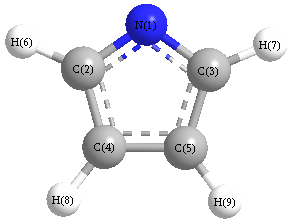
picture of pyrrolide radical state 1 conformation 1
More geometry information
Calculated Bond Angles
atom1 atom2 atom3 angle atom1 atom2 atom3 angle
N1 C2 C4 112.616 N1 C2 H6 120.992
N1 C3 C5 112.616 N1 C3 H7 120.992
C2 N1 C3 104.738 C2 C4 C5 105.015
C2 C4 H8 126.236 C3 C5 C4 105.015
C3 C5 H9 126.236 C4 C2 H6 126.393
C4 C5 H9 128.749 C5 C3 H7 126.393
C5 C4 H8 128.749
Electronic energy levels
Charges, Dipole, Quadrupole and Polarizability