Jump to
S1C2
Energy calculated at CCSD(T)=FULL/cc-pVQZ
| | hartrees |
|---|
| Energy at 0K | -417.962968 |
| Energy at 298.15K | -417.967091 |
| HF Energy | -417.407563 |
| Nuclear repulsion energy | 61.947347 |
The energy at 298.15K was derived from the energy at 0K
and an integrated heat capacity that used the calculated vibrational frequencies.
Vibrational Frequencies calculated at CCSD(T)=FULL/cc-pVQZ
| Mode Number |
Symmetry |
Frequency
(cm-1) |
Scaled Frequency
(cm-1) |
IR Intensities
(km mol-1) |
Raman Act
(Å4/u) |
Dep P |
Dep U |
|---|
| 1 |
A' |
3872 |
3739 |
|
|
|
|
| 2 |
A' |
2351 |
2270 |
|
|
|
|
| 3 |
A' |
1155 |
1115 |
|
|
|
|
| 4 |
A' |
1113 |
1075 |
|
|
|
|
| 5 |
A' |
922 |
890 |
|
|
|
|
| 6 |
A' |
819 |
791 |
|
|
|
|
| 7 |
A" |
2352 |
2271 |
|
|
|
|
| 8 |
A" |
932 |
900 |
|
|
|
|
| 9 |
A" |
411 |
397 |
|
|
|
|
Unscaled Zero Point Vibrational Energy (zpe) 6963.6 cm
-1
Scaled (by 0.9656) Zero Point Vibrational Energy (zpe) 6724.0 cm
-1
See section
III.C.1 List or set vibrational scaling factors
to change the scale factors used here.
See section
III.C.2
Calculate a vibrational scaling factor for a given set of molecules
to determine the least squares best scaling factor.
Geometric Data calculated at CCSD(T)=FULL/cc-pVQZ
Point Group is Cs
Cartesians (Å)
| Atom |
x (Å) |
y (Å) |
z (Å) |
|---|
| P1 |
-0.106 |
-0.565 |
0.000 |
| O2 |
-0.106 |
1.084 |
0.000 |
| H3 |
0.768 |
1.473 |
0.000 |
| H4 |
0.840 |
-0.839 |
1.020 |
| H5 |
0.840 |
-0.839 |
-1.020 |
Atom - Atom Distances (Å)
| |
P1 |
O2 |
H3 |
H4 |
H5 |
| P1 | | 1.6491 | 2.2172 | 1.4183 | 1.4183 |
O2 | 1.6491 | | 0.9572 | 2.3738 | 2.3738 | H3 | 2.2172 | 0.9572 | | 2.5275 | 2.5275 | H4 | 1.4183 | 2.3738 | 2.5275 | | 2.0400 | H5 | 1.4183 | 2.3738 | 2.5275 | 2.0400 | |
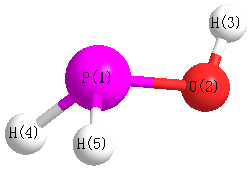 More geometry information
Calculated Bond Angles
| atom1 |
atom2 |
atom3 |
angle |
|
atom1 |
atom2 |
atom3 |
angle |
| P1 |
O2 |
H3 |
113.926 |
|
O2 |
P1 |
H4 |
101.144 |
| O2 |
P1 |
H5 |
101.144 |
|
H4 |
P1 |
H5 |
91.975 |
Electronic energy levels
Charges, Dipole, Quadrupole and Polarizability
Jump to
S1C1
Energy calculated at CCSD(T)=FULL/cc-pVQZ
| | hartrees |
|---|
| Energy at 0K | -417.963101 |
| Energy at 298.15K | -417.967079 |
| HF Energy | -417.407139 |
| Nuclear repulsion energy | 61.873754 |
The energy at 298.15K was derived from the energy at 0K
and an integrated heat capacity that used the calculated vibrational frequencies.
Vibrational Frequencies calculated at CCSD(T)=FULL/cc-pVQZ
| Mode Number |
Symmetry |
Frequency
(cm-1) |
Scaled Frequency
(cm-1) |
IR Intensities
(km mol-1) |
Raman Act
(Å4/u) |
Dep P |
Dep U |
|---|
| 1 |
A' |
3894 |
3760 |
|
|
|
|
| 2 |
A' |
2392 |
2309 |
|
|
|
|
| 3 |
A' |
1163 |
1123 |
|
|
|
|
| 4 |
A' |
1150 |
1111 |
|
|
|
|
| 5 |
A' |
920 |
888 |
|
|
|
|
| 6 |
A' |
814 |
786 |
|
|
|
|
| 7 |
A" |
2390 |
2308 |
|
|
|
|
| 8 |
A" |
944 |
911 |
|
|
|
|
| 9 |
A" |
275 |
265 |
|
|
|
|
Unscaled Zero Point Vibrational Energy (zpe) 6970.4 cm
-1
Scaled (by 0.9656) Zero Point Vibrational Energy (zpe) 6730.6 cm
-1
See section
III.C.1 List or set vibrational scaling factors
to change the scale factors used here.
See section
III.C.2
Calculate a vibrational scaling factor for a given set of molecules
to determine the least squares best scaling factor.
Geometric Data calculated at CCSD(T)=FULL/cc-pVQZ
Point Group is Cs
Cartesians (Å)
| Atom |
x (Å) |
y (Å) |
z (Å) |
|---|
| P1 |
0.039 |
-0.570 |
0.000 |
| O2 |
0.039 |
1.088 |
0.000 |
| H3 |
0.943 |
1.399 |
0.000 |
| H4 |
-0.915 |
-0.779 |
1.020 |
| H5 |
-0.915 |
-0.779 |
-1.020 |
Atom - Atom Distances (Å)
| |
P1 |
O2 |
H3 |
H4 |
H5 |
| P1 | | 1.6578 | 2.1665 | 1.4123 | 1.4123 |
O2 | 1.6578 | | 0.9564 | 2.3316 | 2.3316 | H3 | 2.1665 | 0.9564 | | 3.0393 | 3.0393 | H4 | 1.4123 | 2.3316 | 3.0393 | | 2.0405 | H5 | 1.4123 | 2.3316 | 3.0393 | 2.0405 | |
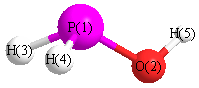 More geometry information
Calculated Bond Angles
| atom1 |
atom2 |
atom3 |
angle |
|
atom1 |
atom2 |
atom3 |
angle |
| P1 |
O2 |
H3 |
108.966 |
|
O2 |
P1 |
H4 |
98.516 |
| O2 |
P1 |
H5 |
98.516 |
|
H4 |
P1 |
H5 |
92.507 |
Electronic energy levels
Charges, Dipole, Quadrupole and Polarizability
