return to home page Computational Chemistry Comparison and Benchmark DataBase Release 22 (May 2022) Standard Reference Database 101 National Institute of Standards and Technology
You are here: Calculated > Energy > Optimized > Energy

All results from a given calculation for C4H5N (Pyrrole)

using model chemistry: CCSD(T)=FULL/TZVP

19 10 17 12 22

States and conformations

State Conformation minimum conformation conformer description state description
1 1 yes C2V 1A1
Energy calculated at CCSD(T)=FULL/TZVP
 hartrees
Energy at 0K-209.757740
Energy at 298.15K 
HF Energy-208.875594
Nuclear repulsion energy160.664215
The energy at 298.15K was derived from the energy at 0K and an integrated heat capacity that used the calculated vibrational frequencies.
Vibrational Frequencies calculated at CCSD(T)=FULL/TZVP
Mode Number Symmetry Frequency
(cm-1)
Scaled Frequency
(cm-1)
IR Intensities
(km mol-1)
Raman Act
(Å4/u)
Dep P Dep U
1 A1 3689 3526        
2 A1 3289 3144        
3 A1 3267 3123        
4 A1 1512 1445        
5 A1 1424 1362        
6 A1 1167 1116        
7 A1 1100 1052        
8 A1 1038 993        
9 A1 894 855        
10 A2 674 644        
11 A2 551 527        
12 A2 356i 341i        
13 B1 699 668        
14 B1 648 619        
15 B1 560 535        
16 B1 67i 64i        
17 B2 3282 3138        
18 B2 3256 3113        
19 B2 1579 1510        
20 B2 1468 1403        
21 B2 1321 1262        
22 B2 1169 1118        
23 B2 1073 1026        
24 B2 874 835        

Unscaled Zero Point Vibrational Energy (zpe) 17054.7 cm-1
Scaled (by 0.956) Zero Point Vibrational Energy (zpe) 16304.3 cm-1
See section III.C.1 List or set vibrational scaling factors to change the scale factors used here.
See section III.C.2 Calculate a vibrational scaling factor for a given set of molecules to determine the least squares best scaling factor.
Rotational Constants (cm-1) from geometry optimized at CCSD(T)=FULL/TZVP
ABC
0.30435 0.29997 0.15107

See section I.F.4 to change rotational constant units
Geometric Data calculated at CCSD(T)=FULL/TZVP

Point Group is C2v

Cartesians (Å)
Atom x (Å) y (Å) z (Å)
N1 0.000 0.000 1.124
H2 0.000 0.000 2.130
C3 0.000 1.126 0.331
C4 0.000 -1.126 0.331
C5 0.000 0.714 -0.984
C6 0.000 -0.714 -0.984
H7 0.000 2.112 0.766
H8 0.000 -2.112 0.766
H9 0.000 1.361 -1.847
H10 0.000 -1.361 -1.847

Atom - Atom Distances (Å)
  N1 H2 C3 C4 C5 C6 H7 H8 H9 H10
N11.00621.37691.37692.22572.22572.14222.14223.26803.2680
H21.00622.12222.12223.19513.19512.51422.51424.20374.2037
C31.37692.12222.25171.37832.26181.07793.26702.19093.3063
C41.37692.12222.25172.26181.37833.26701.07793.30632.1909
C52.22573.19511.37832.26181.42822.24013.32431.07872.2478
C62.22573.19512.26181.37831.42823.32432.24012.24781.0787
H72.14222.51421.07793.26702.24013.32434.22422.71884.3467
H82.14222.51423.26701.07793.32432.24014.22424.34672.7188
H93.26804.20372.19093.30631.07872.24782.71884.34672.7229
H103.26804.20373.30632.19092.24781.07874.34672.71882.7229

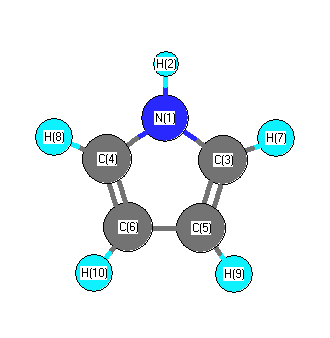
picture of Pyrrole state 1 conformation 1
More geometry information
Calculated Bond Angles
atom1 atom2 atom3 angle atom1 atom2 atom3 angle
N1 C3 C5 107.767 N1 C3 H7 121.050
N1 C4 C6 107.767 N1 C4 H8 121.050
H2 N1 C3 125.149 H2 N1 C4 125.149
C3 N1 C4 109.701 C3 C5 C6 107.382
C3 C5 H9 125.739 C4 C6 C5 107.382
C4 C6 H10 125.739 C5 C3 H7 131.183
C5 C6 H10 126.879 C6 C4 H8 131.183
C6 C5 H9 126.879
Electronic energy levels
Charges, Dipole, Quadrupole and Polarizability