return to home page Computational Chemistry Comparison and Benchmark DataBase Release 22 (May 2022) Standard Reference Database 101 National Institute of Standards and Technology
You are here: Calculated > Energy > Optimized > Energy

All results from a given calculation for CH3COCH2 (Acetonyl radical)

using model chemistry: CCSD=FULL/TZVP

19 10 17 12 22

States and conformations

State Conformation minimum conformation conformer description state description
1 1 yes CS 2A"
Energy calculated at CCSD=FULL/TZVP
 hartrees
Energy at 0K-192.111186
Energy at 298.15K-192.115738
HF Energy-191.408694
Nuclear repulsion energy111.986004
The energy at 298.15K was derived from the energy at 0K and an integrated heat capacity that used the calculated vibrational frequencies.
Vibrational Frequencies calculated at CCSD=FULL/TZVP
Mode Number Symmetry Frequency
(cm-1)
Scaled Frequency
(cm-1)
IR Intensities
(km mol-1)
Raman Act
(Å4/u)
Dep P Dep U
1 A' 3309 3135 2.96      
2 A' 3190 3023 4.81      
3 A' 3186 3019 6.11      
4 A' 3071 2910 6.03      
5 A' 1634 1548 59.98      
6 A' 1509 1430 9.59      
7 A' 1493 1415 23.45      
8 A' 1435 1359 22.83      
9 A' 1292 1224 61.55      
10 A' 1088 1031 4.68      
11 A' 945 895 5.81      
12 A' 836 792 1.00      
13 A' 537 509 13.71      
14 A' 391 370 1.41      
15 A" 3141 2976 12.99      
16 A" 1498 1419 8.99      
17 A" 1043 988 1.11      
18 A" 619 587 38.15      
19 A" 500 474 1.72      
20 A" 338 320 0.05      
21 A" 49 47 0.00      

Unscaled Zero Point Vibrational Energy (zpe) 15551.0 cm-1
Scaled (by 0.9475) Zero Point Vibrational Energy (zpe) 14734.6 cm-1
See section III.C.1 List or set vibrational scaling factors to change the scale factors used here.
See section III.C.2 Calculate a vibrational scaling factor for a given set of molecules to determine the least squares best scaling factor.
Rotational Constants (cm-1) from geometry optimized at CCSD=FULL/TZVP
ABC
0.36441 0.30355 0.17086

See section I.F.4 to change rotational constant units
Geometric Data calculated at CCSD=FULL/TZVP

Point Group is Cs

Cartesians (Å)
Atom x (Å) y (Å) z (Å)
C1 0.000 0.148 0.000
O2 0.445 1.296 0.000
C3 -1.425 -0.085 0.000
C4 0.917 -1.058 0.000
H5 -2.092 0.765 0.000
H6 -1.837 -1.085 0.000
H7 1.953 -0.728 0.000
H8 0.732 -1.675 0.881
H9 0.732 -1.675 -0.881

Atom - Atom Distances (Å)
  C1 O2 C3 C4 H5 H6 H7 H8 H9
C11.23071.44441.51592.18062.21262.14052.15362.1536
O21.23072.32502.40112.59153.29782.52343.11233.1123
C31.44442.32502.53691.08021.08113.43902.82122.8212
C41.51592.40112.53693.51842.75451.08731.09171.0917
H52.18062.59151.08023.51841.86744.31123.83463.8346
H62.21263.29781.08112.75451.86743.80692.77932.7793
H72.14052.52343.43901.08734.31123.80691.77951.7795
H82.15363.11232.82121.09173.83462.77931.77951.7629
H92.15363.11232.82121.09173.83462.77931.77951.7629

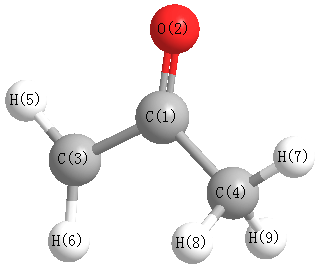
picture of Acetonyl radical state 1 conformation 1
More geometry information
Calculated Bond Angles
atom1 atom2 atom3 angle atom1 atom2 atom3 angle
C1 C3 H5 118.770 C1 C3 H6 121.684
C1 C4 H7 109.521 C1 C4 H8 110.300
C1 C4 H9 110.300 O2 C1 C3 120.504
O2 C1 C4 121.560 C3 C1 C4 117.936
H5 C3 H6 119.546 H7 C4 H8 109.503
H7 C4 H9 109.503 H8 C4 H9 107.686
Electronic energy levels
Charges, Dipole, Quadrupole and Polarizability