Jump to
S2C1
Energy calculated at G2
| | hartrees |
|---|
| Energy at 0K | -151.815489 |
| Energy at 298.15K | -151.810274 |
| HF Energy | -151.183724 |
| Nuclear repulsion energy | 63.966974 |
The energy at 298.15K was derived from the energy at 0K
and an integrated heat capacity that used the calculated vibrational frequencies.
Vibrational Frequencies calculated at HF/6-31G*
| Mode Number |
Symmetry |
Frequency
(cm-1) |
Scaled Frequency
(cm-1) |
IR Intensities
(km mol-1) |
Raman Act
(Å4/u) |
Dep P |
Dep U |
|---|
| 1 |
Σg |
2345 |
2209 |
0.00 |
100.25 |
0.45 |
0.62 |
| 2 |
Σg |
1021 |
962 |
0.00 |
277.57 |
0.36 |
0.53 |
| 3 |
Σu |
1740 |
1640 |
142.35 |
0.00 |
0.00 |
0.00 |
| 4 |
Πg |
408 |
384 |
0.00 |
5.25 |
0.75 |
0.86 |
| 4 |
Πg |
408 |
384 |
0.00 |
5.25 |
0.75 |
0.86 |
| 5 |
Πu |
210 |
197 |
25.62 |
0.00 |
0.00 |
0.00 |
| 5 |
Πu |
210 |
197 |
25.62 |
0.00 |
0.00 |
0.00 |
Unscaled Zero Point Vibrational Energy (zpe) 3170.6 cm
-1
Scaled (by 0.9422) Zero Point Vibrational Energy (zpe) 2987.3 cm
-1
See section
III.C.1 List or set vibrational scaling factors
to change the scale factors used here.
See section
III.C.2
Calculate a vibrational scaling factor for a given set of molecules
to determine the least squares best scaling factor.
Geometric Data calculated at MP2=FULL/6-31G*
Point Group is D∞h
Cartesians (Å)
| Atom |
x (Å) |
y (Å) |
z (Å) |
|---|
| C1 |
0.000 |
0.000 |
0.648 |
| C2 |
0.000 |
0.000 |
-0.648 |
| C3 |
0.000 |
0.000 |
1.961 |
| C4 |
0.000 |
0.000 |
-1.961 |
Atom - Atom Distances (Å)
| |
C1 |
C2 |
C3 |
C4 |
| C1 | | 1.2959 | 1.3127 | 2.6086 |
C2 | 1.2959 | | 2.6086 | 1.3127 | C3 | 1.3127 | 2.6086 | | 3.9214 | C4 | 2.6086 | 1.3127 | 3.9214 | |
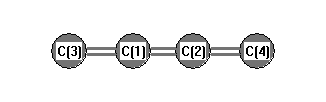 More geometry information
Calculated Bond Angles
| atom1 |
atom2 |
atom3 |
angle |
|
atom1 |
atom2 |
atom3 |
angle |
| C1 |
C2 |
C4 |
180.000 |
|
C2 |
C1 |
C3 |
180.000 |
Electronic energy levels
Charges, Dipole, Quadrupole and Polarizability
Jump to
S1C1
Energy calculated at G2
| | hartrees |
|---|
| Energy at 0K | -151.806454 |
| Energy at 298.15K | -151.801334 |
| HF Energy | -151.135600 |
| Nuclear repulsion energy | 63.938060 |
The energy at 298.15K was derived from the energy at 0K
and an integrated heat capacity that used the calculated vibrational frequencies.
Vibrational Frequencies calculated at HF/6-31G*
| Mode Number |
Symmetry |
Frequency
(cm-1) |
Scaled Frequency
(cm-1) |
IR Intensities
(km mol-1) |
Raman Act
(Å4/u) |
Dep P |
Dep U |
|---|
| 1 |
Σg |
2341 |
2205 |
0.00 |
53.87 |
0.35 |
0.52 |
| 2 |
Σg |
1026 |
966 |
0.00 |
96.44 |
0.31 |
0.48 |
| 3 |
Σu |
1742 |
1641 |
432.71 |
0.00 |
0.00 |
0.00 |
| 4 |
Πg |
475 |
447 |
0.00 |
15.83 |
0.75 |
0.86 |
| 4 |
Πg |
427 |
402 |
0.00 |
6.36 |
0.75 |
0.86 |
| 5 |
Πu |
216 |
204 |
5.55 |
0.00 |
0.00 |
0.00 |
| 5 |
Πu |
215 |
203 |
26.79 |
0.00 |
0.00 |
0.00 |
Unscaled Zero Point Vibrational Energy (zpe) 3220.7 cm
-1
Scaled (by 0.9422) Zero Point Vibrational Energy (zpe) 3034.5 cm
-1
See section
III.C.1 List or set vibrational scaling factors
to change the scale factors used here.
See section
III.C.2
Calculate a vibrational scaling factor for a given set of molecules
to determine the least squares best scaling factor.
Geometric Data calculated at MP2=FULL/6-31G*
Point Group is D∞h
Cartesians (Å)
| Atom |
x (Å) |
y (Å) |
z (Å) |
|---|
| C1 |
0.000 |
0.000 |
0.653 |
| C2 |
0.000 |
0.000 |
-0.653 |
| C3 |
0.000 |
0.000 |
1.971 |
| C4 |
0.000 |
0.000 |
-1.971 |
Atom - Atom Distances (Å)
| |
C1 |
C2 |
C3 |
C4 |
| C1 | | 1.3054 | 1.3182 | 2.6236 |
C2 | 1.3054 | | 2.6236 | 1.3182 | C3 | 1.3182 | 2.6236 | | 3.9419 | C4 | 2.6236 | 1.3182 | 3.9419 | |
More geometry information
Electronic energy levels
Charges, Dipole, Quadrupole and Polarizability
