Jump to
S1C2
Vibrational Frequencies calculated at TPSSh/6-311G*
Geometric Data calculated at TPSSh/6-311G*
Electronic energy levels
Charges, Dipole, Quadrupole and Polarizability
Jump to
S1C1
Energy calculated at TPSSh/6-311G*
| | hartrees |
|---|
| Energy at 0K | -115.988034 |
| Energy at 298.15K | -115.989631 |
| HF Energy | -115.988034 |
| Nuclear repulsion energy | 57.883852 |
The energy at 298.15K was derived from the energy at 0K
and an integrated heat capacity that used the calculated vibrational frequencies.
Vibrational Frequencies calculated at TPSSh/6-311G*
| Mode Number |
Symmetry |
Frequency
(cm-1) |
Scaled Frequency
(cm-1) |
IR Intensities
(km mol-1) |
Raman Act
(Å4/u) |
Dep P |
Dep U |
|---|
| 1 |
A' |
3279 |
3158 |
0.44 |
|
|
|
| 2 |
A' |
3033 |
2921 |
81.25 |
|
|
|
| 3 |
A' |
1659 |
1598 |
0.35 |
|
|
|
| 4 |
A' |
1246 |
1200 |
9.09 |
|
|
|
| 5 |
A' |
1009 |
972 |
20.02 |
|
|
|
| 6 |
A' |
921 |
887 |
6.55 |
|
|
|
| 7 |
A' |
606 |
584 |
71.28 |
|
|
|
| 8 |
A" |
3232 |
3113 |
0.16 |
|
|
|
| 9 |
A" |
1035 |
997 |
28.39 |
|
|
|
| 10 |
A" |
976 |
940 |
3.11 |
|
|
|
| 11 |
A" |
868 |
836 |
0.22 |
|
|
|
| 12 |
A" |
712 |
686 |
35.00 |
|
|
|
Unscaled Zero Point Vibrational Energy (zpe) 9287.3 cm
-1
Scaled (by 0.9632) Zero Point Vibrational Energy (zpe) 8945.5 cm
-1
See section
III.C.1 List or set vibrational scaling factors
to change the scale factors used here.
See section
III.C.2
Calculate a vibrational scaling factor for a given set of molecules
to determine the least squares best scaling factor.
Geometric Data calculated at TPSSh/6-311G*
Point Group is Cs
Cartesians (Å)
| Atom |
x (Å) |
y (Å) |
z (Å) |
|---|
| C1 |
-0.037 |
0.891 |
0.000 |
| H2 |
0.751 |
1.650 |
0.000 |
| C3 |
-0.037 |
-0.419 |
0.657 |
| C4 |
-0.037 |
-0.419 |
-0.657 |
| H5 |
-0.041 |
-0.985 |
1.576 |
| H6 |
-0.041 |
-0.985 |
-1.576 |
Atom - Atom Distances (Å)
| |
C1 |
H2 |
C3 |
C4 |
H5 |
H6 |
| C1 | | 1.0941 | 1.4651 | 1.4651 | 2.4499 | 2.4499 |
H2 | 1.0941 | | 2.3091 | 2.3091 | 3.1708 | 3.1708 | C3 | 1.4651 | 2.3091 | | 1.3144 | 1.0794 | 2.3040 | C4 | 1.4651 | 2.3091 | 1.3144 | | 2.3040 | 1.0794 | H5 | 2.4499 | 3.1708 | 1.0794 | 2.3040 | | 3.1524 | H6 | 2.4499 | 3.1708 | 2.3040 | 1.0794 | 3.1524 | |
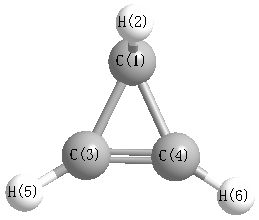 More geometry information
Calculated Bond Angles
| atom1 |
atom2 |
atom3 |
angle |
|
atom1 |
atom2 |
atom3 |
angle |
| C1 |
C3 |
C4 |
63.348 |
|
C1 |
C3 |
H5 |
148.286 |
| C1 |
C4 |
C3 |
63.348 |
|
C1 |
C4 |
H6 |
148.286 |
| H2 |
C1 |
C3 |
128.337 |
|
H2 |
C1 |
C4 |
128.337 |
| C3 |
C1 |
C4 |
53.304 |
|
C3 |
C4 |
H6 |
148.365 |
| C4 |
C3 |
H5 |
148.365 |
|
Electronic energy levels
Charges, Dipole, Quadrupole and Polarizability
Charges from optimized geometry at TPSSh/6-311G*
Charges (e)
| Number |
Element |
Mulliken |
CHELPG |
AIM |
ESP |
| 1 |
C |
-0.247 |
|
|
|
| 2 |
H |
0.193 |
|
|
|
| 3 |
C |
-0.169 |
|
|
|
| 4 |
C |
-0.169 |
|
|
|
| 5 |
H |
0.196 |
|
|
|
| 6 |
H |
0.196 |
|
|
|
Electric dipole moments
Electric dipole components in Debye
(What's a Debye? See section
VII.A.3)
| |
x |
y |
z |
Total |
| |
0.675 |
-1.343 |
0.000 |
1.503 |
| CHELPG |
|
|
|
|
| AIM |
|
|
|
|
| ESP |
|
|
|
|
Electric Quadrupole moment
Quadrupole components in D Å
Polarizabilities
Components of the polarizability tensor.
Units are
Å
3 (Angstrom cubed)
Change units.
| |
x |
y |
z |
| x |
2.651 |
0.299 |
0.000 |
| y |
0.299 |
4.970 |
0.000 |
| z |
0.000 |
0.000 |
4.953 |
<r2> (average value of r
2) Å
2
| <r2> |
33.301 |
| (<r2>)1/2 |
5.771 |
