Jump to
S1C2
S2C1
S2C2
Energy calculated at B3LYP/6-31G
| | hartrees |
|---|
| Energy at 0K | -131.383920 |
| Energy at 298.15K | -131.382861 |
| HF Energy | -131.383920 |
| Nuclear repulsion energy | 46.987492 |
The energy at 298.15K was derived from the energy at 0K
and an integrated heat capacity that used the calculated vibrational frequencies.
Vibrational Frequencies calculated at B3LYP/6-31G
| Mode Number |
Symmetry |
Frequency
(cm-1) |
Scaled Frequency
(cm-1) |
IR Intensities
(km mol-1) |
Raman Act
(Å4/u) |
Dep P |
Dep U |
|---|
| 1 |
A' |
3455 |
3323 |
49.32 |
|
|
|
| 2 |
A' |
1705 |
1640 |
29.05 |
|
|
|
| 3 |
A' |
1260 |
1213 |
2.51 |
|
|
|
| 4 |
A' |
421 |
405 |
0.33 |
|
|
|
| 5 |
A' |
153 |
147 |
56.07 |
|
|
|
| 6 |
A" |
423 |
407 |
0.06 |
|
|
|
Unscaled Zero Point Vibrational Energy (zpe) 3708.5 cm
-1
Scaled (by 0.962) Zero Point Vibrational Energy (zpe) 3567.6 cm
-1
See section
III.C.1 List or set vibrational scaling factors
to change the scale factors used here.
See section
III.C.2
Calculate a vibrational scaling factor for a given set of molecules
to determine the least squares best scaling factor.
Geometric Data calculated at B3LYP/6-31G
Point Group is Cs
Cartesians (Å)
| Atom |
x (Å) |
y (Å) |
z (Å) |
|---|
| C1 |
0.117 |
-1.214 |
0.000 |
| C2 |
0.000 |
0.076 |
0.000 |
| N3 |
-0.170 |
1.292 |
0.000 |
| H4 |
0.489 |
-2.215 |
0.000 |
Atom - Atom Distances (Å)
| |
C1 |
C2 |
N3 |
H4 |
| C1 | | 1.2947 | 2.5223 | 1.0676 |
C2 | 1.2947 | | 1.2283 | 2.3418 | N3 | 2.5223 | 1.2283 | | 3.5681 | H4 | 1.0676 | 2.3418 | 3.5681 | |
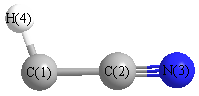 More geometry information
Calculated Bond Angles
| atom1 |
atom2 |
atom3 |
angle |
|
atom1 |
atom2 |
atom3 |
angle |
| C1 |
C2 |
N3 |
177.222 |
|
C2 |
C1 |
H4 |
164.814 |
Electronic energy levels
Charges, Dipole, Quadrupole and Polarizability
Jump to
S1C1
S2C1
S2C2
Energy calculated at B3LYP/6-31G
| | hartrees |
|---|
| Energy at 0K | -131.383908 |
| Energy at 298.15K | |
| HF Energy | -131.383908 |
| Nuclear repulsion energy | 46.999809 |
The energy at 298.15K was derived from the energy at 0K
and an integrated heat capacity that used the calculated vibrational frequencies.
Vibrational Frequencies calculated at B3LYP/6-31G
| Mode Number |
Symmetry |
Frequency
(cm-1) |
Scaled Frequency
(cm-1) |
IR Intensities
(km mol-1) |
Raman Act
(Å4/u) |
Dep P |
Dep U |
|---|
| 1 |
Σ |
3471 |
3339 |
59.82 |
|
|
|
| 2 |
Σ |
1694 |
1630 |
30.27 |
|
|
|
| 3 |
Σ |
1267 |
1219 |
1.94 |
|
|
|
| 4 |
Π |
421 |
405 |
0.03 |
|
|
|
| 4 |
Π |
421 |
405 |
0.03 |
|
|
|
| 5 |
Π |
57i |
55i |
57.92 |
|
|
|
| 5 |
Π |
57i |
55i |
57.92 |
|
|
|
Unscaled Zero Point Vibrational Energy (zpe) 3580.4 cm
-1
Scaled (by 0.962) Zero Point Vibrational Energy (zpe) 3444.4 cm
-1
See section
III.C.1 List or set vibrational scaling factors
to change the scale factors used here.
See section
III.C.2
Calculate a vibrational scaling factor for a given set of molecules
to determine the least squares best scaling factor.
Geometric Data calculated at B3LYP/6-31G
Point Group is C∞v
Cartesians (Å)
| Atom |
x (Å) |
y (Å) |
z (Å) |
|---|
| C1 |
0.000 |
0.000 |
-1.216 |
| C2 |
0.000 |
0.000 |
0.074 |
| N3 |
0.000 |
0.000 |
1.305 |
| H4 |
0.000 |
0.000 |
-2.282 |
Atom - Atom Distances (Å)
| |
C1 |
C2 |
N3 |
H4 |
| C1 | | 1.2893 | 2.5207 | 1.0662 |
C2 | 1.2893 | | 1.2314 | 2.3555 | N3 | 2.5207 | 1.2314 | | 3.5870 | H4 | 1.0662 | 2.3555 | 3.5870 | |
More geometry information
Calculated Bond Angles
| atom1 |
atom2 |
atom3 |
angle |
|
atom1 |
atom2 |
atom3 |
angle |
| C1 |
C2 |
N3 |
180.000 |
|
C2 |
C1 |
H4 |
180.000 |
Electronic energy levels
Charges, Dipole, Quadrupole and Polarizability
Charges from optimized geometry at B3LYP/6-31G
Charges (e)
| Number |
Element |
Mulliken |
CHELPG |
AIM |
ESP |
| 1 |
C |
-0.002 |
|
|
|
| 2 |
C |
-0.038 |
|
|
|
| 3 |
N |
-0.227 |
|
|
|
| 4 |
H |
0.266 |
|
|
|
Electric dipole moments
Electric dipole components in Debye
(What's a Debye? See section
VII.A.3)
| |
x |
y |
z |
Total |
| |
0.000 |
0.000 |
-3.340 |
3.340 |
| CHELPG |
|
|
|
|
| AIM |
|
|
|
|
| ESP |
|
|
|
|
Electric Quadrupole moment
Quadrupole components in D Å
| Primitive |
|---|
| | x | y | z |
|---|
| x |
-16.963 |
0.000 |
0.000 |
| y |
0.000 |
-16.963 |
0.000 |
| z |
0.000 |
0.000 |
-15.846 |
|
| Traceless |
|---|
| | x | y | z |
|---|
| x |
-0.558 |
0.000 |
0.000 |
| y |
0.000 |
-0.558 |
0.000 |
| z |
0.000 |
0.000 |
1.117 |
|
| Polar |
|---|
| 3z2-r2 | 2.233 |
|---|
| x2-y2 | 0.000 |
|---|
| xy | 0.000 |
|---|
| xz | 0.000 |
|---|
| yz | 0.000 |
|---|
|
Polarizabilities
Components of the polarizability tensor.
Units are
Å
3 (Angstrom cubed)
Change units.
| |
x |
y |
z |
| x |
1.467 |
0.000 |
0.000 |
| y |
0.000 |
1.467 |
0.000 |
| z |
0.000 |
0.000 |
6.098 |
<r2> (average value of r
2) Å
2
| <r2> |
36.391 |
| (<r2>)1/2 |
6.032 |
Jump to
S1C1
S1C2
S2C2
Energy calculated at B3LYP/6-31G
| | hartrees |
|---|
| Energy at 0K | -131.349954 |
| Energy at 298.15K | -131.349388 |
| HF Energy | -131.349954 |
| Nuclear repulsion energy | 46.638271 |
The energy at 298.15K was derived from the energy at 0K
and an integrated heat capacity that used the calculated vibrational frequencies.
Vibrational Frequencies calculated at B3LYP/6-31G
| Mode Number |
Symmetry |
Frequency
(cm-1) |
Scaled Frequency
(cm-1) |
IR Intensities
(km mol-1) |
Raman Act
(Å4/u) |
Dep P |
Dep U |
|---|
| 1 |
A' |
3077 |
2960 |
13.34 |
|
|
|
| 2 |
A' |
2034 |
1957 |
14.20 |
|
|
|
| 3 |
A' |
1117 |
1074 |
34.47 |
|
|
|
| 4 |
A' |
846 |
814 |
81.81 |
|
|
|
| 5 |
A' |
427 |
410 |
20.22 |
|
|
|
| 6 |
A" |
349 |
335 |
2.87 |
|
|
|
Unscaled Zero Point Vibrational Energy (zpe) 3924.7 cm
-1
Scaled (by 0.962) Zero Point Vibrational Energy (zpe) 3775.6 cm
-1
See section
III.C.1 List or set vibrational scaling factors
to change the scale factors used here.
See section
III.C.2
Calculate a vibrational scaling factor for a given set of molecules
to determine the least squares best scaling factor.
Geometric Data calculated at B3LYP/6-31G
Point Group is Cs
Cartesians (Å)
| Atom |
x (Å) |
y (Å) |
z (Å) |
|---|
| C1 |
0.338 |
-1.235 |
0.000 |
| C2 |
0.000 |
0.093 |
0.000 |
| N3 |
-0.493 |
1.187 |
0.000 |
| H4 |
1.419 |
-1.455 |
0.000 |
Atom - Atom Distances (Å)
| |
C1 |
C2 |
N3 |
H4 |
| C1 | | 1.3706 | 2.5603 | 1.1025 |
C2 | 1.3706 | | 1.1994 | 2.1002 | N3 | 2.5603 | 1.1994 | | 3.2610 | H4 | 1.1025 | 2.1002 | 3.2610 | |
More geometry information
Electronic energy levels
Charges, Dipole, Quadrupole and Polarizability
Charges from optimized geometry at B3LYP/6-31G
Charges (e)
| Number |
Element |
Mulliken |
CHELPG |
AIM |
ESP |
| 1 |
C |
-0.004 |
|
|
|
| 2 |
C |
0.050 |
|
|
|
| 3 |
N |
-0.218 |
|
|
|
| 4 |
H |
0.171 |
|
|
|
Electric dipole moments
Electric dipole components in Debye
(What's a Debye? See section
VII.A.3)
| |
x |
y |
z |
Total |
| |
2.204 |
-1.172 |
0.000 |
2.497 |
| CHELPG |
|
|
|
|
| AIM |
|
|
|
|
| ESP |
|
|
|
|
Electric Quadrupole moment
Quadrupole components in D Å
| Primitive |
|---|
| | x | y | z |
|---|
| x |
-16.083 |
-1.563 |
0.000 |
| y |
-1.563 |
-21.796 |
0.000 |
| z |
0.000 |
0.000 |
-15.552 |
|
| Traceless |
|---|
| | x | y | z |
|---|
| x |
2.591 |
-1.563 |
0.000 |
| y |
-1.563 |
-5.979 |
0.000 |
| z |
0.000 |
0.000 |
3.387 |
|
| Polar |
|---|
| 3z2-r2 | 6.775 |
|---|
| x2-y2 | 5.713 |
|---|
| xy | -1.563 |
|---|
| xz | 0.000 |
|---|
| yz | 0.000 |
|---|
|
Polarizabilities
Components of the polarizability tensor.
Units are
Å
3 (Angstrom cubed)
Change units.
| |
x |
y |
z |
| x |
2.709 |
-1.585 |
0.000 |
| y |
-1.585 |
5.731 |
0.000 |
| z |
0.000 |
0.000 |
2.176 |
<r2> (average value of r
2) Å
2
| <r2> |
36.702 |
| (<r2>)1/2 |
6.058 |
Jump to
S1C1
S1C2
S2C1
Energy calculated at B3LYP/6-31G
| | hartrees |
|---|
| Energy at 0K | -131.349954 |
| Energy at 298.15K | -131.349388 |
| HF Energy | -131.349954 |
| Nuclear repulsion energy | 46.638271 |
The energy at 298.15K was derived from the energy at 0K
and an integrated heat capacity that used the calculated vibrational frequencies.
Vibrational Frequencies calculated at B3LYP/6-31G
Geometric Data calculated at B3LYP/6-31G
Point Group is Cs
Electronic energy levels
Charges, Dipole, Quadrupole and Polarizability
