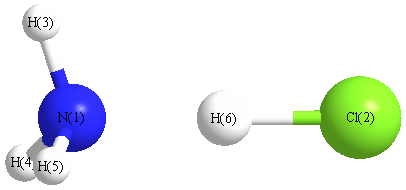
Vibrational Frequencies calculated at B3LYP/6-31G(2df,p)
| Mode Number |
Symmetry |
Frequency
(cm-1) |
Scaled Frequency
(cm-1) |
IR Intensities
(km mol-1) |
Raman Act
(Å4/u) |
Dep P |
Dep U |
|---|
| 1 |
A1 |
3478 |
3356 |
3.42 |
|
|
|
| 2 |
A1 |
2060 |
1988 |
2390.42 |
|
|
|
| 3 |
A1 |
1128 |
1089 |
78.11 |
|
|
|
| 4 |
A1 |
212 |
205 |
45.31 |
|
|
|
| 5 |
E |
3604 |
3478 |
17.13 |
|
|
|
| 5 |
E |
3604 |
3478 |
17.13 |
|
|
|
| 6 |
E |
1665 |
1607 |
21.40 |
|
|
|
| 6 |
E |
1665 |
1607 |
21.40 |
|
|
|
| 7 |
E |
879 |
848 |
51.50 |
|
|
|
| 7 |
E |
879 |
848 |
51.50 |
|
|
|
| 8 |
E |
259 |
250 |
14.17 |
|
|
|
| 8 |
E |
259 |
250 |
14.17 |
|
|
|
Unscaled Zero Point Vibrational Energy (zpe) 9845.5 cm
-1
Scaled (by 0.965) Zero Point Vibrational Energy (zpe) 9500.9 cm
-1
See section
III.C.1 List or set vibrational scaling factors
to change the scale factors used here.
See section
III.C.2
Calculate a vibrational scaling factor for a given set of molecules
to determine the least squares best scaling factor.
Charges, Dipole, Quadrupole and Polarizability
Charges from optimized geometry at B3LYP/6-31G(2df,p)
Charges (e)
| Number |
Element |
Mulliken |
CHELPG |
AIM |
ESP |
| 1 |
N |
-0.693 |
|
|
|
| 2 |
Cl |
-0.448 |
|
|
|
| 3 |
H |
0.270 |
|
|
|
| 4 |
H |
0.270 |
|
|
|
| 5 |
H |
0.270 |
|
|
|
| 6 |
H |
0.330 |
|
|
|
Electric dipole moments
Electric dipole components in Debye
(What's a Debye? See section
VII.A.3)
| |
x |
y |
z |
Total |
| |
0.000 |
0.000 |
-5.258 |
5.258 |
| CHELPG |
|
|
|
|
| AIM |
|
|
|
|
| ESP |
|
|
|
|
Electric Quadrupole moment
Quadrupole components in D Å
Polarizabilities
Components of the polarizability tensor.
Units are
Å
3 (Angstrom cubed)
Change units.
| |
x |
y |
z |
| x |
0.000 |
0.000 |
0.000 |
| y |
0.000 |
0.000 |
0.000 |
| z |
0.000 |
0.000 |
0.000 |
<r2> (average value of r
2) Å
2
| <r2> |
76.612 |
| (<r2>)1/2 |
8.753 |