Jump to
S1C2
S2C1
S2C2
Energy calculated at G4
| | hartrees |
|---|
| Energy at 0K | -39.124202 |
| Energy at 298.15K | -39.120397 |
| HF Energy | -39.154158 |
| Nuclear repulsion energy | 6.140588 |
The energy at 298.15K was derived from the energy at 0K
and an integrated heat capacity that used the calculated vibrational frequencies.
Geometric Data calculated at B3LYP/6-31G(2df,p)
Point Group is C2v
Cartesians (Å)
| Atom |
x (Å) |
y (Å) |
z (Å) |
|---|
| C1 |
0.000 |
0.000 |
0.106 |
| H2 |
0.000 |
0.995 |
-0.318 |
| H3 |
0.000 |
-0.995 |
-0.318 |
Atom - Atom Distances (Å)
| |
C1 |
H2 |
H3 |
| C1 | | 1.0810 | 1.0810 |
H2 | 1.0810 | | 1.9890 | H3 | 1.0810 | 1.9890 | |
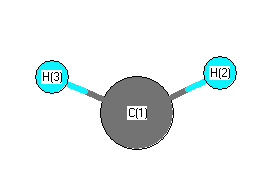 More geometry information
Calculated Bond Angles
| atom1 |
atom2 |
atom3 |
angle |
|
atom1 |
atom2 |
atom3 |
angle |
| H2 |
C1 |
H3 |
133.483 |
|
Electronic energy levels
Charges, Dipole, Quadrupole and Polarizability
Charges from optimized geometry at B3LYP/6-31G(2df,p)
Charges (e)
| Number |
Element |
Mulliken |
CHELPG |
AIM |
ESP |
| 1 |
C |
-0.324 |
|
|
|
| 2 |
H |
0.162 |
|
|
|
| 3 |
H |
0.162 |
|
|
|
Electric dipole moments
Electric dipole components in Debye
(What's a Debye? See section
VII.A.3)
| |
x |
y |
z |
Total |
| |
0.000 |
0.000 |
-0.602 |
0.602 |
| CHELPG |
|
|
|
|
| AIM |
|
|
|
|
| ESP |
|
|
|
|
Electric Quadrupole moment
Quadrupole components in D Å
Polarizabilities
Components of the polarizability tensor.
Units are
Å
3 (Angstrom cubed)
Change units.
| |
x |
y |
z |
| x |
0.000 |
0.000 |
0.000 |
| y |
0.000 |
0.000 |
0.000 |
| z |
0.000 |
0.000 |
0.000 |
<r2> (average value of r
2) Å
2
| <r2> |
6.597 |
| (<r2>)1/2 |
2.568 |
Jump to
S1C1
S2C1
S2C2
Energy calculated at G4
| | hartrees |
|---|
| Energy at 0K | -39.117022 |
| Energy at 298.15K | -39.113718 |
| HF Energy | -39.145522 |
| Nuclear repulsion energy | 6.196755 |
The energy at 298.15K was derived from the energy at 0K
and an integrated heat capacity that used the calculated vibrational frequencies.
Vibrational Frequencies calculated at B3LYP/6-31G(2df,p)
| Mode Number |
Symmetry |
Frequency
(cm-1) |
Scaled Frequency
(cm-1) |
IR Intensities
(km mol-1) |
Raman Act
(Å4/u) |
Dep P |
Dep U |
|---|
| 1 |
Σg |
3228 |
3115 |
0.00 |
|
|
|
| 2 |
Σu |
3575 |
3450 |
52.63 |
|
|
|
| 3 |
Πu |
965i |
932i |
104.92 |
|
|
|
| 4 |
Πu |
965i |
932i |
104.92 |
|
|
|
Unscaled Zero Point Vibrational Energy (zpe) 2436.0 cm
-1
Scaled (by 0.965) Zero Point Vibrational Energy (zpe) 2350.8 cm
-1
See section
III.C.1 List or set vibrational scaling factors
to change the scale factors used here.
See section
III.C.2
Calculate a vibrational scaling factor for a given set of molecules
to determine the least squares best scaling factor.
Geometric Data calculated at B3LYP/6-31G(2df,p)
Point Group is D∞h
Cartesians (Å)
| Atom |
x (Å) |
y (Å) |
z (Å) |
|---|
| C1 |
0.000 |
0.000 |
0.000 |
| H2 |
0.000 |
0.000 |
1.067 |
| H3 |
0.000 |
0.000 |
-1.067 |
Atom - Atom Distances (Å)
| |
C1 |
H2 |
H3 |
| C1 | | 1.0669 | 1.0669 |
H2 | 1.0669 | | 2.1338 | H3 | 1.0669 | 2.1338 | |
More geometry information
Calculated Bond Angles
| atom1 |
atom2 |
atom3 |
angle |
|
atom1 |
atom2 |
atom3 |
angle |
| H2 |
C1 |
H3 |
180.000 |
|
Electronic energy levels
Charges, Dipole, Quadrupole and Polarizability
Charges from optimized geometry at B3LYP/6-31G(2df,p)
Charges (e)
| Number |
Element |
Mulliken |
CHELPG |
AIM |
ESP |
| 1 |
C |
-0.375 |
|
|
|
| 2 |
H |
0.187 |
|
|
|
| 3 |
H |
0.187 |
|
|
|
Electric dipole moments
Electric dipole components in Debye
(What's a Debye? See section
VII.A.3)
| |
x |
y |
z |
Total |
| |
0.000 |
0.000 |
0.000 |
0.000 |
| CHELPG |
|
|
|
|
| AIM |
|
|
|
|
| ESP |
|
|
|
|
Electric Quadrupole moment
Quadrupole components in D Å
Polarizabilities
Components of the polarizability tensor.
Units are
Å
3 (Angstrom cubed)
Change units.
| |
x |
y |
z |
| x |
0.000 |
0.000 |
0.000 |
| y |
0.000 |
0.000 |
0.000 |
| z |
0.000 |
0.000 |
0.000 |
<r2> (average value of r
2) Å
2
| <r2> |
6.556 |
| (<r2>)1/2 |
2.560 |
Jump to
S1C1
S1C2
S2C2
Energy calculated at G4
| | hartrees |
|---|
| Energy at 0K | -39.110475 |
| Energy at 298.15K | -39.106691 |
| HF Energy | -39.135132 |
| Nuclear repulsion energy | 5.990491 |
The energy at 298.15K was derived from the energy at 0K
and an integrated heat capacity that used the calculated vibrational frequencies.
Geometric Data calculated at B3LYP/6-31G(2df,p)
Point Group is C2v
Cartesians (Å)
| Atom |
x (Å) |
y (Å) |
z (Å) |
|---|
| C1 |
0.000 |
0.000 |
0.180 |
| H2 |
0.000 |
0.855 |
-0.540 |
| H3 |
0.000 |
-0.855 |
-0.540 |
Atom - Atom Distances (Å)
| |
C1 |
H2 |
H3 |
| C1 | | 1.1179 | 1.1179 |
H2 | 1.1179 | | 1.7110 | H3 | 1.1179 | 1.7110 | |
More geometry information
Electronic energy levels
Charges, Dipole, Quadrupole and Polarizability
Charges from optimized geometry at B3LYP/6-31G(2df,p)
Charges (e)
| Number |
Element |
Mulliken |
CHELPG |
AIM |
ESP |
| 1 |
C |
-0.297 |
|
|
|
| 2 |
H |
0.148 |
|
|
|
| 3 |
H |
0.148 |
|
|
|
Electric dipole moments
Electric dipole components in Debye
(What's a Debye? See section
VII.A.3)
| |
x |
y |
z |
Total |
| |
0.000 |
0.000 |
-1.730 |
1.730 |
| CHELPG |
|
|
|
|
| AIM |
|
|
|
|
| ESP |
|
|
|
|
Electric Quadrupole moment
Quadrupole components in D Å
Polarizabilities
Components of the polarizability tensor.
Units are
Å
3 (Angstrom cubed)
Change units.
| |
x |
y |
z |
| x |
0.000 |
0.000 |
0.000 |
| y |
0.000 |
0.000 |
0.000 |
| z |
0.000 |
0.000 |
0.000 |
<r2> (average value of r
2) Å
2
| <r2> |
6.857 |
| (<r2>)1/2 |
2.619 |
Jump to
S1C1
S1C2
S2C1
Energy calculated at G4
| | hartrees |
|---|
| Energy at 0K | -39.110475 |
| Energy at 298.15K | -39.106691 |
| HF Energy | -39.135132 |
| Nuclear repulsion energy | 5.990491 |
The energy at 298.15K was derived from the energy at 0K
and an integrated heat capacity that used the calculated vibrational frequencies.
Vibrational Frequencies calculated at B3LYP/6-31G(2df,p)
Geometric Data calculated at B3LYP/6-31G(2df,p)
Point Group is C2v
Electronic energy levels
Charges, Dipole, Quadrupole and Polarizability
