Jump to
S1C2
Vibrational Frequencies calculated at QCISD/6-31G*
Geometric Data calculated at QCISD/6-31G*
Electronic energy levels
Charges, Dipole, Quadrupole and Polarizability
Jump to
S1C1
Energy calculated at QCISD/6-31G*
| | hartrees |
|---|
| Energy at 0K | -484.095483 |
| Energy at 298.15K | -484.099600 |
| Nuclear repulsion energy | 318.319665 |
The energy at 298.15K was derived from the energy at 0K
and an integrated heat capacity that used the calculated vibrational frequencies.
Vibrational Frequencies calculated at QCISD/6-31G*
| Mode Number |
Symmetry |
Frequency
(cm-1) |
Scaled Frequency
(cm-1) |
IR Intensities
(km mol-1) |
Raman Act
(Å4/u) |
Dep P |
Dep U |
|---|
| 1 |
A |
1823 |
1736 |
334.49 |
|
|
|
| 2 |
A |
1414 |
1347 |
48.40 |
|
|
|
| 3 |
A |
896 |
854 |
24.81 |
|
|
|
| 4 |
A |
826 |
786 |
3.09 |
|
|
|
| 5 |
A |
670 |
638 |
0.70 |
|
|
|
| 6 |
A |
409 |
390 |
0.56 |
|
|
|
| 7 |
A |
243 |
232 |
0.65 |
|
|
|
| 8 |
A |
72 |
69 |
0.43 |
|
|
|
| 9 |
B |
1780 |
1695 |
410.71 |
|
|
|
| 10 |
B |
1317 |
1254 |
321.20 |
|
|
|
| 11 |
B |
767 |
731 |
439.86 |
|
|
|
| 12 |
B |
735 |
700 |
16.22 |
|
|
|
| 13 |
B |
653 |
622 |
199.14 |
|
|
|
| 14 |
B |
436 |
415 |
83.35 |
|
|
|
| 15 |
B |
25 |
24 |
0.76 |
|
|
|
Unscaled Zero Point Vibrational Energy (zpe) 6033.2 cm
-1
Scaled (by 0.9523) Zero Point Vibrational Energy (zpe) 5745.4 cm
-1
See section
III.C.1 List or set vibrational scaling factors
to change the scale factors used here.
See section
III.C.2
Calculate a vibrational scaling factor for a given set of molecules
to determine the least squares best scaling factor.
Geometric Data calculated at QCISD/6-31G*
Point Group is C2
Cartesians (Å)
| Atom |
x (Å) |
y (Å) |
z (Å) |
|---|
| O1 |
0.000 |
0.000 |
0.849 |
| N2 |
0.000 |
1.227 |
0.017 |
| N3 |
0.000 |
-1.227 |
0.017 |
| O4 |
0.607 |
2.109 |
0.562 |
| O5 |
-0.607 |
-2.109 |
0.562 |
| O6 |
-0.640 |
1.179 |
-1.002 |
| O7 |
0.640 |
-1.179 |
-1.002 |
Atom - Atom Distances (Å)
| |
O1 |
N2 |
N3 |
O4 |
O5 |
O6 |
O7 |
| O1 | | 1.4828 | 1.4828 | 2.2130 | 2.2130 | 2.2856 | 2.2856 |
N2 | 1.4828 | | 2.4541 | 1.2012 | 3.4340 | 1.2037 | 2.6896 | N3 | 1.4828 | 2.4541 | | 3.4340 | 1.2012 | 2.6896 | 1.2037 | O4 | 2.2130 | 1.2012 | 3.4340 | | 4.3885 | 2.2054 | 3.6404 | O5 | 2.2130 | 3.4340 | 1.2012 | 4.3885 | | 3.6404 | 2.2054 | O6 | 2.2856 | 1.2037 | 2.6896 | 2.2054 | 3.6404 | | 2.6821 | O7 | 2.2856 | 2.6896 | 1.2037 | 3.6404 | 2.2054 | 2.6821 | |
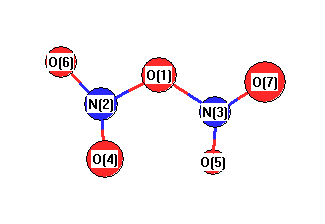 More geometry information
Calculated Bond Angles
| atom1 |
atom2 |
atom3 |
angle |
|
atom1 |
atom2 |
atom3 |
angle |
| O1 |
N2 |
O4 |
110.646 |
|
O1 |
N2 |
O6 |
116.216 |
| O1 |
N3 |
O5 |
110.646 |
|
O1 |
N3 |
O7 |
116.216 |
| N2 |
O1 |
N3 |
111.697 |
|
O4 |
N2 |
O6 |
133.006 |
| O5 |
N3 |
O7 |
133.006 |
|
Electronic energy levels
Charges, Dipole, Quadrupole and Polarizability
