Jump to
S1C2
Energy calculated at CCSD(T)/6-31G*
| | hartrees |
|---|
| Energy at 0K | -191.362198 |
| Energy at 298.15K | |
| HF Energy | -190.758570 |
| Nuclear repulsion energy | 102.331170 |
The energy at 298.15K was derived from the energy at 0K
and an integrated heat capacity that used the calculated vibrational frequencies.
Vibrational Frequencies calculated at CCSD(T)/6-31G*
| Mode Number |
Symmetry |
Frequency
(cm-1) |
Scaled Frequency
(cm-1) |
IR Intensities
(km mol-1) |
Raman Act
(Å4/u) |
Dep P |
Dep U |
|---|
| 1 |
A' |
3250 |
3127 |
|
|
|
|
| 2 |
A' |
3198 |
3077 |
|
|
|
|
| 3 |
A' |
3158 |
3039 |
|
|
|
|
| 4 |
A' |
2933 |
2822 |
|
|
|
|
| 5 |
A' |
1775 |
1708 |
|
|
|
|
| 6 |
A' |
1681 |
1617 |
|
|
|
|
| 7 |
A' |
1478 |
1422 |
|
|
|
|
| 8 |
A' |
1412 |
1359 |
|
|
|
|
| 9 |
A' |
1311 |
1262 |
|
|
|
|
| 10 |
A' |
1193 |
1148 |
|
|
|
|
| 11 |
A' |
936 |
901 |
|
|
|
|
| 12 |
A' |
572 |
550 |
|
|
|
|
| 13 |
A' |
320 |
308 |
|
|
|
|
| 14 |
A" |
1014 |
975 |
|
|
|
|
| 15 |
A" |
998 |
960 |
|
|
|
|
| 16 |
A" |
953 |
917 |
|
|
|
|
| 17 |
A" |
593 |
571 |
|
|
|
|
| 18 |
A" |
161 |
155 |
|
|
|
|
Unscaled Zero Point Vibrational Energy (zpe) 13467.8 cm
-1
Scaled (by 0.9621) Zero Point Vibrational Energy (zpe) 12957.4 cm
-1
See section
III.C.1 List or set vibrational scaling factors
to change the scale factors used here.
See section
III.C.2
Calculate a vibrational scaling factor for a given set of molecules
to determine the least squares best scaling factor.
Geometric Data calculated at CCSD(T)/6-31G*
Point Group is Cs
Cartesians (Å)
| Atom |
x (Å) |
y (Å) |
z (Å) |
|---|
| C1 |
-0.146 |
-0.751 |
0.000 |
| C2 |
0.000 |
0.721 |
0.000 |
| C3 |
1.219 |
1.294 |
0.000 |
| O4 |
-1.227 |
-1.329 |
0.000 |
| H5 |
0.810 |
-1.323 |
0.000 |
| H6 |
-0.921 |
1.306 |
0.000 |
| H7 |
1.355 |
2.374 |
0.000 |
| H8 |
2.128 |
0.688 |
0.000 |
Atom - Atom Distances (Å)
| |
C1 |
C2 |
C3 |
O4 |
H5 |
H6 |
H7 |
H8 |
| C1 | | 1.4796 | 2.4586 | 1.2255 | 1.1138 | 2.1978 | 3.4662 | 2.6910 |
C2 | 1.4796 | | 1.3470 | 2.3891 | 2.1990 | 1.0906 | 2.1365 | 2.1280 | C3 | 2.4586 | 1.3470 | | 3.5861 | 2.6485 | 2.1405 | 1.0885 | 1.0914 | O4 | 1.2255 | 2.3891 | 3.5861 | | 2.0365 | 2.6520 | 4.5133 | 3.9142 | H5 | 1.1138 | 2.1990 | 2.6485 | 2.0365 | | 3.1473 | 3.7367 | 2.4048 | H6 | 2.1978 | 1.0906 | 2.1405 | 2.6520 | 3.1473 | | 2.5138 | 3.1106 | H7 | 3.4662 | 2.1365 | 1.0885 | 4.5133 | 3.7367 | 2.5138 | | 1.8542 | H8 | 2.6910 | 2.1280 | 1.0914 | 3.9142 | 2.4048 | 3.1106 | 1.8542 | |
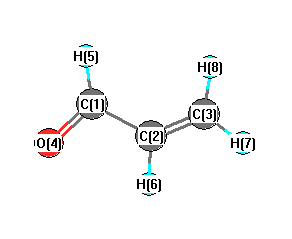 More geometry information
Calculated Bond Angles
| atom1 |
atom2 |
atom3 |
angle |
|
atom1 |
atom2 |
atom3 |
angle |
| C1 |
C2 |
C3 |
120.791 |
|
C1 |
C2 |
H6 |
116.730 |
| C2 |
C1 |
O4 |
123.781 |
|
C2 |
C1 |
H5 |
115.249 |
| C2 |
C3 |
H7 |
122.264 |
|
C2 |
C3 |
H8 |
121.191 |
| C3 |
C2 |
H6 |
122.479 |
|
O4 |
C1 |
H5 |
120.970 |
| H7 |
C3 |
H8 |
116.545 |
|
Electronic energy levels
Charges, Dipole, Quadrupole and Polarizability
Jump to
S1C1
Energy calculated at CCSD(T)/6-31G*
| | hartrees |
|---|
| Energy at 0K | -191.360083 |
| Energy at 298.15K | |
| HF Energy | -190.755986 |
| Nuclear repulsion energy | 103.976942 |
The energy at 298.15K was derived from the energy at 0K
and an integrated heat capacity that used the calculated vibrational frequencies.
Vibrational Frequencies calculated at CCSD(T)/6-31G*
| Mode Number |
Symmetry |
Frequency
(cm-1) |
Scaled Frequency
(cm-1) |
IR Intensities
(km mol-1) |
Raman Act
(Å4/u) |
Dep P |
Dep U |
|---|
| 1 |
A' |
3262 |
3138 |
|
|
|
|
| 2 |
A' |
3183 |
3062 |
|
|
|
|
| 3 |
A' |
3166 |
3046 |
|
|
|
|
| 4 |
A' |
2957 |
2845 |
|
|
|
|
| 5 |
A' |
1771 |
1704 |
|
|
|
|
| 6 |
A' |
1677 |
1614 |
|
|
|
|
| 7 |
A' |
1459 |
1403 |
|
|
|
|
| 8 |
A' |
1448 |
1393 |
|
|
|
|
| 9 |
A' |
1324 |
1273 |
|
|
|
|
| 10 |
A' |
1083 |
1042 |
|
|
|
|
| 11 |
A' |
951 |
915 |
|
|
|
|
| 12 |
A' |
683 |
657 |
|
|
|
|
| 13 |
A' |
295 |
284 |
|
|
|
|
| 14 |
A" |
1008 |
970 |
|
|
|
|
| 15 |
A" |
1000 |
962 |
|
|
|
|
| 16 |
A" |
956 |
920 |
|
|
|
|
| 17 |
A" |
554 |
533 |
|
|
|
|
| 18 |
A" |
166 |
160 |
|
|
|
|
Unscaled Zero Point Vibrational Energy (zpe) 13471.3 cm
-1
Scaled (by 0.9621) Zero Point Vibrational Energy (zpe) 12960.7 cm
-1
See section
III.C.1 List or set vibrational scaling factors
to change the scale factors used here.
See section
III.C.2
Calculate a vibrational scaling factor for a given set of molecules
to determine the least squares best scaling factor.
Geometric Data calculated at CCSD(T)/6-31G*
Point Group is Cs
Cartesians (Å)
| Atom |
x (Å) |
y (Å) |
z (Å) |
|---|
| C1 |
-0.898 |
-0.282 |
0.000 |
| C2 |
0.000 |
0.906 |
0.000 |
| C3 |
1.339 |
0.762 |
0.000 |
| O4 |
-0.498 |
-1.441 |
0.000 |
| H5 |
-1.988 |
-0.065 |
0.000 |
| H6 |
-0.473 |
1.891 |
0.000 |
| H7 |
2.012 |
1.618 |
0.000 |
| H8 |
1.781 |
-0.234 |
0.000 |
Atom - Atom Distances (Å)
| |
C1 |
C2 |
C3 |
O4 |
H5 |
H6 |
H7 |
H8 |
| C1 | | 1.4894 | 2.4687 | 1.2265 | 1.1114 | 2.2137 | 3.4755 | 2.6791 |
C2 | 1.4894 | | 1.3469 | 2.3999 | 2.2127 | 1.0917 | 2.1345 | 2.1146 | C3 | 2.4687 | 1.3469 | | 2.8688 | 3.4284 | 2.1342 | 1.0888 | 1.0896 | O4 | 1.2265 | 2.3999 | 2.8688 | | 2.0283 | 3.3319 | 3.9572 | 2.5788 | H5 | 1.1114 | 2.2127 | 3.4284 | 2.0283 | | 2.4742 | 4.3400 | 3.7725 | H6 | 2.2137 | 1.0917 | 2.1342 | 3.3319 | 2.4742 | | 2.4998 | 3.0968 | H7 | 3.4755 | 2.1345 | 1.0888 | 3.9572 | 4.3400 | 2.4998 | | 1.8660 | H8 | 2.6791 | 2.1146 | 1.0896 | 2.5788 | 3.7725 | 3.0968 | 1.8660 | |
More geometry information
Calculated Bond Angles
| atom1 |
atom2 |
atom3 |
angle |
|
atom1 |
atom2 |
atom3 |
angle |
| C1 |
C2 |
C3 |
120.928 |
|
C1 |
C2 |
H6 |
117.280 |
| C2 |
C1 |
O4 |
123.887 |
|
C2 |
C1 |
H5 |
115.832 |
| C2 |
C3 |
H7 |
122.054 |
|
C2 |
C3 |
H8 |
120.062 |
| C3 |
C2 |
H6 |
121.791 |
|
O4 |
C1 |
H5 |
120.281 |
| H7 |
C3 |
H8 |
117.883 |
|
Electronic energy levels
Charges, Dipole, Quadrupole and Polarizability
