Jump to
S1C2
Energy calculated at CID/6-31G*
| | hartrees |
|---|
| Energy at 0K | -191.258995 |
| Energy at 298.15K | |
| HF Energy | -190.761702 |
| Nuclear repulsion energy | 103.368391 |
The energy at 298.15K was derived from the energy at 0K
and an integrated heat capacity that used the calculated vibrational frequencies.
Vibrational Frequencies calculated at CID/6-31G*
| Mode Number |
Symmetry |
Frequency
(cm-1) |
Scaled Frequency
(cm-1) |
IR Intensities
(km mol-1) |
Raman Act
(Å4/u) |
Dep P |
Dep U |
|---|
| 1 |
A' |
3359 |
3102 |
6.96 |
|
|
|
| 2 |
A' |
3310 |
3058 |
1.00 |
|
|
|
| 3 |
A' |
3267 |
3018 |
4.60 |
|
|
|
| 4 |
A' |
3067 |
2833 |
81.45 |
|
|
|
| 5 |
A' |
1919 |
1772 |
212.03 |
|
|
|
| 6 |
A' |
1788 |
1652 |
2.15 |
|
|
|
| 7 |
A' |
1536 |
1419 |
9.96 |
|
|
|
| 8 |
A' |
1470 |
1357 |
5.50 |
|
|
|
| 9 |
A' |
1364 |
1260 |
2.37 |
|
|
|
| 10 |
A' |
1237 |
1143 |
35.17 |
|
|
|
| 11 |
A' |
970 |
896 |
20.42 |
|
|
|
| 12 |
A' |
595 |
550 |
6.83 |
|
|
|
| 13 |
A' |
335 |
309 |
11.60 |
|
|
|
| 14 |
A" |
1080 |
997 |
2.66 |
|
|
|
| 15 |
A" |
1069 |
988 |
20.53 |
|
|
|
| 16 |
A" |
1044 |
964 |
41.70 |
|
|
|
| 17 |
A" |
630 |
582 |
10.76 |
|
|
|
| 18 |
A" |
164 |
152 |
6.17 |
|
|
|
Unscaled Zero Point Vibrational Energy (zpe) 14101.1 cm
-1
Scaled (by 0.9237) Zero Point Vibrational Energy (zpe) 13025.2 cm
-1
See section
III.C.1 List or set vibrational scaling factors
to change the scale factors used here.
See section
III.C.2
Calculate a vibrational scaling factor for a given set of molecules
to determine the least squares best scaling factor.
Geometric Data calculated at CID/6-31G*
Point Group is Cs
Cartesians (Å)
| Atom |
x (Å) |
y (Å) |
z (Å) |
|---|
| C1 |
-0.145 |
-0.749 |
0.000 |
| C2 |
0.000 |
0.719 |
0.000 |
| C3 |
1.202 |
1.286 |
0.000 |
| O4 |
-1.208 |
-1.319 |
0.000 |
| H5 |
0.802 |
-1.316 |
0.000 |
| H6 |
-0.915 |
1.295 |
0.000 |
| H7 |
1.333 |
2.358 |
0.000 |
| H8 |
2.106 |
0.690 |
0.000 |
Atom - Atom Distances (Å)
| |
C1 |
C2 |
C3 |
O4 |
H5 |
H6 |
H7 |
H8 |
| C1 | | 1.4751 | 2.4402 | 1.2065 | 1.1032 | 2.1847 | 3.4407 | 2.6718 |
C2 | 1.4751 | | 1.3287 | 2.3693 | 2.1869 | 1.0817 | 2.1126 | 2.1062 | C3 | 2.4402 | 1.3287 | | 3.5488 | 2.6322 | 2.1171 | 1.0803 | 1.0828 | O4 | 1.2065 | 2.3693 | 3.5488 | | 2.0098 | 2.6307 | 4.4697 | 3.8758 | H5 | 1.1032 | 2.1869 | 2.6322 | 2.0098 | | 3.1250 | 3.7121 | 2.3928 | H6 | 2.1847 | 1.0817 | 2.1171 | 2.6307 | 3.1250 | | 2.4866 | 3.0814 | H7 | 3.4407 | 2.1126 | 1.0803 | 4.4697 | 3.7121 | 2.4866 | | 1.8385 | H8 | 2.6718 | 2.1062 | 1.0828 | 3.8758 | 2.3928 | 3.0814 | 1.8385 | |
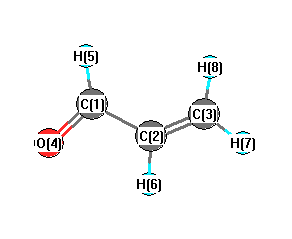 More geometry information
Calculated Bond Angles
| atom1 |
atom2 |
atom3 |
angle |
|
atom1 |
atom2 |
atom3 |
angle |
| C1 |
C2 |
C3 |
120.898 |
|
C1 |
C2 |
H6 |
116.558 |
| C2 |
C1 |
O4 |
123.834 |
|
C2 |
C1 |
H5 |
115.270 |
| C2 |
C3 |
H7 |
122.220 |
|
C2 |
C3 |
H8 |
121.368 |
| C3 |
C2 |
H6 |
122.544 |
|
O4 |
C1 |
H5 |
120.896 |
| H7 |
C3 |
H8 |
116.413 |
|
Electronic energy levels
Charges, Dipole, Quadrupole and Polarizability
Jump to
S1C1
Energy calculated at CID/6-31G*
| | hartrees |
|---|
| Energy at 0K | -191.256557 |
| Energy at 298.15K | |
| HF Energy | -190.759063 |
| Nuclear repulsion energy | 105.015295 |
The energy at 298.15K was derived from the energy at 0K
and an integrated heat capacity that used the calculated vibrational frequencies.
Vibrational Frequencies calculated at CID/6-31G*
| Mode Number |
Symmetry |
Frequency
(cm-1) |
Scaled Frequency
(cm-1) |
IR Intensities
(km mol-1) |
Raman Act
(Å4/u) |
Dep P |
Dep U |
|---|
| 1 |
A' |
3373 |
3116 |
2.81 |
|
|
|
| 2 |
A' |
3297 |
3045 |
9.06 |
|
|
|
| 3 |
A' |
3277 |
3027 |
4.89 |
|
|
|
| 4 |
A' |
3090 |
2854 |
122.63 |
|
|
|
| 5 |
A' |
1910 |
1765 |
113.70 |
|
|
|
| 6 |
A' |
1788 |
1651 |
46.78 |
|
|
|
| 7 |
A' |
1515 |
1399 |
41.14 |
|
|
|
| 8 |
A' |
1505 |
1391 |
0.90 |
|
|
|
| 9 |
A' |
1380 |
1275 |
1.88 |
|
|
|
| 10 |
A' |
1125 |
1039 |
5.36 |
|
|
|
| 11 |
A' |
987 |
912 |
61.02 |
|
|
|
| 12 |
A' |
713 |
658 |
16.11 |
|
|
|
| 13 |
A' |
307 |
283 |
7.70 |
|
|
|
| 14 |
A" |
1080 |
997 |
2.77 |
|
|
|
| 15 |
A" |
1070 |
989 |
52.02 |
|
|
|
| 16 |
A" |
1051 |
971 |
2.92 |
|
|
|
| 17 |
A" |
590 |
545 |
9.50 |
|
|
|
| 18 |
A" |
162 |
149 |
9.26 |
|
|
|
Unscaled Zero Point Vibrational Energy (zpe) 14109.7 cm
-1
Scaled (by 0.9237) Zero Point Vibrational Energy (zpe) 13033.2 cm
-1
See section
III.C.1 List or set vibrational scaling factors
to change the scale factors used here.
See section
III.C.2
Calculate a vibrational scaling factor for a given set of molecules
to determine the least squares best scaling factor.
Geometric Data calculated at CID/6-31G*
Point Group is Cs
Cartesians (Å)
| Atom |
x (Å) |
y (Å) |
z (Å) |
|---|
| C1 |
-0.888 |
-0.290 |
0.000 |
| C2 |
0.000 |
0.898 |
0.000 |
| C3 |
1.322 |
0.767 |
0.000 |
| O4 |
-0.490 |
-1.430 |
0.000 |
| H5 |
-1.969 |
-0.082 |
0.000 |
| H6 |
-0.475 |
1.871 |
0.000 |
| H7 |
1.982 |
1.622 |
0.000 |
| H8 |
1.773 |
-0.216 |
0.000 |
Atom - Atom Distances (Å)
| |
C1 |
C2 |
C3 |
O4 |
H5 |
H6 |
H7 |
H8 |
| C1 | | 1.4833 | 2.4497 | 1.2077 | 1.1009 | 2.2003 | 3.4483 | 2.6621 |
C2 | 1.4833 | | 1.3288 | 2.3794 | 2.1993 | 1.0826 | 2.1098 | 2.0940 | C3 | 2.4497 | 1.3288 | | 2.8477 | 3.3987 | 2.1094 | 1.0802 | 1.0807 | O4 | 1.2077 | 2.3794 | 2.8477 | | 2.0014 | 3.3014 | 3.9275 | 2.5684 | H5 | 1.1009 | 2.1993 | 3.3987 | 2.0014 | | 2.4589 | 4.3024 | 3.7445 | H6 | 2.2003 | 1.0826 | 2.1094 | 3.3014 | 2.4589 | | 2.4692 | 3.0673 | H7 | 3.4483 | 2.1098 | 1.0802 | 3.9275 | 4.3024 | 2.4692 | | 1.8495 | H8 | 2.6621 | 2.0940 | 1.0807 | 2.5684 | 3.7445 | 3.0673 | 1.8495 | |
More geometry information
Calculated Bond Angles
| atom1 |
atom2 |
atom3 |
angle |
|
atom1 |
atom2 |
atom3 |
angle |
| C1 |
C2 |
C3 |
121.080 |
|
C1 |
C2 |
H6 |
117.217 |
| C2 |
C1 |
O4 |
123.990 |
|
C2 |
C1 |
H5 |
115.866 |
| C2 |
C3 |
H7 |
121.937 |
|
C2 |
C3 |
H8 |
120.351 |
| C3 |
C2 |
H6 |
121.703 |
|
O4 |
C1 |
H5 |
120.144 |
| H7 |
C3 |
H8 |
117.712 |
|
Electronic energy levels
Charges, Dipole, Quadrupole and Polarizability
