Jump to
S1C2
Energy calculated at CCSD(T)/6-31G*
| | hartrees |
|---|
| Energy at 0K | -3108.001178 |
| Energy at 298.15K | |
| HF Energy | -3107.438263 |
| Nuclear repulsion energy | 287.272919 |
The energy at 298.15K was derived from the energy at 0K
and an integrated heat capacity that used the calculated vibrational frequencies.
Vibrational Frequencies calculated at CCSD(T)/6-31G*
| Mode Number |
Symmetry |
Frequency
(cm-1) |
Scaled Frequency
(cm-1) |
IR Intensities
(km mol-1) |
Raman Act
(Å4/u) |
Dep P |
Dep U |
|---|
| 1 |
A' |
200 |
192 |
|
|
|
|
| 2 |
A' |
252 |
243 |
|
|
|
|
| 3 |
A' |
650 |
625 |
|
|
|
|
| 4 |
A' |
775 |
745 |
|
|
|
|
| 5 |
A' |
1093 |
1052 |
|
|
|
|
| 6 |
A' |
1257 |
1210 |
|
|
|
|
| 7 |
A' |
1368 |
1316 |
|
|
|
|
| 8 |
A' |
1528 |
1470 |
|
|
|
|
| 9 |
A' |
1533 |
1475 |
|
|
|
|
| 10 |
A' |
3123 |
3005 |
|
|
|
|
| 11 |
A' |
3135 |
3016 |
|
|
|
|
| 12 |
A" |
116 |
111 |
|
|
|
|
| 13 |
A" |
778 |
748 |
|
|
|
|
| 14 |
A" |
1000 |
962 |
|
|
|
|
| 15 |
A" |
1159 |
1115 |
|
|
|
|
| 16 |
A" |
1323 |
1272 |
|
|
|
|
| 17 |
A" |
3184 |
3063 |
|
|
|
|
| 18 |
A" |
3210 |
3088 |
|
|
|
|
Unscaled Zero Point Vibrational Energy (zpe) 12841.2 cm
-1
Scaled (by 0.9621) Zero Point Vibrational Energy (zpe) 12354.5 cm
-1
See section
III.C.1 List or set vibrational scaling factors
to change the scale factors used here.
See section
III.C.2
Calculate a vibrational scaling factor for a given set of molecules
to determine the least squares best scaling factor.
Geometric Data calculated at CCSD(T)/6-31G*
Point Group is Cs
Cartesians (Å)
| Atom |
x (Å) |
y (Å) |
z (Å) |
|---|
| C1 |
0.000 |
0.659 |
0.000 |
| C2 |
1.239 |
-0.216 |
0.000 |
| Br3 |
-1.595 |
-0.503 |
0.000 |
| Cl4 |
2.703 |
0.828 |
0.000 |
| H5 |
-0.064 |
1.280 |
0.896 |
| H6 |
-0.064 |
1.280 |
-0.896 |
| H7 |
1.277 |
-0.847 |
0.892 |
| H8 |
1.277 |
-0.847 |
-0.892 |
Atom - Atom Distances (Å)
| |
C1 |
C2 |
Br3 |
Cl4 |
H5 |
H6 |
H7 |
H8 |
| C1 | | 1.5174 | 1.9734 | 2.7087 | 1.0922 | 1.0922 | 2.1669 | 2.1669 |
C2 | 1.5174 | | 2.8483 | 1.7987 | 2.1773 | 2.1773 | 1.0933 | 1.0933 | Br3 | 1.9734 | 2.8483 | | 4.4996 | 2.5153 | 2.5153 | 3.0266 | 3.0266 | Cl4 | 2.7087 | 1.7987 | 4.4996 | | 2.9437 | 2.9437 | 2.3745 | 2.3745 | H5 | 1.0922 | 2.1773 | 2.5153 | 2.9437 | | 1.7925 | 2.5144 | 3.0857 | H6 | 1.0922 | 2.1773 | 2.5153 | 2.9437 | 1.7925 | | 3.0857 | 2.5144 | H7 | 2.1669 | 1.0933 | 3.0266 | 2.3745 | 2.5144 | 3.0857 | | 1.7847 | H8 | 2.1669 | 1.0933 | 3.0266 | 2.3745 | 3.0857 | 2.5144 | 1.7847 | |
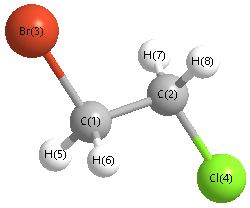 More geometry information
Calculated Bond Angles
| atom1 |
atom2 |
atom3 |
angle |
|
atom1 |
atom2 |
atom3 |
angle |
| C1 |
C2 |
Cl4 |
109.246 |
|
C1 |
C2 |
H7 |
111.162 |
| C1 |
C2 |
H8 |
111.162 |
|
C2 |
C1 |
Br3 |
108.663 |
| C2 |
C1 |
Cl4 |
38.825 |
|
C2 |
C1 |
H6 |
112.076 |
| Br3 |
C1 |
H5 |
106.715 |
|
Br3 |
C1 |
H6 |
106.715 |
| Cl4 |
C2 |
H7 |
107.876 |
|
Cl4 |
C2 |
H8 |
107.876 |
| H5 |
C1 |
H6 |
110.294 |
|
H7 |
C2 |
H8 |
109.405 |
Electronic energy levels
Charges, Dipole, Quadrupole and Polarizability
Jump to
S1C1
Energy calculated at CCSD(T)/6-31G*
| | hartrees |
|---|
| Energy at 0K | -3107.998624 |
| Energy at 298.15K | |
| HF Energy | -3107.434880 |
| Nuclear repulsion energy | 304.327634 |
The energy at 298.15K was derived from the energy at 0K
and an integrated heat capacity that used the calculated vibrational frequencies.
Vibrational Frequencies calculated at CCSD(T)/6-31G*
| Mode Number |
Symmetry |
Frequency
(cm-1) |
Scaled Frequency
(cm-1) |
IR Intensities
(km mol-1) |
Raman Act
(Å4/u) |
Dep P |
Dep U |
|---|
| 1 |
A |
3189 |
3068 |
|
|
|
|
| 2 |
A |
3165 |
3045 |
|
|
|
|
| 3 |
A |
3117 |
2999 |
|
|
|
|
| 4 |
A |
3096 |
2979 |
|
|
|
|
| 5 |
A |
1518 |
1460 |
|
|
|
|
| 6 |
A |
1510 |
1453 |
|
|
|
|
| 7 |
A |
1380 |
1327 |
|
|
|
|
| 8 |
A |
1328 |
1277 |
|
|
|
|
| 9 |
A |
1240 |
1193 |
|
|
|
|
| 10 |
A |
1171 |
1127 |
|
|
|
|
| 11 |
A |
1069 |
1028 |
|
|
|
|
| 12 |
A |
964 |
927 |
|
|
|
|
| 13 |
A |
894 |
860 |
|
|
|
|
| 14 |
A |
701 |
675 |
|
|
|
|
| 15 |
A |
579 |
557 |
|
|
|
|
| 16 |
A |
393 |
378 |
|
|
|
|
| 17 |
A |
246 |
237 |
|
|
|
|
| 18 |
A |
105 |
101 |
|
|
|
|
Unscaled Zero Point Vibrational Energy (zpe) 12831.5 cm
-1
Scaled (by 0.9621) Zero Point Vibrational Energy (zpe) 12345.2 cm
-1
See section
III.C.1 List or set vibrational scaling factors
to change the scale factors used here.
See section
III.C.2
Calculate a vibrational scaling factor for a given set of molecules
to determine the least squares best scaling factor.
Geometric Data calculated at CCSD(T)/6-31G*
Point Group is C1
Cartesians (Å)
| Atom |
x (Å) |
y (Å) |
z (Å) |
|---|
| C1 |
0.017 |
1.125 |
-0.385 |
| C2 |
1.293 |
0.905 |
0.406 |
| Br3 |
-1.349 |
-0.226 |
0.036 |
| Cl4 |
2.149 |
-0.588 |
-0.088 |
| H5 |
-0.423 |
2.093 |
-0.124 |
| H6 |
0.190 |
1.071 |
-1.462 |
| H7 |
1.975 |
1.745 |
0.228 |
| H8 |
1.082 |
0.830 |
1.476 |
Atom - Atom Distances (Å)
| |
C1 |
C2 |
Br3 |
Cl4 |
H5 |
H6 |
H7 |
H8 |
| C1 | | 1.5170 | 1.9674 | 2.7514 | 1.0944 | 1.0927 | 2.1437 | 2.1646 |
C2 | 1.5170 | | 2.8977 | 1.7906 | 2.1533 | 2.1755 | 1.0967 | 1.0939 | Br3 | 1.9674 | 2.8977 | | 3.5196 | 2.5020 | 2.5096 | 3.8698 | 3.0167 | Cl4 | 2.7514 | 1.7906 | 3.5196 | | 3.7156 | 2.9115 | 2.3606 | 2.3663 | H5 | 1.0944 | 2.1533 | 2.5020 | 3.7156 | | 1.7923 | 2.4493 | 2.5339 | H6 | 1.0927 | 2.1755 | 2.5096 | 2.9115 | 1.7923 | | 2.5494 | 3.0805 | H7 | 2.1437 | 1.0967 | 3.8698 | 2.3606 | 2.4493 | 2.5494 | | 1.7868 | H8 | 2.1646 | 1.0939 | 3.0167 | 2.3663 | 2.5339 | 3.0805 | 1.7868 | |
More geometry information
Calculated Bond Angles
| atom1 |
atom2 |
atom3 |
angle |
|
atom1 |
atom2 |
atom3 |
angle |
| C1 |
C2 |
Cl4 |
112.310 |
|
C1 |
C2 |
H7 |
109.140 |
| C1 |
C2 |
H8 |
110.963 |
|
C2 |
C1 |
Br3 |
111.884 |
| C2 |
C1 |
Cl4 |
37.019 |
|
C2 |
C1 |
H6 |
111.912 |
| Br3 |
C1 |
H5 |
106.067 |
|
Br3 |
C1 |
H6 |
106.674 |
| Cl4 |
C2 |
H7 |
107.229 |
|
Cl4 |
C2 |
H8 |
107.783 |
| H5 |
C1 |
H6 |
110.065 |
|
H7 |
C2 |
H8 |
109.309 |
Electronic energy levels
Charges, Dipole, Quadrupole and Polarizability
