return to home page Computational Chemistry Comparison and Benchmark DataBase Release 22 (May 2022) Standard Reference Database 101 National Institute of Standards and Technology
You are here: Calculated > Energy > Optimized > Energy

All results from a given calculation for C3H5Cl (1-Propene, 3-chloro-)

using model chemistry: CCSD(T)/6-31G*

19 10 17 12 22

States and conformations

State Conformation minimum conformation conformer description state description
1 1 yes C1 1A
Energy calculated at CCSD(T)/6-31G*
 hartrees
Energy at 0K-576.546651
Energy at 298.15K-576.551644
HF Energy-575.970114
Nuclear repulsion energy142.739273
The energy at 298.15K was derived from the energy at 0K and an integrated heat capacity that used the calculated vibrational frequencies.
Vibrational Frequencies calculated at CCSD(T)/6-31G*
Mode Number Symmetry Frequency
(cm-1)
Scaled Frequency
(cm-1)
IR Intensities
(km mol-1)
Raman Act
(Å4/u)
Dep P Dep U
1 A 3248 3124        
2 A 3181 3061        
3 A 3161 3041        
4 A 3157 3037        
5 A 3099 2982        
6 A 1714 1649        
7 A 1526 1468        
8 A 1479 1423        
9 A 1346 1295        
10 A 1327 1276        
11 A 1254 1207        
12 A 1147 1104        
13 A 1005 967        
14 A 967 930        
15 A 926 890        
16 A 924 889        
17 A 773 743        
18 A 604 581        
19 A 406 391        
20 A 290 279        
21 A 103 99        

Unscaled Zero Point Vibrational Energy (zpe) 15817.0 cm-1
Scaled (by 0.9621) Zero Point Vibrational Energy (zpe) 15217.5 cm-1
See section III.C.1 List or set vibrational scaling factors to change the scale factors used here.
See section III.C.2 Calculate a vibrational scaling factor for a given set of molecules to determine the least squares best scaling factor.
Rotational Constants (cm-1) from geometry optimized at CCSD(T)/6-31G*
ABC
0.71784 0.09215 0.08946

See section I.F.4 to change rotational constant units
Geometric Data calculated at CCSD(T)/6-31G*

Point Group is C1

Cartesians (Å)
Atom x (Å) y (Å) z (Å)
C1 2.234 -0.181 -0.313
C2 1.128 -0.151 0.448
C3 -0.043 0.736 0.156
Cl4 -1.543 -0.235 -0.121
H5 2.330 0.431 -1.211
H6 3.080 -0.819 -0.064
H7 1.047 -0.781 1.336
H8 -0.266 1.403 0.996
H9 0.126 1.337 -0.743

Atom - Atom Distances (Å)
  C1 C2 C3 Cl4 H5 H6 H7 H8 H9
C11.34312.49943.78231.09071.08882.11883.23602.6326
C21.34311.49802.73262.12972.12591.09172.15802.1532
C32.49941.49801.80822.75543.49612.20971.09551.0947
Cl43.78232.73261.80824.07784.66003.02182.35882.3759
H51.09072.12972.75544.07781.85523.09863.54282.4276
H61.08882.12593.49614.66001.85522.46884.15433.7194
H72.11881.09172.20973.02183.09862.46882.57073.1074
H83.23602.15801.09552.35883.54284.15432.57071.7842
H92.63262.15321.09472.37592.42763.71943.10741.7842

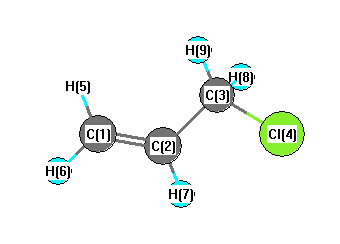
picture of 1-Propene, 3-chloro- state 1 conformation 1
More geometry information
Calculated Bond Angles
atom1 atom2 atom3 angle atom1 atom2 atom3 angle
C1 C2 C3 123.125 C1 C2 H7 120.612
C2 C1 H5 121.756 C2 C1 H6 121.548
C2 C3 Cl4 111.137 C2 C3 H8 111.685
C2 C3 H9 111.348 C3 C2 H7 116.260
Cl4 C3 H8 106.035 Cl4 C3 H9 107.295
H5 C1 H6 116.696 H8 C3 H9 109.104
Electronic energy levels
Charges, Dipole, Quadrupole and Polarizability