return to home page Computational Chemistry Comparison and Benchmark DataBase Release 22 (May 2022) Standard Reference Database 101 National Institute of Standards and Technology
You are here: Calculated > Energy > Optimized > Energy

All results from a given calculation for C3H5Cl (1-Propene, 3-chloro-)

using model chemistry: CID/6-31G*

19 10 17 12 22

States and conformations

State Conformation minimum conformation conformer description state description
1 1 yes C1 1A
Energy calculated at CID/6-31G*
 hartrees
Energy at 0K-576.447675
Energy at 298.15K-576.452803
HF Energy-575.971517
Nuclear repulsion energy143.743438
The energy at 298.15K was derived from the energy at 0K and an integrated heat capacity that used the calculated vibrational frequencies.
Vibrational Frequencies calculated at CID/6-31G*
Mode Number Symmetry Frequency
(cm-1)
Scaled Frequency
(cm-1)
IR Intensities
(km mol-1)
Raman Act
(Å4/u)
Dep P Dep U
1 A 3354 3098 12.24      
2 A 3290 3039 5.84      
3 A 3271 3021 7.49      
4 A 3264 3015 2.49      
5 A 3208 2963 16.78      
6 A 1817 1678 0.83      
7 A 1576 1456 4.36      
8 A 1530 1414 8.80      
9 A 1400 1293 18.48      
10 A 1376 1271 24.93      
11 A 1301 1202 0.58      
12 A 1187 1097 1.23      
13 A 1074 992 16.48      
14 A 1013 936 43.05      
15 A 1002 926 6.00      
16 A 960 886 6.08      
17 A 815 752 54.83      
18 A 639 590 6.35      
19 A 423 391 0.70      
20 A 302 279 4.54      
21 A 108 99 0.49      

Unscaled Zero Point Vibrational Energy (zpe) 16454.8 cm-1
Scaled (by 0.9237) Zero Point Vibrational Energy (zpe) 15199.3 cm-1
See section III.C.1 List or set vibrational scaling factors to change the scale factors used here.
See section III.C.2 Calculate a vibrational scaling factor for a given set of molecules to determine the least squares best scaling factor.
Rotational Constants (cm-1) from geometry optimized at CID/6-31G*
ABC
0.73583 0.09315 0.09041

See section I.F.4 to change rotational constant units
Geometric Data calculated at CID/6-31G*

Point Group is C1

Cartesians (Å)
Atom x (Å) y (Å) z (Å)
C1 2.221 -0.169 -0.311
C2 1.126 -0.164 0.435
C3 -0.044 0.725 0.169
Cl4 -1.536 -0.229 -0.124
H5 2.323 0.465 -1.182
H6 3.060 -0.809 -0.078
H7 1.043 -0.815 1.297
H8 -0.259 1.367 1.018
H9 0.121 1.342 -0.710

Atom - Atom Distances (Å)
  C1 C2 C3 Cl4 H5 H6 H7 H8 H9
C11.32562.48173.76231.08231.08062.09553.20602.6182
C21.32561.49252.72032.10822.10311.08312.14492.1418
C32.48171.49251.79512.73723.47102.19621.08681.0857
Cl43.76232.72031.79514.06104.63273.00142.34162.3571
H51.08232.10822.73724.06101.83993.06963.51042.4172
H61.08062.10313.47104.63271.83992.44174.11783.6969
H72.09551.08312.19623.00143.06962.44172.55603.0866
H83.20602.14491.08682.34163.51044.11782.55601.7692
H92.61822.14181.08572.35712.41723.69693.08661.7692

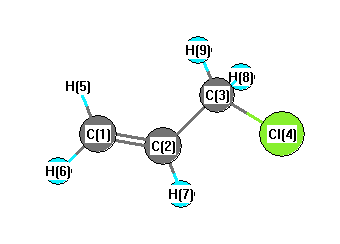
picture of 1-Propene, 3-chloro- state 1 conformation 1
More geometry information
Calculated Bond Angles
atom1 atom2 atom3 angle atom1 atom2 atom3 angle
C1 C2 C3 123.324 C1 C2 H7 120.572
C2 C1 H5 121.893 C2 C1 H6 121.534
C2 C3 Cl4 111.338 C2 C3 H8 111.557
C2 C3 H9 111.371 C3 C2 H7 116.100
Cl4 C3 H8 106.065 Cl4 C3 H9 107.229
H5 C1 H6 116.574 H8 C3 H9 109.043
Electronic energy levels
Charges, Dipole, Quadrupole and Polarizability