return to home page Computational Chemistry Comparison and Benchmark DataBase Release 22 (May 2022) Standard Reference Database 101 National Institute of Standards and Technology
You are here: Calculated > Energy > Optimized > Energy

All results from a given calculation for C3H5Cl (1-Propene, 3-chloro-)

using model chemistry: QCISD/6-31G*

19 10 17 12 22

States and conformations

State Conformation minimum conformation conformer description state description
1 1 yes C1 1A
Energy calculated at QCISD/6-31G*
 hartrees
Energy at 0K-576.529356
Energy at 298.15K-576.534381
HF Energy-575.970568
Nuclear repulsion energy142.944176
The energy at 298.15K was derived from the energy at 0K and an integrated heat capacity that used the calculated vibrational frequencies.
Vibrational Frequencies calculated at QCISD/6-31G*
Mode Number Symmetry Frequency
(cm-1)
Scaled Frequency
(cm-1)
IR Intensities
(km mol-1)
Raman Act
(Å4/u)
Dep P Dep U
1 A 3262 3107 14.07      
2 A 3199 3046 6.60      
3 A 3178 3027 11.21      
4 A 3174 3023 1.00      
5 A 3118 2969 17.45      
6 A 1743 1660 0.90      
7 A 1535 1461 3.90      
8 A 1489 1418 7.42      
9 A 1358 1293 17.10      
10 A 1337 1274 21.50      
11 A 1264 1204 0.63      
12 A 1156 1101 1.01      
13 A 1024 975 18.38      
14 A 975 928 6.33      
15 A 948 903 35.43      
16 A 933 889 5.72      
17 A 784 747 47.11      
18 A 613 584 5.32      
19 A 410 391 0.63      
20 A 293 279 4.16      
21 A 102 97 0.47      

Unscaled Zero Point Vibrational Energy (zpe) 15947.3 cm-1
Scaled (by 0.9523) Zero Point Vibrational Energy (zpe) 15186.6 cm-1
See section III.C.1 List or set vibrational scaling factors to change the scale factors used here.
See section III.C.2 Calculate a vibrational scaling factor for a given set of molecules to determine the least squares best scaling factor.
Rotational Constants (cm-1) from geometry optimized at QCISD/6-31G*
ABC
0.72608 0.09222 0.08952

See section I.F.4 to change rotational constant units
Geometric Data calculated at QCISD/6-31G*

Point Group is C1

Cartesians (Å)
Atom x (Å) y (Å) z (Å)
C1 2.234 -0.170 -0.312
C2 1.127 -0.165 0.439
C3 -0.043 0.729 0.170
Cl4 -1.543 -0.231 -0.125
H5 2.338 0.468 -1.189
H6 3.078 -0.816 -0.078
H7 1.041 -0.820 1.306
H8 -0.261 1.377 1.024
H9 0.123 1.349 -0.715

Atom - Atom Distances (Å)
  C1 C2 C3 Cl4 H5 H6 H7 H8 H9
C11.33812.49623.78251.08931.08762.11323.22622.6319
C21.33811.49762.73012.12512.12051.09032.15552.1521
C32.49621.49761.80472.75413.49172.20651.09401.0932
Cl43.78252.73011.80474.08424.65813.01212.35522.3707
H51.08932.12512.75414.08421.85183.09293.53262.4298
H61.08762.12053.49174.65811.85182.46284.14403.7176
H72.11321.09032.20653.01213.09292.46282.56943.1038
H83.22622.15551.09402.35523.53264.14402.56941.7819
H92.63192.15211.09322.37072.42983.71763.10381.7819

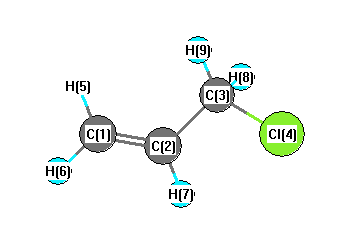
picture of 1-Propene, 3-chloro- state 1 conformation 1
More geometry information
Calculated Bond Angles
atom1 atom2 atom3 angle atom1 atom2 atom3 angle
C1 C2 C3 123.256 C1 C2 H7 120.627
C2 C1 H5 121.869 C2 C1 H6 121.562
C2 C3 Cl4 111.190 C2 C3 H8 111.611
C2 C3 H9 111.382 C3 C2 H7 116.112
Cl4 C3 H8 106.077 Cl4 C3 H9 107.224
H5 C1 H6 116.569 H8 C3 H9 109.121
Electronic energy levels
Charges, Dipole, Quadrupole and Polarizability