return to home page Computational Chemistry Comparison and Benchmark DataBase Release 22 (May 2022) Standard Reference Database 101 National Institute of Standards and Technology
You are here: Calculated > Energy > Optimized > Energy

All results from a given calculation for C2H5CN (ethyl cyanide)

using model chemistry: CID/6-31G*

19 10 17 12 22

States and conformations

State Conformation minimum conformation conformer description state description
1 1 yes Cs 1A'
Energy calculated at CID/6-31G*
 hartrees
Energy at 0K-171.451819
Energy at 298.15K 
HF Energy-170.961702
Nuclear repulsion energy103.033466
The energy at 298.15K was derived from the energy at 0K and an integrated heat capacity that used the calculated vibrational frequencies.
Vibrational Frequencies calculated at CID/6-31G*
Mode Number Symmetry Frequency
(cm-1)
Scaled Frequency
(cm-1)
IR Intensities
(km mol-1)
Raman Act
(Å4/u)
Dep P Dep U
1 A' 3252 3004 18.48      
2 A' 3178 2935 5.90      
3 A' 3170 2928 16.49      
4 A' 2482 2293 4.79      
5 A' 1592 1470 6.12      
6 A' 1569 1449 4.21      
7 A' 1511 1396 1.90      
8 A' 1437 1327 3.29      
9 A' 1157 1068 4.90      
10 A' 1075 993 1.43      
11 A' 880 813 1.00      
12 A' 567 524 0.95      
13 A' 221 204 4.91      
14 A" 3259 3010 17.92      
15 A" 3221 2975 1.20      
16 A" 1585 1464 7.30      
17 A" 1357 1253 0.00      
18 A" 1180 1090 0.27      
19 A" 830 767 3.53      
20 A" 406 375 0.68      
21 A" 232 215 1.18      

Unscaled Zero Point Vibrational Energy (zpe) 17079.7 cm-1
Scaled (by 0.9237) Zero Point Vibrational Energy (zpe) 15776.5 cm-1
See section III.C.1 List or set vibrational scaling factors to change the scale factors used here.
See section III.C.2 Calculate a vibrational scaling factor for a given set of molecules to determine the least squares best scaling factor.
Rotational Constants (cm-1) from geometry optimized at CID/6-31G*
ABC
0.93643 0.15684 0.14136

See section I.F.4 to change rotational constant units
Geometric Data calculated at CID/6-31G*

Point Group is Cs

Cartesians (Å)
Atom x (Å) y (Å) z (Å)
C1 1.509 0.566 0.000
C2 0.000 0.816 0.000
C3 -0.768 -0.437 0.000
N4 -1.359 -1.426 0.000
H5 2.040 1.517 0.000
H6 1.809 0.004 0.882
H7 1.809 0.004 -0.882
H8 -0.296 1.392 0.876
H9 -0.296 1.392 -0.876

Atom - Atom Distances (Å)
  C1 C2 C3 N4 H5 H6 H7 H8 H9
C11.52952.48773.49231.08871.08821.08822.16972.1697
C21.52951.46862.62132.15692.17022.17021.08981.0898
C32.48771.46861.15273.42012.75922.75922.08152.0815
N43.49232.62131.15274.49593.58663.58663.13633.1363
H51.08872.15693.42014.49591.76611.76612.49782.4978
H61.08822.17022.75923.58661.76611.76432.52133.0740
H71.08822.17022.75923.58661.76611.76433.07402.5213
H82.16971.08982.08153.13632.49782.52133.07401.7529
H92.16971.08982.08153.13632.49783.07402.52131.7529

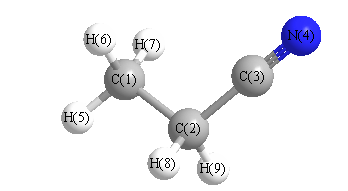
picture of ethyl cyanide state 1 conformation 1
More geometry information
Calculated Bond Angles
atom1 atom2 atom3 angle atom1 atom2 atom3 angle
C1 C2 C3 112.133 C1 C2 H8 110.739
C1 C2 H9 110.739 C2 C1 H5 109.789
C2 C1 H6 110.879 C2 C1 H7 110.879
C2 C3 N4 179.376 C3 C2 H8 107.981
C3 C2 H9 107.981 H5 C1 H6 108.449
H5 C1 H7 108.449 H6 C1 H7 108.321
H8 C2 H9 107.073
Electronic energy levels
Charges, Dipole, Quadrupole and Polarizability