Jump to
S1C2
Energy calculated at QCISD/6-31G*
| | hartrees |
|---|
| Energy at 0K | -612.403529 |
| Energy at 298.15K | -612.406744 |
| HF Energy | -611.809260 |
| Nuclear repulsion energy | 142.240978 |
The energy at 298.15K was derived from the energy at 0K
and an integrated heat capacity that used the calculated vibrational frequencies.
Vibrational Frequencies calculated at QCISD/6-31G*
| Mode Number |
Symmetry |
Frequency
(cm-1) |
Scaled Frequency
(cm-1) |
IR Intensities
(km mol-1) |
Raman Act
(Å4/u) |
Dep P |
Dep U |
|---|
| 1 |
A |
3188 |
3036 |
0.75 |
|
|
|
| 2 |
A |
3123 |
2974 |
9.00 |
|
|
|
| 3 |
A |
3013 |
2869 |
55.74 |
|
|
|
| 4 |
A |
1825 |
1738 |
111.57 |
|
|
|
| 5 |
A |
1503 |
1431 |
11.02 |
|
|
|
| 6 |
A |
1442 |
1373 |
7.32 |
|
|
|
| 7 |
A |
1327 |
1263 |
25.06 |
|
|
|
| 8 |
A |
1225 |
1167 |
1.32 |
|
|
|
| 9 |
A |
1075 |
1024 |
34.78 |
|
|
|
| 10 |
A |
1060 |
1010 |
0.49 |
|
|
|
| 11 |
A |
837 |
797 |
35.70 |
|
|
|
| 12 |
A |
730 |
695 |
4.33 |
|
|
|
| 13 |
A |
467 |
444 |
9.36 |
|
|
|
| 14 |
A |
280 |
267 |
13.28 |
|
|
|
| 15 |
A |
25 |
23 |
20.04 |
|
|
|
Unscaled Zero Point Vibrational Energy (zpe) 10559.1 cm
-1
Scaled (by 0.9523) Zero Point Vibrational Energy (zpe) 10055.5 cm
-1
See section
III.C.1 List or set vibrational scaling factors
to change the scale factors used here.
See section
III.C.2
Calculate a vibrational scaling factor for a given set of molecules
to determine the least squares best scaling factor.
Geometric Data calculated at QCISD/6-31G*
Point Group is C1
Cartesians (Å)
| Atom |
x (Å) |
y (Å) |
z (Å) |
|---|
| C1 |
0.025 |
0.644 |
0.066 |
| C2 |
1.158 |
-0.371 |
0.077 |
| Cl3 |
-1.570 |
-0.149 |
-0.035 |
| O4 |
2.313 |
-0.028 |
-0.090 |
| H5 |
0.061 |
1.235 |
0.987 |
| H6 |
0.148 |
1.315 |
-0.788 |
| H7 |
0.875 |
-1.426 |
0.262 |
Atom - Atom Distances (Å)
| |
C1 |
C2 |
Cl3 |
O4 |
H5 |
H6 |
H7 |
| C1 | | 1.5217 | 1.7842 | 2.3891 | 1.0947 | 1.0928 | 2.2466 |
C2 | 1.5217 | | 2.7395 | 1.2155 | 2.1478 | 2.1483 | 1.1079 | Cl3 | 1.7842 | 2.7395 | | 3.8845 | 2.3704 | 2.3792 | 2.7740 | O4 | 2.3891 | 1.2155 | 3.8845 | | 2.7975 | 2.6418 | 2.0359 | H5 | 1.0947 | 2.1478 | 2.3704 | 2.7975 | | 1.7786 | 2.8759 | H6 | 1.0928 | 2.1483 | 2.3792 | 2.6418 | 1.7786 | | 3.0245 | H7 | 2.2466 | 1.1079 | 2.7740 | 2.0359 | 2.8759 | 3.0245 | |
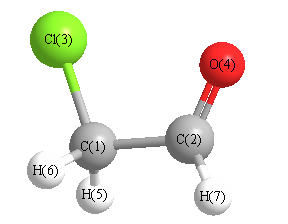 More geometry information
Calculated Bond Angles
| atom1 |
atom2 |
atom3 |
angle |
|
atom1 |
atom2 |
atom3 |
angle |
| C1 |
C2 |
O4 |
121.174 |
|
C1 |
C2 |
H7 |
116.491 |
| C2 |
C1 |
Cl3 |
111.677 |
|
C2 |
C1 |
H5 |
109.257 |
| C2 |
C1 |
H6 |
109.409 |
|
Cl3 |
C1 |
H5 |
108.454 |
| Cl3 |
C1 |
H6 |
109.203 |
|
O4 |
C2 |
H7 |
122.327 |
| H5 |
C1 |
H6 |
108.790 |
|
Electronic energy levels
Charges, Dipole, Quadrupole and Polarizability
Jump to
S1C1
Energy calculated at QCISD/6-31G*
| | hartrees |
|---|
| Energy at 0K | -612.401955 |
| Energy at 298.15K | -612.405421 |
| HF Energy | -611.806941 |
| Nuclear repulsion energy | 146.537491 |
The energy at 298.15K was derived from the energy at 0K
and an integrated heat capacity that used the calculated vibrational frequencies.
Vibrational Frequencies calculated at QCISD/6-31G*
| Mode Number |
Symmetry |
Frequency
(cm-1) |
Scaled Frequency
(cm-1) |
IR Intensities
(km mol-1) |
Raman Act
(Å4/u) |
Dep P |
Dep U |
|---|
| 1 |
A' |
3098 |
2950 |
16.22 |
|
|
|
| 2 |
A' |
2969 |
2827 |
90.09 |
|
|
|
| 3 |
A' |
1844 |
1756 |
101.09 |
|
|
|
| 4 |
A' |
1503 |
1431 |
17.75 |
|
|
|
| 5 |
A' |
1441 |
1372 |
13.88 |
|
|
|
| 6 |
A' |
1367 |
1302 |
18.75 |
|
|
|
| 7 |
A' |
984 |
937 |
5.26 |
|
|
|
| 8 |
A' |
796 |
758 |
7.30 |
|
|
|
| 9 |
A' |
650 |
619 |
40.61 |
|
|
|
| 10 |
A' |
223 |
212 |
2.87 |
|
|
|
| 11 |
A" |
3150 |
2999 |
2.46 |
|
|
|
| 12 |
A" |
1242 |
1183 |
2.35 |
|
|
|
| 13 |
A" |
1069 |
1018 |
1.18 |
|
|
|
| 14 |
A" |
726 |
691 |
1.57 |
|
|
|
| 15 |
A" |
153 |
145 |
1.19 |
|
|
|
Unscaled Zero Point Vibrational Energy (zpe) 10607.4 cm
-1
Scaled (by 0.9523) Zero Point Vibrational Energy (zpe) 10101.4 cm
-1
See section
III.C.1 List or set vibrational scaling factors
to change the scale factors used here.
See section
III.C.2
Calculate a vibrational scaling factor for a given set of molecules
to determine the least squares best scaling factor.
Geometric Data calculated at QCISD/6-31G*
Point Group is Cs
Cartesians (Å)
| Atom |
x (Å) |
y (Å) |
z (Å) |
|---|
| C1 |
0.000 |
0.928 |
0.000 |
| C2 |
1.366 |
0.266 |
0.000 |
| Cl3 |
-1.343 |
-0.228 |
0.000 |
| O4 |
1.576 |
-0.928 |
0.000 |
| H5 |
-0.081 |
1.570 |
0.885 |
| H6 |
-0.081 |
1.570 |
-0.885 |
| H7 |
2.199 |
1.001 |
0.000 |
Atom - Atom Distances (Å)
| |
C1 |
C2 |
Cl3 |
O4 |
H5 |
H6 |
H7 |
| C1 | | 1.5178 | 1.7720 | 2.4347 | 1.0966 | 1.0966 | 2.2006 |
C2 | 1.5178 | | 2.7539 | 1.2126 | 2.1392 | 2.1392 | 1.1112 | Cl3 | 1.7720 | 2.7539 | | 3.0019 | 2.3685 | 2.3685 | 3.7498 | O4 | 2.4347 | 1.2126 | 3.0019 | | 3.1254 | 3.1254 | 2.0276 | H5 | 1.0966 | 2.1392 | 2.3685 | 3.1254 | | 1.7706 | 2.5111 | H6 | 1.0966 | 2.1392 | 2.3685 | 3.1254 | 1.7706 | | 2.5111 | H7 | 2.2006 | 1.1112 | 3.7498 | 2.0276 | 2.5111 | 2.5111 | |
More geometry information
Calculated Bond Angles
| atom1 |
atom2 |
atom3 |
angle |
|
atom1 |
atom2 |
atom3 |
angle |
| C1 |
C2 |
O4 |
125.814 |
|
C1 |
C2 |
H7 |
112.742 |
| C2 |
C1 |
Cl3 |
113.444 |
|
C2 |
C1 |
H5 |
108.753 |
| C2 |
C1 |
H6 |
108.753 |
|
Cl3 |
C1 |
H5 |
109.029 |
| Cl3 |
C1 |
H6 |
109.029 |
|
O4 |
C2 |
H7 |
121.444 |
| H5 |
C1 |
H6 |
107.677 |
|
Electronic energy levels
Charges, Dipole, Quadrupole and Polarizability
