Jump to
S1C2
S2C1
S2C2
Energy calculated at QCISD/6-31G*
| | hartrees |
|---|
| Energy at 0K | -1816.793512 |
| Energy at 298.15K | -1816.794920 |
| Nuclear repulsion energy | 67.110309 |
The energy at 298.15K was derived from the energy at 0K
and an integrated heat capacity that used the calculated vibrational frequencies.
Vibrational Frequencies calculated at QCISD/6-31G*
| Mode Number |
Symmetry |
Frequency
(cm-1) |
Scaled Frequency
(cm-1) |
IR Intensities
(km mol-1) |
Raman Act
(Å4/u) |
Dep P |
Dep U |
|---|
| 1 |
A1 |
3127 |
2978 |
29.51 |
|
|
|
| 2 |
A1 |
1407 |
1340 |
20.18 |
|
|
|
| 3 |
A1 |
562 |
535 |
19.02 |
|
|
|
| 4 |
B1 |
668 |
636 |
80.66 |
|
|
|
| 5 |
B2 |
3222 |
3069 |
13.31 |
|
|
|
| 6 |
B2 |
583 |
555 |
2.08 |
|
|
|
Unscaled Zero Point Vibrational Energy (zpe) 4784.5 cm
-1
Scaled (by 0.9523) Zero Point Vibrational Energy (zpe) 4556.3 cm
-1
See section
III.C.1 List or set vibrational scaling factors
to change the scale factors used here.
See section
III.C.2
Calculate a vibrational scaling factor for a given set of molecules
to determine the least squares best scaling factor.
Geometric Data calculated at QCISD/6-31G*
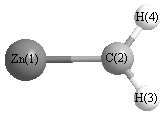
Point Group is C2v
Cartesians (Å)
| Atom |
x (Å) |
y (Å) |
z (Å) |
|---|
| Zn1 |
0.000 |
0.000 |
0.439 |
| C2 |
0.000 |
0.000 |
-1.496 |
| H3 |
0.000 |
0.911 |
-2.099 |
| H4 |
0.000 |
-0.911 |
-2.099 |
Atom - Atom Distances (Å)
| |
Zn1 |
C2 |
H3 |
H4 |
| Zn1 | | 1.9348 | 2.6962 | 2.6962 |
C2 | 1.9348 | | 1.0925 | 1.0925 | H3 | 2.6962 | 1.0925 | | 1.8223 | H4 | 2.6962 | 1.0925 | 1.8223 | |
 More geometry information
Calculated Bond Angles
| atom1 |
atom2 |
atom3 |
angle |
|
atom1 |
atom2 |
atom3 |
angle |
| Zn1 |
C2 |
H3 |
123.491 |
|
Zn1 |
C2 |
H4 |
123.491 |
| H3 |
C2 |
H4 |
113.018 |
|
Electronic energy levels
Charges, Dipole, Quadrupole and Polarizability
Jump to
S1C1
S2C1
S2C2
Energy calculated at QCISD/6-31G*
| | hartrees |
|---|
| Energy at 0K | -1816.793512 |
| Energy at 298.15K | -1816.794920 |
| Nuclear repulsion energy | 67.110309 |
The energy at 298.15K was derived from the energy at 0K
and an integrated heat capacity that used the calculated vibrational frequencies.
Vibrational Frequencies calculated at QCISD/6-31G*
Geometric Data calculated at QCISD/6-31G*
Point Group is C2v
Electronic energy levels
Charges, Dipole, Quadrupole and Polarizability
Jump to
S1C1
S1C2
S2C2
Energy calculated at QCISD/6-31G*
| | hartrees |
|---|
| Energy at 0K | -1816.747463 |
| Energy at 298.15K | -1816.749146 |
| Nuclear repulsion energy | 71.428403 |
The energy at 298.15K was derived from the energy at 0K
and an integrated heat capacity that used the calculated vibrational frequencies.
Vibrational Frequencies calculated at QCISD/6-31G*
| Mode Number |
Symmetry |
Frequency
(cm-1) |
Scaled Frequency
(cm-1) |
IR Intensities
(km mol-1) |
Raman Act
(Å4/u) |
Dep P |
Dep U |
|---|
| 1 |
A1 |
3203 |
3050 |
0.73 |
|
|
|
| 2 |
A1 |
1245 |
1186 |
127.35 |
|
|
|
| 4 |
B1 |
684 |
651 |
82.12 |
|
|
|
| 5 |
B2 |
3363 |
3203 |
5.16 |
|
|
|
| 6 |
B2 |
690 |
657 |
0.00 |
|
|
|
Unscaled Zero Point Vibrational Energy (zpe) 4592.2 cm
-1
Scaled (by 0.9523) Zero Point Vibrational Energy (zpe) 4373.2 cm
-1
See section
III.C.1 List or set vibrational scaling factors
to change the scale factors used here.
See section
III.C.2
Calculate a vibrational scaling factor for a given set of molecules
to determine the least squares best scaling factor.
Geometric Data calculated at QCISD/6-31G*
Point Group is C2v
Cartesians (Å)
| Atom |
x (Å) |
y (Å) |
z (Å) |
|---|
| Zn1 |
0.000 |
0.000 |
0.407 |
| C2 |
0.000 |
0.000 |
-1.404 |
| H3 |
0.000 |
0.964 |
-1.897 |
| H4 |
0.000 |
-0.964 |
-1.897 |
Atom - Atom Distances (Å)
| |
Zn1 |
C2 |
H3 |
H4 |
| Zn1 | | 1.8117 | 2.4975 | 2.4975 |
C2 | 1.8117 | | 1.0827 | 1.0827 | H3 | 2.4975 | 1.0827 | | 1.9287 | H4 | 2.4975 | 1.0827 | 1.9287 | |
More geometry information
Electronic energy levels
Charges, Dipole, Quadrupole and Polarizability
Jump to
S1C1
S1C2
S2C1
Energy calculated at QCISD/6-31G*
| | hartrees |
|---|
| Energy at 0K | -1816.776430 |
| Energy at 298.15K | -1816.777897 |
| Nuclear repulsion energy | 68.228413 |
The energy at 298.15K was derived from the energy at 0K
and an integrated heat capacity that used the calculated vibrational frequencies.
Vibrational Frequencies calculated at QCISD/6-31G*
| Mode Number |
Symmetry |
Frequency
(cm-1) |
Scaled Frequency
(cm-1) |
IR Intensities
(km mol-1) |
Raman Act
(Å4/u) |
Dep P |
Dep U |
|---|
| 1 |
A' |
2995 |
2852 |
24.26 |
|
|
|
| 2 |
A' |
1422 |
1354 |
7.02 |
|
|
|
| 3 |
A' |
759 |
723 |
313.60 |
|
|
|
| 4 |
A' |
519 |
495 |
25.74 |
|
|
|
| 5 |
A" |
3069 |
2923 |
25.90 |
|
|
|
| 6 |
A" |
671 |
639 |
37.05 |
|
|
|
Unscaled Zero Point Vibrational Energy (zpe) 4717.1 cm
-1
Scaled (by 0.9523) Zero Point Vibrational Energy (zpe) 4492.1 cm
-1
See section
III.C.1 List or set vibrational scaling factors
to change the scale factors used here.
See section
III.C.2
Calculate a vibrational scaling factor for a given set of molecules
to determine the least squares best scaling factor.
Geometric Data calculated at QCISD/6-31G*
Point Group is Cs
Cartesians (Å)
| Atom |
x (Å) |
y (Å) |
z (Å) |
|---|
| Zn1 |
-0.030 |
-0.424 |
0.000 |
| C2 |
-0.030 |
1.499 |
0.000 |
| H3 |
0.534 |
1.856 |
0.884 |
| H4 |
0.534 |
1.856 |
-0.884 |
Atom - Atom Distances (Å)
| |
Zn1 |
C2 |
H3 |
H4 |
| Zn1 | | 1.9229 | 2.5087 | 2.5087 |
C2 | 1.9229 | | 1.1068 | 1.1068 | H3 | 2.5087 | 1.1068 | | 1.7672 | H4 | 2.5087 | 1.1068 | 1.7672 | |
More geometry information
Electronic energy levels
Charges, Dipole, Quadrupole and Polarizability
