Jump to
S2C1
Energy calculated at PBE1PBE/6-31G*
| | hartrees |
|---|
| Energy at 0K | -151.085212 |
| Energy at 298.15K | -151.083510 |
| HF Energy | -151.085212 |
| Nuclear repulsion energy | 45.734481 |
The energy at 298.15K was derived from the energy at 0K
and an integrated heat capacity that used the calculated vibrational frequencies.
Geometric Data calculated at PBE1PBE/6-31G*
Point Group is C∞v
Cartesians (Å)
| Atom |
x (Å) |
y (Å) |
z (Å) |
|---|
| C1 |
0.000 |
0.000 |
-1.423 |
| C2 |
0.000 |
0.000 |
-0.057 |
| O3 |
0.000 |
0.000 |
1.110 |
Atom - Atom Distances (Å)
| |
C1 |
C2 |
O3 |
| C1 | | 1.3660 | 2.5332 |
C2 | 1.3660 | | 1.1672 | O3 | 2.5332 | 1.1672 | |
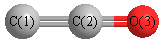 More geometry information
Calculated Bond Angles
| atom1 |
atom2 |
atom3 |
angle |
|
atom1 |
atom2 |
atom3 |
angle |
| C1 |
C2 |
O3 |
180.000 |
|
Electronic energy levels
Charges, Dipole, Quadrupole and Polarizability
Charges from optimized geometry at PBE1PBE/6-31G*
Charges (e)
| Number |
Element |
Mulliken |
CHELPG |
AIM |
ESP |
| 1 |
C |
-0.065 |
|
|
|
| 2 |
C |
0.351 |
|
|
|
| 3 |
O |
-0.286 |
|
|
|
Electric dipole moments
Electric dipole components in Debye
(What's a Debye? See section
VII.A.3)
| |
x |
y |
z |
Total |
| |
0.000 |
0.000 |
1.257 |
1.257 |
| CHELPG |
|
|
|
|
| AIM |
|
|
|
|
| ESP |
|
|
|
|
Electric Quadrupole moment
Quadrupole components in D Å
| Primitive |
|---|
| | x | y | z |
|---|
| x |
-15.416 |
0.000 |
0.000 |
| y |
0.000 |
-15.416 |
0.000 |
| z |
0.000 |
0.000 |
-21.813 |
|
| Traceless |
|---|
| | x | y | z |
|---|
| x |
3.198 |
0.000 |
0.000 |
| y |
0.000 |
3.198 |
0.000 |
| z |
0.000 |
0.000 |
-6.396 |
|
| Polar |
|---|
| 3z2-r2 | -12.793 |
|---|
| x2-y2 | 0.000 |
|---|
| xy | 0.000 |
|---|
| xz | 0.000 |
|---|
| yz | 0.000 |
|---|
|
Polarizabilities
Components of the polarizability tensor.
Units are
Å
3 (Angstrom cubed)
Change units.
| |
x |
y |
z |
| x |
2.020 |
0.000 |
0.000 |
| y |
0.000 |
2.020 |
0.000 |
| z |
0.000 |
0.000 |
5.061 |
<r2> (average value of r
2) Å
2
| <r2> |
32.990 |
| (<r2>)1/2 |
5.744 |
Jump to
S1C1
Energy calculated at PBE1PBE/6-31G*
| | hartrees |
|---|
| Energy at 0K | -151.039375 |
| Energy at 298.15K | -151.037733 |
| HF Energy | -151.039375 |
| Nuclear repulsion energy | 45.622941 |
The energy at 298.15K was derived from the energy at 0K
and an integrated heat capacity that used the calculated vibrational frequencies.
Geometric Data calculated at PBE1PBE/6-31G*
Point Group is C∞v
Cartesians (Å)
| Atom |
x (Å) |
y (Å) |
z (Å) |
|---|
| C1 |
0.000 |
0.000 |
-1.424 |
| C2 |
0.000 |
0.000 |
-0.060 |
| O3 |
0.000 |
0.000 |
1.113 |
Atom - Atom Distances (Å)
| |
C1 |
C2 |
O3 |
| C1 | | 1.3641 | 2.5375 |
C2 | 1.3641 | | 1.1734 | O3 | 2.5375 | 1.1734 | |
More geometry information
Calculated Bond Angles
| atom1 |
atom2 |
atom3 |
angle |
|
atom1 |
atom2 |
atom3 |
angle |
| C1 |
C2 |
O3 |
180.000 |
|
Electronic energy levels
Charges, Dipole, Quadrupole and Polarizability
Charges from optimized geometry at PBE1PBE/6-31G*
Charges (e)
| Number |
Element |
Mulliken |
CHELPG |
AIM |
ESP |
| 1 |
C |
-0.041 |
|
|
|
| 2 |
C |
0.336 |
|
|
|
| 3 |
O |
-0.295 |
|
|
|
Electric dipole moments
Electric dipole components in Debye
(What's a Debye? See section
VII.A.3)
| |
x |
y |
z |
Total |
| |
0.000 |
0.000 |
0.991 |
0.991 |
| CHELPG |
|
|
|
|
| AIM |
|
|
|
|
| ESP |
|
|
|
|
Electric Quadrupole moment
Quadrupole components in D Å
| Primitive |
|---|
| | x | y | z |
|---|
| x |
-17.119 |
0.000 |
0.000 |
| y |
0.000 |
-13.828 |
0.000 |
| z |
0.000 |
0.000 |
-21.514 |
|
| Traceless |
|---|
| | x | y | z |
|---|
| x |
0.552 |
0.000 |
0.000 |
| y |
0.000 |
5.489 |
0.000 |
| z |
0.000 |
0.000 |
-6.041 |
|
| Polar |
|---|
| 3z2-r2 | -12.082 |
|---|
| x2-y2 | -3.291 |
|---|
| xy | 0.000 |
|---|
| xz | 0.000 |
|---|
| yz | 0.000 |
|---|
|
Polarizabilities
Components of the polarizability tensor.
Units are
Å
3 (Angstrom cubed)
Change units.
| |
x |
y |
z |
| x |
1.628 |
0.000 |
0.000 |
| y |
0.000 |
1.963 |
0.000 |
| z |
0.000 |
0.000 |
4.928 |
<r2> (average value of r
2) Å
2
| <r2> |
33.029 |
| (<r2>)1/2 |
5.747 |
