Jump to
S2C1
Energy calculated at PBEPBEultrafine/6-31G*
| | hartrees |
|---|
| Energy at 0K | -151.089582 |
| Energy at 298.15K | -151.087690 |
| HF Energy | -151.089582 |
| Nuclear repulsion energy | 45.154905 |
The energy at 298.15K was derived from the energy at 0K
and an integrated heat capacity that used the calculated vibrational frequencies.
Vibrational Frequencies calculated at PBEPBEultrafine/6-31G*
| Mode Number |
Symmetry |
Frequency
(cm-1) |
Scaled Frequency
(cm-1) |
IR Intensities
(km mol-1) |
Raman Act
(Å4/u) |
Dep P |
Dep U |
|---|
| 1 |
Σ |
1973 |
1940 |
82.46 |
|
|
|
| 2 |
Σ |
1062 |
1045 |
21.68 |
|
|
|
| 3 |
Π |
270 |
265 |
38.25 |
|
|
|
| 3 |
Π |
270 |
265 |
38.25 |
|
|
|
Unscaled Zero Point Vibrational Energy (zpe) 1786.9 cm
-1
Scaled (by 0.9835) Zero Point Vibrational Energy (zpe) 1757.4 cm
-1
See section
III.C.1 List or set vibrational scaling factors
to change the scale factors used here.
See section
III.C.2
Calculate a vibrational scaling factor for a given set of molecules
to determine the least squares best scaling factor.
Geometric Data calculated at PBEPBEultrafine/6-31G*
Point Group is C∞v
Cartesians (Å)
| Atom |
x (Å) |
y (Å) |
z (Å) |
|---|
| C1 |
0.000 |
0.000 |
-1.440 |
| C2 |
0.000 |
0.000 |
-0.060 |
| O3 |
0.000 |
0.000 |
1.125 |
Atom - Atom Distances (Å)
| |
C1 |
C2 |
O3 |
| C1 | | 1.3800 | 2.5644 |
C2 | 1.3800 | | 1.1844 | O3 | 2.5644 | 1.1844 | |
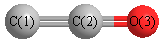 More geometry information
Calculated Bond Angles
| atom1 |
atom2 |
atom3 |
angle |
|
atom1 |
atom2 |
atom3 |
angle |
| C1 |
C2 |
O3 |
180.000 |
|
Electronic energy levels
Charges, Dipole, Quadrupole and Polarizability
Charges from optimized geometry at PBEPBEultrafine/6-31G*
Charges (e)
| Number |
Element |
Mulliken |
CHELPG |
AIM |
ESP |
| 1 |
C |
-0.066 |
|
|
|
| 2 |
C |
0.328 |
|
|
|
| 3 |
O |
-0.262 |
|
|
|
Electric dipole moments
Electric dipole components in Debye
(What's a Debye? See section
VII.A.3)
| |
x |
y |
z |
Total |
| |
0.000 |
0.000 |
1.261 |
1.261 |
| CHELPG |
|
|
|
|
| AIM |
|
|
|
|
| ESP |
|
|
|
|
Electric Quadrupole moment
Quadrupole components in D Å
| Primitive |
|---|
| | x | y | z |
|---|
| x |
-15.430 |
0.000 |
0.000 |
| y |
0.000 |
-15.430 |
0.000 |
| z |
0.000 |
0.000 |
-21.477 |
|
| Traceless |
|---|
| | x | y | z |
|---|
| x |
3.023 |
0.000 |
0.000 |
| y |
0.000 |
3.023 |
0.000 |
| z |
0.000 |
0.000 |
-6.047 |
|
| Polar |
|---|
| 3z2-r2 | -12.094 |
|---|
| x2-y2 | 0.000 |
|---|
| xy | 0.000 |
|---|
| xz | 0.000 |
|---|
| yz | 0.000 |
|---|
|
Polarizabilities
Components of the polarizability tensor.
Units are
Å
3 (Angstrom cubed)
Change units.
| |
x |
y |
z |
| x |
2.005 |
0.000 |
0.000 |
| y |
0.000 |
2.005 |
0.000 |
| z |
0.000 |
0.000 |
5.137 |
<r2> (average value of r
2) Å
2
| <r2> |
33.474 |
| (<r2>)1/2 |
5.786 |
Jump to
S1C1
Energy calculated at PBEPBEultrafine/6-31G*
| | hartrees |
|---|
| Energy at 0K | -151.046704 |
| Energy at 298.15K | -151.044849 |
| HF Energy | -151.046704 |
| Nuclear repulsion energy | 45.034924 |
The energy at 298.15K was derived from the energy at 0K
and an integrated heat capacity that used the calculated vibrational frequencies.
Vibrational Frequencies calculated at PBEPBEultrafine/6-31G*
| Mode Number |
Symmetry |
Frequency
(cm-1) |
Scaled Frequency
(cm-1) |
IR Intensities
(km mol-1) |
Raman Act
(Å4/u) |
Dep P |
Dep U |
|---|
| 1 |
Σ |
1969 |
1937 |
40.28 |
|
|
|
| 2 |
Σ |
1079 |
1061 |
36.90 |
|
|
|
| 3 |
Π |
431 |
424 |
3.32 |
|
|
|
| 3 |
Π |
170 |
167 |
54.91 |
|
|
|
Unscaled Zero Point Vibrational Energy (zpe) 1824.7 cm
-1
Scaled (by 0.9835) Zero Point Vibrational Energy (zpe) 1794.6 cm
-1
See section
III.C.1 List or set vibrational scaling factors
to change the scale factors used here.
See section
III.C.2
Calculate a vibrational scaling factor for a given set of molecules
to determine the least squares best scaling factor.
Geometric Data calculated at PBEPBEultrafine/6-31G*
Point Group is C∞v
Cartesians (Å)
| Atom |
x (Å) |
y (Å) |
z (Å) |
|---|
| C1 |
0.000 |
0.000 |
-1.441 |
| C2 |
0.000 |
0.000 |
-0.064 |
| O3 |
0.000 |
0.000 |
1.128 |
Atom - Atom Distances (Å)
| |
C1 |
C2 |
O3 |
| C1 | | 1.3771 | 2.5688 |
C2 | 1.3771 | | 1.1918 | O3 | 2.5688 | 1.1918 | |
More geometry information
Calculated Bond Angles
| atom1 |
atom2 |
atom3 |
angle |
|
atom1 |
atom2 |
atom3 |
angle |
| C1 |
C2 |
O3 |
180.000 |
|
Electronic energy levels
Charges, Dipole, Quadrupole and Polarizability
Charges from optimized geometry at PBEPBEultrafine/6-31G*
Charges (e)
| Number |
Element |
Mulliken |
CHELPG |
AIM |
ESP |
| 1 |
C |
-0.049 |
|
|
|
| 2 |
C |
0.317 |
|
|
|
| 3 |
O |
-0.267 |
|
|
|
Electric dipole moments
Electric dipole components in Debye
(What's a Debye? See section
VII.A.3)
| |
x |
y |
z |
Total |
| |
0.000 |
0.000 |
1.061 |
1.061 |
| CHELPG |
|
|
|
|
| AIM |
|
|
|
|
| ESP |
|
|
|
|
Electric Quadrupole moment
Quadrupole components in D Å
| Primitive |
|---|
| | x | y | z |
|---|
| x |
-17.105 |
0.000 |
0.000 |
| y |
0.000 |
-13.867 |
0.000 |
| z |
0.000 |
0.000 |
-21.202 |
|
| Traceless |
|---|
| | x | y | z |
|---|
| x |
0.429 |
0.000 |
0.000 |
| y |
0.000 |
5.286 |
0.000 |
| z |
0.000 |
0.000 |
-5.716 |
|
| Polar |
|---|
| 3z2-r2 | -11.431 |
|---|
| x2-y2 | -3.238 |
|---|
| xy | 0.000 |
|---|
| xz | 0.000 |
|---|
| yz | 0.000 |
|---|
|
Polarizabilities
Components of the polarizability tensor.
Units are
Å
3 (Angstrom cubed)
Change units.
| |
x |
y |
z |
| x |
2.005 |
0.000 |
0.000 |
| y |
0.000 |
2.005 |
0.000 |
| z |
0.000 |
0.000 |
5.137 |
<r2> (average value of r
2) Å
2
| <r2> |
33.522 |
| (<r2>)1/2 |
5.790 |
