Jump to
S2C1
Energy calculated at B2PLYP=FULLultrafine/6-31G*
| | hartrees |
|---|
| Energy at 0K | -151.934912 |
| Energy at 298.15K | |
| HF Energy | -151.784238 |
| Nuclear repulsion energy | 63.144632 |
The energy at 298.15K was derived from the energy at 0K
and an integrated heat capacity that used the calculated vibrational frequencies.
Vibrational Frequencies calculated at B2PLYP=FULLultrafine/6-31G*
| Mode Number |
Symmetry |
Frequency
(cm-1) |
Scaled Frequency
(cm-1) |
IR Intensities
(km mol-1) |
Raman Act
(Å4/u) |
Dep P |
Dep U |
|---|
| 1 |
Σg |
2137 |
2027 |
0.00 |
44.57 |
0.55 |
0.71 |
| 2 |
Σg |
942 |
894 |
0.00 |
65.01 |
0.39 |
0.56 |
| 3 |
Σu |
1594 |
1512 |
284.95 |
0.00 |
0.33 |
0.50 |
| 4 |
Πg |
389 |
369 |
0.00 |
1.78 |
0.75 |
0.86 |
| 4 |
Πg |
389 |
369 |
0.00 |
1.78 |
0.75 |
0.86 |
| 5 |
Πu |
183 |
173 |
23.13 |
0.00 |
0.75 |
0.86 |
| 5 |
Πu |
183 |
173 |
23.13 |
0.00 |
0.00 |
0.00 |
Unscaled Zero Point Vibrational Energy (zpe) 2908.3 cm
-1
Scaled (by 0.9487) Zero Point Vibrational Energy (zpe) 2759.1 cm
-1
See section
III.C.1 List or set vibrational scaling factors
to change the scale factors used here.
See section
III.C.2
Calculate a vibrational scaling factor for a given set of molecules
to determine the least squares best scaling factor.
Geometric Data calculated at B2PLYP=FULLultrafine/6-31G*
Point Group is D∞h
Cartesians (Å)
| Atom |
x (Å) |
y (Å) |
z (Å) |
|---|
| C1 |
0.000 |
0.000 |
0.648 |
| C2 |
0.000 |
0.000 |
-0.648 |
| C3 |
0.000 |
0.000 |
1.962 |
| C4 |
0.000 |
0.000 |
-1.962 |
Atom - Atom Distances (Å)
| |
C1 |
C2 |
C3 |
C4 |
| C1 | | 1.2953 | 1.3145 | 2.6098 |
C2 | 1.2953 | | 2.6098 | 1.3145 | C3 | 1.3145 | 2.6098 | | 3.9244 | C4 | 2.6098 | 1.3145 | 3.9244 | |
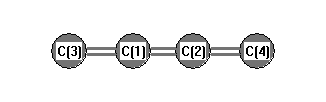 More geometry information
Calculated Bond Angles
| atom1 |
atom2 |
atom3 |
angle |
|
atom1 |
atom2 |
atom3 |
angle |
| C1 |
C2 |
C4 |
180.000 |
|
C2 |
C1 |
C3 |
180.000 |
Electronic energy levels
Charges, Dipole, Quadrupole and Polarizability
Charges from optimized geometry at B2PLYP=FULLultrafine/6-31G*
Charges (e)
| Number |
Element |
Mulliken |
CHELPG |
AIM |
ESP |
| 1 |
C |
0.076 |
|
|
|
| 2 |
C |
0.076 |
|
|
|
| 3 |
C |
-0.076 |
|
|
|
| 4 |
C |
-0.076 |
|
|
|
Electric dipole moments
Electric dipole components in Debye
(What's a Debye? See section
VII.A.3)
| |
x |
y |
z |
Total |
| |
0.000 |
0.000 |
0.000 |
0.000 |
| CHELPG |
|
|
|
|
| AIM |
|
|
|
|
| ESP |
|
|
|
|
Electric Quadrupole moment
Quadrupole components in D Å
| Primitive |
|---|
| | x | y | z |
|---|
| x |
-21.314 |
0.000 |
0.000 |
| y |
0.000 |
-21.314 |
0.000 |
| z |
0.000 |
0.000 |
-32.451 |
|
| Traceless |
|---|
| | x | y | z |
|---|
| x |
5.569 |
0.000 |
0.000 |
| y |
0.000 |
5.569 |
0.000 |
| z |
0.000 |
0.000 |
-11.137 |
|
| Polar |
|---|
| 3z2-r2 | -22.275 |
|---|
| x2-y2 | 0.000 |
|---|
| xy | 0.000 |
|---|
| xz | 0.000 |
|---|
| yz | 0.000 |
|---|
|
Polarizabilities
Components of the polarizability tensor.
Units are
Å
3 (Angstrom cubed)
Change units.
| |
x |
y |
z |
| x |
2.894 |
0.000 |
0.000 |
| y |
0.000 |
2.894 |
0.000 |
| z |
0.000 |
0.000 |
12.192 |
<r2> (average value of r
2) Å
2
| <r2> |
66.867 |
| (<r2>)1/2 |
8.177 |
Jump to
S1C1
Energy calculated at B2PLYP=FULLultrafine/6-31G*
| | hartrees |
|---|
| Energy at 0K | -151.911277 |
| Energy at 298.15K | |
| HF Energy | -151.749196 |
| Nuclear repulsion energy | 62.958264 |
The energy at 298.15K was derived from the energy at 0K
and an integrated heat capacity that used the calculated vibrational frequencies.
Vibrational Frequencies calculated at B2PLYP=FULLultrafine/6-31G*
| Mode Number |
Symmetry |
Frequency
(cm-1) |
Scaled Frequency
(cm-1) |
IR Intensities
(km mol-1) |
Raman Act
(Å4/u) |
Dep P |
Dep U |
|---|
| 1 |
Σg |
2117 |
2008 |
0.00 |
44.95 |
0.40 |
0.57 |
| 2 |
Σg |
931 |
883 |
0.00 |
63.37 |
0.33 |
0.49 |
| 3 |
Σu |
1600 |
1518 |
332.44 |
0.00 |
0.33 |
0.50 |
| 4 |
Πg |
460 |
436 |
0.00 |
7.39 |
0.75 |
0.86 |
| 4 |
Πg |
347 |
329 |
0.00 |
4.79 |
0.75 |
0.86 |
| 5 |
Πu |
209 |
198 |
8.33 |
0.00 |
0.00 |
0.00 |
| 5 |
Πu |
169 |
160 |
34.63 |
0.00 |
0.75 |
0.86 |
Unscaled Zero Point Vibrational Energy (zpe) 2916.0 cm
-1
Scaled (by 0.9487) Zero Point Vibrational Energy (zpe) 2766.4 cm
-1
See section
III.C.1 List or set vibrational scaling factors
to change the scale factors used here.
See section
III.C.2
Calculate a vibrational scaling factor for a given set of molecules
to determine the least squares best scaling factor.
Geometric Data calculated at B2PLYP=FULLultrafine/6-31G*
Point Group is D∞h
Cartesians (Å)
| Atom |
x (Å) |
y (Å) |
z (Å) |
|---|
| C1 |
0.000 |
0.000 |
0.651 |
| C2 |
0.000 |
0.000 |
-0.651 |
| C3 |
0.000 |
0.000 |
1.968 |
| C4 |
0.000 |
0.000 |
-1.968 |
Atom - Atom Distances (Å)
| |
C1 |
C2 |
C3 |
C4 |
| C1 | | 1.3012 | 1.3172 | 2.6184 |
C2 | 1.3012 | | 2.6184 | 1.3172 | C3 | 1.3172 | 2.6184 | | 3.9356 | C4 | 2.6184 | 1.3172 | 3.9356 | |
More geometry information
Electronic energy levels
Charges, Dipole, Quadrupole and Polarizability
