return to home page Computational Chemistry Comparison and Benchmark DataBase Release 22 (May 2022) Standard Reference Database 101 National Institute of Standards and Technology
You are here: Calculated > Energy > Optimized > Energy

All results from a given calculation for Na2O (disodium monoxide)

using model chemistry: CID/6-31G*

19 10 17 12 22

States and conformations

State Conformation minimum conformation conformer description state description
1 1 no D*H 1Σg
1 2 yes C2V 1A1

Conformer 1 (D*H)

Jump to S1C2
Energy calculated at CID/6-31G*
 hartrees
Energy at 0K-398.696370
Energy at 298.15K 
HF Energy-398.485555
Nuclear repulsion energy63.353613
The energy at 298.15K was derived from the energy at 0K and an integrated heat capacity that used the calculated vibrational frequencies.
Vibrational Frequencies calculated at CID/6-31G*
Mode Number Symmetry Frequency
(cm-1)
Scaled Frequency
(cm-1)
IR Intensities
(km mol-1)
Raman Act
(Å4/u)
Dep P Dep U
1 Σg 384 354 0.00      
2 Σu 721 666 164.70      
3 Πu 40i 37i 112.88      
3 Πu 40i 37i 112.88      

Unscaled Zero Point Vibrational Energy (zpe) 512.7 cm-1
Scaled (by 0.9237) Zero Point Vibrational Energy (zpe) 473.6 cm-1
See section III.C.1 List or set vibrational scaling factors to change the scale factors used here.
See section III.C.2 Calculate a vibrational scaling factor for a given set of molecules to determine the least squares best scaling factor.
Rotational Constants (cm-1) from geometry optimized at CID/6-31G*
B
0.09395

See section I.F.4 to change rotational constant units
Geometric Data calculated at CID/6-31G*

Point Group is D∞h

Cartesians (Å)
Atom x (Å) y (Å) z (Å)
O1 0.000 0.000 0.000
Na2 0.000 0.000 1.975
Na3 0.000 0.000 -1.975

Atom - Atom Distances (Å)
  O1 Na2 Na3
O11.97541.9754
Na21.97543.9509
Na31.97543.9509

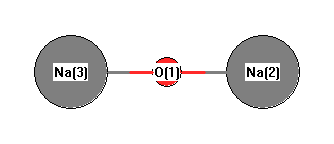
picture of disodium monoxide state 1 conformation 1
More geometry information
Calculated Bond Angles
atom1 atom2 atom3 angle atom1 atom2 atom3 angle
Na2 O1 Na3 180.000
Electronic energy levels
Charges, Dipole, Quadrupole and Polarizability

Conformer 2 (C2V)

Jump to S1C1
Energy calculated at CID/6-31G*
 hartrees
Energy at 0K-398.696465
Energy at 298.15K-398.697927
HF Energy-398.485157
Nuclear repulsion energy63.558802
The energy at 298.15K was derived from the energy at 0K and an integrated heat capacity that used the calculated vibrational frequencies.
Vibrational Frequencies calculated at CID/6-31G*
Mode Number Symmetry Frequency
(cm-1)
Scaled Frequency
(cm-1)
IR Intensities
(km mol-1)
Raman Act
(Å4/u)
Dep P Dep U
1 A1 397 367 6.62      
2 A1 53 49 93.40      
3 B2 709 655 158.46      

Unscaled Zero Point Vibrational Energy (zpe) 579.3 cm-1
Scaled (by 0.9237) Zero Point Vibrational Energy (zpe) 535.1 cm-1
See section III.C.1 List or set vibrational scaling factors to change the scale factors used here.
See section III.C.2 Calculate a vibrational scaling factor for a given set of molecules to determine the least squares best scaling factor.
Rotational Constants (cm-1) from geometry optimized at CID/6-31G*
ABC
9.40125 0.09737 0.09637

See section I.F.4 to change rotational constant units
Geometric Data calculated at CID/6-31G*

Point Group is C2v

Cartesians (Å)
Atom x (Å) y (Å) z (Å)
O1 0.000 0.000 0.285
Na2 0.000 1.941 -0.104
Na3 0.000 -1.941 -0.104

Atom - Atom Distances (Å)
  O1 Na2 Na3
O11.97911.9791
Na21.97913.8810
Na31.97913.8810

picture of disodium monoxide state 1 conformation 2
More geometry information
Calculated Bond Angles
atom1 atom2 atom3 angle atom1 atom2 atom3 angle
Na2 O1 Na3 157.345
Electronic energy levels
Charges, Dipole, Quadrupole and Polarizability