Jump to
S1C2
S1C3
Energy calculated at MP2/6-31G*
| | hartrees |
|---|
| Energy at 0K | -166.034863 |
| Energy at 298.15K | |
| HF Energy | -165.633709 |
| Nuclear repulsion energy | 48.615954 |
The energy at 298.15K was derived from the energy at 0K
and an integrated heat capacity that used the calculated vibrational frequencies.
Vibrational Frequencies calculated at MP2/6-31G*
| Mode Number |
Symmetry |
Frequency
(cm-1) |
Scaled Frequency
(cm-1) |
IR Intensities
(km mol-1) |
Raman Act
(Å4/u) |
Dep P |
Dep U |
|---|
| 1 |
A1 |
3937 |
3712 |
57.36 |
|
|
|
| 2 |
A1 |
741 |
698 |
10.49 |
|
|
|
| 3 |
A1 |
584 |
550 |
185.03 |
|
|
|
| 4 |
A1 |
278 |
263 |
4.77 |
|
|
|
| 5 |
A2 |
244i |
230i |
0.00 |
|
|
|
| 6 |
B1 |
340 |
321 |
69.55 |
|
|
|
| 7 |
B2 |
3934 |
3710 |
164.78 |
|
|
|
| 8 |
B2 |
1544 |
1456 |
340.32 |
|
|
|
| 9 |
B2 |
442 |
416 |
357.10 |
|
|
|
Unscaled Zero Point Vibrational Energy (zpe) 5777.3 cm
-1
Scaled (by 0.943) Zero Point Vibrational Energy (zpe) 5448.0 cm
-1
See section
III.C.1 List or set vibrational scaling factors
to change the scale factors used here.
See section
III.C.2
Calculate a vibrational scaling factor for a given set of molecules
to determine the least squares best scaling factor.
Geometric Data calculated at MP2/6-31G*
Point Group is C2v
Cartesians (Å)
| Atom |
x (Å) |
y (Å) |
z (Å) |
|---|
| Be1 |
0.000 |
0.000 |
0.015 |
| O2 |
0.000 |
1.436 |
0.079 |
| O3 |
0.000 |
-1.436 |
0.079 |
| H4 |
0.000 |
2.046 |
-0.665 |
| H5 |
0.000 |
-2.046 |
-0.665 |
Atom - Atom Distances (Å)
| |
Be1 |
O2 |
O3 |
H4 |
H5 |
| Be1 | | 1.4378 | 1.4378 | 2.1556 | 2.1556 |
O2 | 1.4378 | | 2.8727 | 0.9621 | 3.5607 | O3 | 1.4378 | 2.8727 | | 3.5607 | 0.9621 | H4 | 2.1556 | 0.9621 | 3.5607 | | 4.0913 | H5 | 2.1556 | 3.5607 | 0.9621 | 4.0913 | |
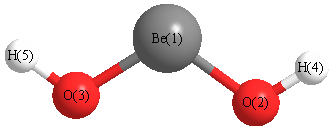 More geometry information
Calculated Bond Angles
| atom1 |
atom2 |
atom3 |
angle |
|
atom1 |
atom2 |
atom3 |
angle |
| Be1 |
O2 |
H4 |
126.708 |
|
Be1 |
O3 |
H5 |
126.708 |
| O2 |
Be1 |
O3 |
174.828 |
|
Electronic energy levels
Charges, Dipole, Quadrupole and Polarizability
Jump to
S1C1
S1C3
Energy calculated at MP2/6-31G*
| | hartrees |
|---|
| Energy at 0K | -166.036030 |
| Energy at 298.15K | -166.037512 |
| HF Energy | -165.634480 |
| Nuclear repulsion energy | 48.585078 |
The energy at 298.15K was derived from the energy at 0K
and an integrated heat capacity that used the calculated vibrational frequencies.
Vibrational Frequencies calculated at MP2/6-31G*
| Mode Number |
Symmetry |
Frequency
(cm-1) |
Scaled Frequency
(cm-1) |
IR Intensities
(km mol-1) |
Raman Act
(Å4/u) |
Dep P |
Dep U |
|---|
| 1 |
A |
3914 |
3691 |
30.57 |
|
|
|
| 2 |
A |
734 |
692 |
3.64 |
|
|
|
| 3 |
A |
585 |
552 |
99.60 |
|
|
|
| 4 |
A |
297 |
280 |
50.31 |
|
|
|
| 5 |
A |
247 |
233 |
123.82 |
|
|
|
| 6 |
B |
3912 |
3689 |
172.26 |
|
|
|
| 7 |
B |
1540 |
1453 |
331.99 |
|
|
|
| 8 |
B |
577 |
544 |
391.01 |
|
|
|
| 9 |
B |
292 |
275 |
100.02 |
|
|
|
Unscaled Zero Point Vibrational Energy (zpe) 6048.4 cm
-1
Scaled (by 0.943) Zero Point Vibrational Energy (zpe) 5703.6 cm
-1
See section
III.C.1 List or set vibrational scaling factors
to change the scale factors used here.
See section
III.C.2
Calculate a vibrational scaling factor for a given set of molecules
to determine the least squares best scaling factor.
Geometric Data calculated at MP2/6-31G*
Point Group is C2
Cartesians (Å)
| Atom |
x (Å) |
y (Å) |
z (Å) |
|---|
| Be1 |
0.000 |
0.000 |
-0.024 |
| O2 |
0.000 |
1.440 |
-0.056 |
| O3 |
0.000 |
-1.440 |
-0.056 |
| H4 |
0.570 |
1.987 |
0.496 |
| H5 |
-0.570 |
-1.987 |
0.496 |
Atom - Atom Distances (Å)
| |
Be1 |
O2 |
O3 |
H4 |
H5 |
| Be1 | | 1.4401 | 1.4401 | 2.1314 | 2.1314 |
O2 | 1.4401 | | 2.8796 | 0.9637 | 3.5173 | O3 | 1.4401 | 2.8796 | | 3.5173 | 0.9637 | H4 | 2.1314 | 0.9637 | 3.5173 | | 4.1341 | H5 | 2.1314 | 3.5173 | 0.9637 | 4.1341 | |
More geometry information
Calculated Bond Angles
| atom1 |
atom2 |
atom3 |
angle |
|
atom1 |
atom2 |
atom3 |
angle |
| Be1 |
O2 |
H4 |
123.703 |
|
Be1 |
O3 |
H5 |
123.703 |
| O2 |
Be1 |
O3 |
177.454 |
|
Electronic energy levels
Charges, Dipole, Quadrupole and Polarizability
Jump to
S1C1
S1C2
Energy calculated at MP2/6-31G*
| | hartrees |
|---|
| Energy at 0K | -166.029391 |
| Energy at 298.15K | |
| HF Energy | -165.629835 |
| Nuclear repulsion energy | 49.304364 |
The energy at 298.15K was derived from the energy at 0K
and an integrated heat capacity that used the calculated vibrational frequencies.
Vibrational Frequencies calculated at MP2/6-31G*
| Mode Number |
Symmetry |
Frequency
(cm-1) |
Scaled Frequency
(cm-1) |
IR Intensities
(km mol-1) |
Raman Act
(Å4/u) |
Dep P |
Dep U |
|---|
| 1 |
Σg |
4135 |
3899 |
0.00 |
|
|
|
| 2 |
Σg |
799 |
753 |
0.00 |
|
|
|
| 3 |
Σu |
4130 |
3894 |
510.50 |
|
|
|
| 4 |
Σu |
1664 |
1569 |
516.02 |
|
|
|
| 5 |
Πg |
340i |
320i |
0.00 |
|
|
|
| 5 |
Πg |
340i |
320i |
0.00 |
|
|
|
| 6 |
Πu |
350 |
330 |
13.42 |
|
|
|
| 6 |
Πu |
350 |
330 |
13.42 |
|
|
|
| 7 |
Πu |
346i |
326i |
391.98 |
|
|
|
| 7 |
Πu |
346i |
326i |
391.98 |
|
|
|
Unscaled Zero Point Vibrational Energy (zpe) 5028.4 cm
-1
Scaled (by 0.943) Zero Point Vibrational Energy (zpe) 4741.8 cm
-1
See section
III.C.1 List or set vibrational scaling factors
to change the scale factors used here.
See section
III.C.2
Calculate a vibrational scaling factor for a given set of molecules
to determine the least squares best scaling factor.
Geometric Data calculated at MP2/6-31G*
Point Group is D∞h
Cartesians (Å)
| Atom |
x (Å) |
y (Å) |
z (Å) |
|---|
| Be1 |
0.000 |
0.000 |
0.000 |
| O2 |
0.000 |
0.000 |
1.403 |
| O3 |
0.000 |
0.000 |
-1.403 |
| H4 |
0.000 |
0.000 |
2.352 |
| H5 |
0.000 |
0.000 |
-2.352 |
Atom - Atom Distances (Å)
| |
Be1 |
O2 |
O3 |
H4 |
H5 |
| Be1 | | 1.4028 | 1.4028 | 2.3517 | 2.3517 |
O2 | 1.4028 | | 2.8056 | 0.9489 | 3.7545 | O3 | 1.4028 | 2.8056 | | 3.7545 | 0.9489 | H4 | 2.3517 | 0.9489 | 3.7545 | | 4.7034 | H5 | 2.3517 | 3.7545 | 0.9489 | 4.7034 | |
More geometry information
Calculated Bond Angles
| atom1 |
atom2 |
atom3 |
angle |
|
atom1 |
atom2 |
atom3 |
angle |
| Be1 |
O2 |
H4 |
180.000 |
|
Be1 |
O3 |
H5 |
180.000 |
| O2 |
Be1 |
O3 |
180.000 |
|
Electronic energy levels
Charges, Dipole, Quadrupole and Polarizability
