Jump to
S1C2
S1C3
Energy calculated at QCISD/6-31G*
| | hartrees |
|---|
| Energy at 0K | -166.046889 |
| Energy at 298.15K | |
| HF Energy | -165.633816 |
| Nuclear repulsion energy | 48.667535 |
The energy at 298.15K was derived from the energy at 0K
and an integrated heat capacity that used the calculated vibrational frequencies.
Vibrational Frequencies calculated at QCISD/6-31G*
| Mode Number |
Symmetry |
Frequency
(cm-1) |
Scaled Frequency
(cm-1) |
IR Intensities
(km mol-1) |
Raman Act
(Å4/u) |
Dep P |
Dep U |
|---|
| 1 |
A1 |
3927 |
3740 |
45.23 |
|
|
|
| 2 |
A1 |
743 |
708 |
10.60 |
|
|
|
| 3 |
A1 |
588 |
560 |
186.45 |
|
|
|
| 4 |
A1 |
281 |
268 |
5.57 |
|
|
|
| 5 |
A2 |
250i |
238i |
0.00 |
|
|
|
| 6 |
B1 |
341 |
325 |
72.62 |
|
|
|
| 7 |
B2 |
3925 |
3738 |
130.27 |
|
|
|
| 8 |
B2 |
1549 |
1475 |
346.72 |
|
|
|
| 9 |
B2 |
445 |
424 |
356.53 |
|
|
|
Unscaled Zero Point Vibrational Energy (zpe) 5774.2 cm
-1
Scaled (by 0.9523) Zero Point Vibrational Energy (zpe) 5498.8 cm
-1
See section
III.C.1 List or set vibrational scaling factors
to change the scale factors used here.
See section
III.C.2
Calculate a vibrational scaling factor for a given set of molecules
to determine the least squares best scaling factor.
Geometric Data calculated at QCISD/6-31G*
Point Group is C2v
Cartesians (Å)
| Atom |
x (Å) |
y (Å) |
z (Å) |
|---|
| Be1 |
0.000 |
0.000 |
0.015 |
| O2 |
0.000 |
1.434 |
0.079 |
| O3 |
0.000 |
-1.434 |
0.079 |
| H4 |
0.000 |
2.048 |
-0.662 |
| H5 |
0.000 |
-2.048 |
-0.662 |
Atom - Atom Distances (Å)
| |
Be1 |
O2 |
O3 |
H4 |
H5 |
| Be1 | | 1.4358 | 1.4358 | 2.1571 | 2.1571 |
O2 | 1.4358 | | 2.8687 | 0.9618 | 3.5603 | O3 | 1.4358 | 2.8687 | | 3.5603 | 0.9618 | H4 | 2.1571 | 0.9618 | 3.5603 | | 4.0962 | H5 | 2.1571 | 3.5603 | 0.9618 | 4.0962 | |
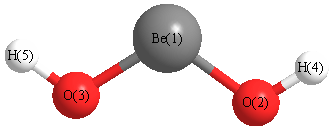 More geometry information
Calculated Bond Angles
| atom1 |
atom2 |
atom3 |
angle |
|
atom1 |
atom2 |
atom3 |
angle |
| Be1 |
O2 |
H4 |
127.118 |
|
Be1 |
O3 |
H5 |
127.118 |
| O2 |
Be1 |
O3 |
174.925 |
|
Electronic energy levels
Charges, Dipole, Quadrupole and Polarizability
Jump to
S1C1
S1C3
Energy calculated at QCISD/6-31G*
| | hartrees |
|---|
| Energy at 0K | -166.048135 |
| Energy at 298.15K | -166.049637 |
| HF Energy | -165.634567 |
| Nuclear repulsion energy | 48.632988 |
The energy at 298.15K was derived from the energy at 0K
and an integrated heat capacity that used the calculated vibrational frequencies.
Vibrational Frequencies calculated at QCISD/6-31G*
| Mode Number |
Symmetry |
Frequency
(cm-1) |
Scaled Frequency
(cm-1) |
IR Intensities
(km mol-1) |
Raman Act
(Å4/u) |
Dep P |
Dep U |
|---|
| 1 |
A |
3901 |
3715 |
23.12 |
|
|
|
| 2 |
A |
736 |
701 |
3.35 |
|
|
|
| 3 |
A |
592 |
563 |
96.46 |
|
|
|
| 4 |
A |
300 |
286 |
60.75 |
|
|
|
| 5 |
A |
250 |
238 |
119.97 |
|
|
|
| 6 |
B |
3899 |
3713 |
132.42 |
|
|
|
| 7 |
B |
1545 |
1471 |
337.04 |
|
|
|
| 8 |
B |
586 |
558 |
393.52 |
|
|
|
| 9 |
B |
293 |
279 |
99.52 |
|
|
|
Unscaled Zero Point Vibrational Energy (zpe) 6050.7 cm
-1
Scaled (by 0.9523) Zero Point Vibrational Energy (zpe) 5762.1 cm
-1
See section
III.C.1 List or set vibrational scaling factors
to change the scale factors used here.
See section
III.C.2
Calculate a vibrational scaling factor for a given set of molecules
to determine the least squares best scaling factor.
Geometric Data calculated at QCISD/6-31G*
Point Group is C2
Cartesians (Å)
| Atom |
x (Å) |
y (Å) |
z (Å) |
|---|
| Be1 |
0.000 |
0.000 |
-0.024 |
| O2 |
0.000 |
1.438 |
-0.055 |
| O3 |
0.000 |
-1.438 |
-0.055 |
| H4 |
0.577 |
1.987 |
0.488 |
| H5 |
-0.577 |
-1.987 |
0.488 |
Atom - Atom Distances (Å)
| |
Be1 |
O2 |
O3 |
H4 |
H5 |
| Be1 | | 1.4383 | 1.4383 | 2.1310 | 2.1310 |
O2 | 1.4383 | | 2.8760 | 0.9635 | 3.5151 | O3 | 1.4383 | 2.8760 | | 3.5151 | 0.9635 | H4 | 2.1310 | 0.9635 | 3.5151 | | 4.1374 | H5 | 2.1310 | 3.5151 | 0.9635 | 4.1374 | |
More geometry information
Calculated Bond Angles
| atom1 |
atom2 |
atom3 |
angle |
|
atom1 |
atom2 |
atom3 |
angle |
| Be1 |
O2 |
H4 |
123.858 |
|
Be1 |
O3 |
H5 |
123.858 |
| O2 |
Be1 |
O3 |
177.507 |
|
Electronic energy levels
Charges, Dipole, Quadrupole and Polarizability
Jump to
S1C1
S1C2
Energy calculated at QCISD/6-31G*
| | hartrees |
|---|
| Energy at 0K | -166.041270 |
| Energy at 298.15K | |
| HF Energy | -165.629945 |
| Nuclear repulsion energy | 49.362567 |
The energy at 298.15K was derived from the energy at 0K
and an integrated heat capacity that used the calculated vibrational frequencies.
Vibrational Frequencies calculated at QCISD/6-31G*
| Mode Number |
Symmetry |
Frequency
(cm-1) |
Scaled Frequency
(cm-1) |
IR Intensities
(km mol-1) |
Raman Act
(Å4/u) |
Dep P |
Dep U |
|---|
| 1 |
Σg |
4137 |
3940 |
0.00 |
|
|
|
| 2 |
Σg |
802 |
764 |
0.00 |
|
|
|
| 3 |
Σu |
4132 |
3935 |
446.29 |
|
|
|
| 4 |
Σu |
1669 |
1589 |
525.70 |
|
|
|
| 5 |
Πg |
350i |
333i |
0.00 |
|
|
|
| 5 |
Πg |
350i |
333i |
0.00 |
|
|
|
| 6 |
Πu |
351 |
335 |
14.61 |
|
|
|
| 6 |
Πu |
351 |
335 |
14.61 |
|
|
|
| 7 |
Πu |
353i |
336i |
392.36 |
|
|
|
| 7 |
Πu |
353i |
336i |
392.36 |
|
|
|
Unscaled Zero Point Vibrational Energy (zpe) 5018.3 cm
-1
Scaled (by 0.9523) Zero Point Vibrational Energy (zpe) 4778.9 cm
-1
See section
III.C.1 List or set vibrational scaling factors
to change the scale factors used here.
See section
III.C.2
Calculate a vibrational scaling factor for a given set of molecules
to determine the least squares best scaling factor.
Geometric Data calculated at QCISD/6-31G*
Point Group is D∞h
Cartesians (Å)
| Atom |
x (Å) |
y (Å) |
z (Å) |
|---|
| Be1 |
0.000 |
0.000 |
0.000 |
| O2 |
0.000 |
0.000 |
1.401 |
| O3 |
0.000 |
0.000 |
-1.401 |
| H4 |
0.000 |
0.000 |
2.349 |
| H5 |
0.000 |
0.000 |
-2.349 |
Atom - Atom Distances (Å)
| |
Be1 |
O2 |
O3 |
H4 |
H5 |
| Be1 | | 1.4010 | 1.4010 | 2.3492 | 2.3492 |
O2 | 1.4010 | | 2.8019 | 0.9483 | 3.7502 | O3 | 1.4010 | 2.8019 | | 3.7502 | 0.9483 | H4 | 2.3492 | 0.9483 | 3.7502 | | 4.6985 | H5 | 2.3492 | 3.7502 | 0.9483 | 4.6985 | |
More geometry information
Calculated Bond Angles
| atom1 |
atom2 |
atom3 |
angle |
|
atom1 |
atom2 |
atom3 |
angle |
| Be1 |
O2 |
H4 |
180.000 |
|
Be1 |
O3 |
H5 |
180.000 |
| O2 |
Be1 |
O3 |
180.000 |
|
Electronic energy levels
Charges, Dipole, Quadrupole and Polarizability
