Jump to
S1C2
S1C3
Energy calculated at CCSD(T)=FULL/6-31G*
| | hartrees |
|---|
| Energy at 0K | -166.062993 |
| Energy at 298.15K | |
| HF Energy | -165.633799 |
| Nuclear repulsion energy | 48.742803 |
The energy at 298.15K was derived from the energy at 0K
and an integrated heat capacity that used the calculated vibrational frequencies.
Vibrational Frequencies calculated at CCSD(T)=FULL/6-31G*
| Mode Number |
Symmetry |
Frequency
(cm-1) |
Scaled Frequency
(cm-1) |
IR Intensities
(km mol-1) |
Raman Act
(Å4/u) |
Dep P |
Dep U |
|---|
| 1 |
A1 |
3906 |
3791 |
|
|
|
|
| 2 |
A1 |
745 |
723 |
|
|
|
|
| 3 |
A1 |
572 |
556 |
|
|
|
|
| 4 |
A1 |
283 |
274 |
|
|
|
|
| 5 |
A2 |
250i |
242i |
|
|
|
|
| 6 |
B1 |
344 |
334 |
|
|
|
|
| 7 |
B2 |
3903 |
3789 |
|
|
|
|
| 8 |
B2 |
1553 |
1508 |
|
|
|
|
| 9 |
B2 |
423 |
410 |
|
|
|
|
Unscaled Zero Point Vibrational Energy (zpe) 5739.7 cm
-1
Scaled (by 0.9707) Zero Point Vibrational Energy (zpe) 5571.5 cm
-1
See section
III.C.1 List or set vibrational scaling factors
to change the scale factors used here.
See section
III.C.2
Calculate a vibrational scaling factor for a given set of molecules
to determine the least squares best scaling factor.
Geometric Data calculated at CCSD(T)=FULL/6-31G*
Point Group is C2v
Cartesians (Å)
| Atom |
x (Å) |
y (Å) |
z (Å) |
|---|
| Be1 |
0.000 |
0.000 |
0.015 |
| O2 |
0.000 |
1.431 |
0.079 |
| O3 |
0.000 |
-1.431 |
0.079 |
| H4 |
0.000 |
2.048 |
-0.661 |
| H5 |
0.000 |
-2.048 |
-0.661 |
Atom - Atom Distances (Å)
| |
Be1 |
O2 |
O3 |
H4 |
H5 |
| Be1 | | 1.4324 | 1.4324 | 2.1563 | 2.1563 |
O2 | 1.4324 | | 2.8620 | 0.9630 | 3.5566 | O3 | 1.4324 | 2.8620 | | 3.5566 | 0.9630 | H4 | 2.1563 | 0.9630 | 3.5566 | | 4.0957 | H5 | 2.1563 | 3.5566 | 0.9630 | 4.0957 | |
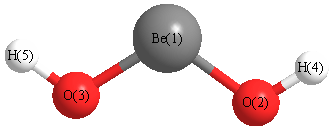 More geometry information
Calculated Bond Angles
| atom1 |
atom2 |
atom3 |
angle |
|
atom1 |
atom2 |
atom3 |
angle |
| Be1 |
O2 |
H4 |
127.272 |
|
Be1 |
O3 |
H5 |
127.272 |
| O2 |
Be1 |
O3 |
174.874 |
|
Electronic energy levels
Charges, Dipole, Quadrupole and Polarizability
Jump to
S1C1
S1C3
Energy calculated at CCSD(T)=FULL/6-31G*
| | hartrees |
|---|
| Energy at 0K | -166.064236 |
| Energy at 298.15K | -166.065712 |
| HF Energy | -165.634548 |
| Nuclear repulsion energy | 48.704536 |
The energy at 298.15K was derived from the energy at 0K
and an integrated heat capacity that used the calculated vibrational frequencies.
Vibrational Frequencies calculated at CCSD(T)=FULL/6-31G*
| Mode Number |
Symmetry |
Frequency
(cm-1) |
Scaled Frequency
(cm-1) |
IR Intensities
(km mol-1) |
Raman Act
(Å4/u) |
Dep P |
Dep U |
|---|
| 1 |
A |
3879 |
3765 |
|
|
|
|
| 2 |
A |
737 |
715 |
|
|
|
|
| 3 |
A |
577 |
560 |
|
|
|
|
| 4 |
A |
300 |
291 |
|
|
|
|
| 5 |
A |
245 |
237 |
|
|
|
|
| 6 |
B |
3878 |
3764 |
|
|
|
|
| 7 |
B |
1548 |
1503 |
|
|
|
|
| 8 |
B |
571 |
554 |
|
|
|
|
| 9 |
B |
292 |
284 |
|
|
|
|
Unscaled Zero Point Vibrational Energy (zpe) 6013.1 cm
-1
Scaled (by 0.9707) Zero Point Vibrational Energy (zpe) 5836.9 cm
-1
See section
III.C.1 List or set vibrational scaling factors
to change the scale factors used here.
See section
III.C.2
Calculate a vibrational scaling factor for a given set of molecules
to determine the least squares best scaling factor.
Geometric Data calculated at CCSD(T)=FULL/6-31G*
Point Group is C2
Cartesians (Å)
| Atom |
x (Å) |
y (Å) |
z (Å) |
|---|
| Be1 |
0.000 |
0.000 |
-0.024 |
| O2 |
0.000 |
1.435 |
-0.055 |
| O3 |
0.000 |
-1.435 |
-0.055 |
| H4 |
0.575 |
1.985 |
0.490 |
| H5 |
-0.575 |
-1.985 |
0.490 |
Atom - Atom Distances (Å)
| |
Be1 |
O2 |
O3 |
H4 |
H5 |
| Be1 | | 1.4351 | 1.4351 | 2.1296 | 2.1296 |
O2 | 1.4351 | | 2.8696 | 0.9648 | 3.5104 | O3 | 1.4351 | 2.8696 | | 3.5104 | 0.9648 | H4 | 2.1296 | 0.9648 | 3.5104 | | 4.1335 | H5 | 2.1296 | 3.5104 | 0.9648 | 4.1335 | |
More geometry information
Calculated Bond Angles
| atom1 |
atom2 |
atom3 |
angle |
|
atom1 |
atom2 |
atom3 |
angle |
| Be1 |
O2 |
H4 |
123.912 |
|
Be1 |
O3 |
H5 |
123.912 |
| O2 |
Be1 |
O3 |
177.513 |
|
Electronic energy levels
Charges, Dipole, Quadrupole and Polarizability
Jump to
S1C1
S1C2
Energy calculated at CCSD(T)=FULL/6-31G*
| | hartrees |
|---|
| Energy at 0K | -166.058137 |
| Energy at 298.15K | |
| HF Energy | -165.629929 |
| Nuclear repulsion energy | 49.480647 |
The energy at 298.15K was derived from the energy at 0K
and an integrated heat capacity that used the calculated vibrational frequencies.
Vibrational Frequencies calculated at CCSD(T)=FULL/6-31G*
| Mode Number |
Symmetry |
Frequency
(cm-1) |
Scaled Frequency
(cm-1) |
IR Intensities
(km mol-1) |
Raman Act
(Å4/u) |
Dep P |
Dep U |
|---|
| 1 |
Σg |
4118 |
3997 |
|
|
|
|
| 2 |
Σg |
802 |
779 |
|
|
|
|
| 3 |
Σu |
4113 |
3993 |
|
|
|
|
| 4 |
Σu |
1677 |
1627 |
|
|
|
|
| 5 |
Πg |
313i |
303i |
|
|
|
|
| 5 |
Πg |
313i |
303i |
|
|
|
|
| 6 |
Πu |
357 |
347 |
|
|
|
|
| 6 |
Πu |
357 |
347 |
|
|
|
|
| 7 |
Πu |
314i |
305i |
|
|
|
|
| 7 |
Πu |
314i |
305i |
|
|
|
|
Unscaled Zero Point Vibrational Energy (zpe) 5085.8 cm
-1
Scaled (by 0.9707) Zero Point Vibrational Energy (zpe) 4936.8 cm
-1
See section
III.C.1 List or set vibrational scaling factors
to change the scale factors used here.
See section
III.C.2
Calculate a vibrational scaling factor for a given set of molecules
to determine the least squares best scaling factor.
Geometric Data calculated at CCSD(T)=FULL/6-31G*
Point Group is D∞h
Cartesians (Å)
| Atom |
x (Å) |
y (Å) |
z (Å) |
|---|
| Be1 |
0.000 |
0.000 |
0.000 |
| O2 |
0.000 |
0.000 |
1.396 |
| O3 |
0.000 |
0.000 |
-1.396 |
| H4 |
0.000 |
0.000 |
2.346 |
| H5 |
0.000 |
0.000 |
-2.346 |
Atom - Atom Distances (Å)
| |
Be1 |
O2 |
O3 |
H4 |
H5 |
| Be1 | | 1.3962 | 1.3962 | 2.3456 | 2.3456 |
O2 | 1.3962 | | 2.7924 | 0.9494 | 3.7418 | O3 | 1.3962 | 2.7924 | | 3.7418 | 0.9494 | H4 | 2.3456 | 0.9494 | 3.7418 | | 4.6913 | H5 | 2.3456 | 3.7418 | 0.9494 | 4.6913 | |
More geometry information
Calculated Bond Angles
| atom1 |
atom2 |
atom3 |
angle |
|
atom1 |
atom2 |
atom3 |
angle |
| Be1 |
O2 |
H4 |
180.000 |
|
Be1 |
O3 |
H5 |
180.000 |
| O2 |
Be1 |
O3 |
180.000 |
|
Electronic energy levels
Charges, Dipole, Quadrupole and Polarizability
