Jump to
S1C2
S1C3
Energy calculated at QCISD(T)=FULL/6-31G*
| | hartrees |
|---|
| Energy at 0K | -166.063468 |
| Energy at 298.15K | |
| HF Energy | -165.633778 |
| Nuclear repulsion energy | 48.733695 |
The energy at 298.15K was derived from the energy at 0K
and an integrated heat capacity that used the calculated vibrational frequencies.
Vibrational Frequencies calculated at QCISD(T)=FULL/6-31G*
| Mode Number |
Symmetry |
Frequency
(cm-1) |
Scaled Frequency
(cm-1) |
IR Intensities
(km mol-1) |
Raman Act
(Å4/u) |
Dep P |
Dep U |
|---|
| 1 |
A1 |
3903 |
3903 |
|
|
|
|
| 2 |
A1 |
744 |
744 |
|
|
|
|
| 3 |
A1 |
572 |
572 |
|
|
|
|
| 4 |
A1 |
282 |
282 |
|
|
|
|
| 5 |
A2 |
250i |
250i |
|
|
|
|
| 6 |
B1 |
344 |
344 |
|
|
|
|
| 7 |
B2 |
3901 |
3901 |
|
|
|
|
| 8 |
B2 |
1552 |
1552 |
|
|
|
|
| 9 |
B2 |
424 |
424 |
|
|
|
|
Unscaled Zero Point Vibrational Energy (zpe) 5735.4 cm
-1
Scaled (by 1) Zero Point Vibrational Energy (zpe) 5735.4 cm
-1
See section
III.C.1 List or set vibrational scaling factors
to change the scale factors used here.
See section
III.C.2
Calculate a vibrational scaling factor for a given set of molecules
to determine the least squares best scaling factor.
Geometric Data calculated at QCISD(T)=FULL/6-31G*
Point Group is C2v
Cartesians (Å)
| Atom |
x (Å) |
y (Å) |
z (Å) |
|---|
| Be1 |
0.000 |
0.000 |
0.014 |
| O2 |
0.000 |
1.431 |
0.079 |
| O3 |
0.000 |
-1.431 |
0.079 |
| H4 |
0.000 |
2.048 |
-0.661 |
| H5 |
0.000 |
-2.048 |
-0.661 |
Atom - Atom Distances (Å)
| |
Be1 |
O2 |
O3 |
H4 |
H5 |
| Be1 | | 1.4328 | 1.4328 | 2.1562 | 2.1562 |
O2 | 1.4328 | | 2.8626 | 0.9631 | 3.5569 | O3 | 1.4328 | 2.8626 | | 3.5569 | 0.9631 | H4 | 2.1562 | 0.9631 | 3.5569 | | 4.0957 | H5 | 2.1562 | 3.5569 | 0.9631 | 4.0957 | |
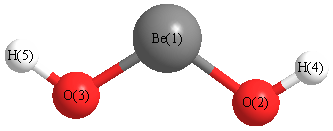 More geometry information
Calculated Bond Angles
| atom1 |
atom2 |
atom3 |
angle |
|
atom1 |
atom2 |
atom3 |
angle |
| Be1 |
O2 |
H4 |
127.210 |
|
Be1 |
O3 |
H5 |
127.210 |
| O2 |
Be1 |
O3 |
174.804 |
|
Electronic energy levels
Charges, Dipole, Quadrupole and Polarizability
Jump to
S1C1
S1C3
Energy calculated at QCISD(T)=FULL/6-31G*
| | hartrees |
|---|
| Energy at 0K | -166.064717 |
| Energy at 298.15K | -166.066192 |
| HF Energy | -165.634526 |
| Nuclear repulsion energy | 48.695079 |
The energy at 298.15K was derived from the energy at 0K
and an integrated heat capacity that used the calculated vibrational frequencies.
Vibrational Frequencies calculated at QCISD(T)=FULL/6-31G*
| Mode Number |
Symmetry |
Frequency
(cm-1) |
Scaled Frequency
(cm-1) |
IR Intensities
(km mol-1) |
Raman Act
(Å4/u) |
Dep P |
Dep U |
|---|
| 1 |
A |
3877 |
3877 |
|
|
|
|
| 2 |
A |
736 |
736 |
|
|
|
|
| 3 |
A |
577 |
577 |
|
|
|
|
| 4 |
A |
299 |
299 |
|
|
|
|
| 5 |
A |
245 |
245 |
|
|
|
|
| 6 |
B |
3875 |
3875 |
|
|
|
|
| 7 |
B |
1547 |
1547 |
|
|
|
|
| 8 |
B |
571 |
571 |
|
|
|
|
| 9 |
B |
292 |
292 |
|
|
|
|
Unscaled Zero Point Vibrational Energy (zpe) 6009.6 cm
-1
Scaled (by 1) Zero Point Vibrational Energy (zpe) 6009.6 cm
-1
See section
III.C.1 List or set vibrational scaling factors
to change the scale factors used here.
See section
III.C.2
Calculate a vibrational scaling factor for a given set of molecules
to determine the least squares best scaling factor.
Geometric Data calculated at QCISD(T)=FULL/6-31G*
Point Group is C2
Cartesians (Å)
| Atom |
x (Å) |
y (Å) |
z (Å) |
|---|
| Be1 |
0.000 |
0.000 |
-0.024 |
| O2 |
0.000 |
1.435 |
-0.055 |
| O3 |
0.000 |
-1.435 |
-0.055 |
| H4 |
0.576 |
1.985 |
0.490 |
| H5 |
-0.576 |
-1.985 |
0.490 |
Atom - Atom Distances (Å)
| |
Be1 |
O2 |
O3 |
H4 |
H5 |
| Be1 | | 1.4355 | 1.4355 | 2.1295 | 2.1295 |
O2 | 1.4355 | | 2.8703 | 0.9649 | 3.5107 | O3 | 1.4355 | 2.8703 | | 3.5107 | 0.9649 | H4 | 2.1295 | 0.9649 | 3.5107 | | 4.1331 | H5 | 2.1295 | 3.5107 | 0.9649 | 4.1331 | |
More geometry information
Calculated Bond Angles
| atom1 |
atom2 |
atom3 |
angle |
|
atom1 |
atom2 |
atom3 |
angle |
| Be1 |
O2 |
H4 |
123.850 |
|
Be1 |
O3 |
H5 |
123.850 |
| O2 |
Be1 |
O3 |
177.469 |
|
Electronic energy levels
Charges, Dipole, Quadrupole and Polarizability
Jump to
S1C1
S1C2
Energy calculated at QCISD(T)=FULL/6-31G*
| | hartrees |
|---|
| Energy at 0K | -166.058583 |
| Energy at 298.15K | |
| HF Energy | -165.629920 |
| Nuclear repulsion energy | 49.473028 |
The energy at 298.15K was derived from the energy at 0K
and an integrated heat capacity that used the calculated vibrational frequencies.
Vibrational Frequencies calculated at QCISD(T)=FULL/6-31G*
| Mode Number |
Symmetry |
Frequency
(cm-1) |
Scaled Frequency
(cm-1) |
IR Intensities
(km mol-1) |
Raman Act
(Å4/u) |
Dep P |
Dep U |
|---|
| 1 |
Σg |
4117 |
4117 |
|
|
|
|
| 2 |
Σg |
801 |
801 |
|
|
|
|
| 3 |
Σu |
4112 |
4112 |
|
|
|
|
| 4 |
Σu |
1675 |
1675 |
|
|
|
|
| 5 |
Πg |
313i |
313i |
|
|
|
|
| 5 |
Πg |
313i |
313i |
|
|
|
|
| 6 |
Πu |
357 |
357 |
|
|
|
|
| 6 |
Πu |
357 |
357 |
|
|
|
|
| 7 |
Πu |
315i |
315i |
|
|
|
|
| 7 |
Πu |
315i |
315i |
|
|
|
|
Unscaled Zero Point Vibrational Energy (zpe) 5081.1 cm
-1
Scaled (by 1) Zero Point Vibrational Energy (zpe) 5081.1 cm
-1
See section
III.C.1 List or set vibrational scaling factors
to change the scale factors used here.
See section
III.C.2
Calculate a vibrational scaling factor for a given set of molecules
to determine the least squares best scaling factor.
Geometric Data calculated at QCISD(T)=FULL/6-31G*
Point Group is D∞h
Cartesians (Å)
| Atom |
x (Å) |
y (Å) |
z (Å) |
|---|
| Be1 |
0.000 |
0.000 |
0.000 |
| O2 |
0.000 |
0.000 |
1.396 |
| O3 |
0.000 |
0.000 |
-1.396 |
| H4 |
0.000 |
0.000 |
2.346 |
| H5 |
0.000 |
0.000 |
-2.346 |
Atom - Atom Distances (Å)
| |
Be1 |
O2 |
O3 |
H4 |
H5 |
| Be1 | | 1.3964 | 1.3964 | 2.3459 | 2.3459 |
O2 | 1.3964 | | 2.7929 | 0.9495 | 3.7424 | O3 | 1.3964 | 2.7929 | | 3.7424 | 0.9495 | H4 | 2.3459 | 0.9495 | 3.7424 | | 4.6919 | H5 | 2.3459 | 3.7424 | 0.9495 | 4.6919 | |
More geometry information
Calculated Bond Angles
| atom1 |
atom2 |
atom3 |
angle |
|
atom1 |
atom2 |
atom3 |
angle |
| Be1 |
O2 |
H4 |
180.000 |
|
Be1 |
O3 |
H5 |
180.000 |
| O2 |
Be1 |
O3 |
180.000 |
|
Electronic energy levels
Charges, Dipole, Quadrupole and Polarizability
