Jump to
S1C2
Energy calculated at CCSD/6-31G*
| | hartrees |
|---|
| Energy at 0K | -130.726190 |
| Energy at 298.15K | |
| HF Energy | -130.386889 |
| Nuclear repulsion energy | 34.887544 |
The energy at 298.15K was derived from the energy at 0K
and an integrated heat capacity that used the calculated vibrational frequencies.
Vibrational Frequencies calculated at CCSD/6-31G*
| Mode Number |
Symmetry |
Frequency
(cm-1) |
Scaled Frequency
(cm-1) |
IR Intensities
(km mol-1) |
Raman Act
(Å4/u) |
Dep P |
Dep U |
|---|
| 1 |
A1 |
3497 |
3303 |
3.97 |
|
|
|
| 2 |
A1 |
1700 |
1605 |
18.47 |
|
|
|
| 3 |
A1 |
1415 |
1336 |
1.31 |
|
|
|
| 4 |
B1 |
446i |
421i |
243.42 |
|
|
|
| 5 |
B2 |
3633 |
3430 |
3.57 |
|
|
|
| 6 |
B2 |
1282 |
1211 |
2.13 |
|
|
|
Unscaled Zero Point Vibrational Energy (zpe) 5540.2 cm
-1
Scaled (by 0.9443) Zero Point Vibrational Energy (zpe) 5231.7 cm
-1
See section
III.C.1 List or set vibrational scaling factors
to change the scale factors used here.
See section
III.C.2
Calculate a vibrational scaling factor for a given set of molecules
to determine the least squares best scaling factor.
Geometric Data calculated at CCSD/6-31G*
Point Group is C2v
Cartesians (Å)
| Atom |
x (Å) |
y (Å) |
z (Å) |
|---|
| N1 |
0.000 |
0.000 |
-0.545 |
| O2 |
0.000 |
0.000 |
0.740 |
| H3 |
0.000 |
0.881 |
-1.053 |
| H4 |
0.000 |
-0.881 |
-1.053 |
Atom - Atom Distances (Å)
| |
N1 |
O2 |
H3 |
H4 |
| N1 | | 1.2851 | 1.0165 | 1.0165 |
O2 | 1.2851 | | 1.9973 | 1.9973 | H3 | 1.0165 | 1.9973 | | 1.7615 | H4 | 1.0165 | 1.9973 | 1.7615 | |
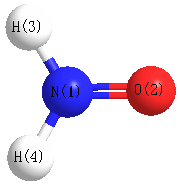 More geometry information
Calculated Bond Angles
| atom1 |
atom2 |
atom3 |
angle |
|
atom1 |
atom2 |
atom3 |
angle |
| O2 |
N1 |
H3 |
119.955 |
|
O2 |
N1 |
H4 |
119.955 |
| H3 |
N1 |
H4 |
120.091 |
|
Electronic energy levels
Charges, Dipole, Quadrupole and Polarizability
Jump to
S1C1
Energy calculated at CCSD/6-31G*
| | hartrees |
|---|
| Energy at 0K | -130.726866 |
| Energy at 298.15K | -130.729375 |
| HF Energy | -130.388271 |
| Nuclear repulsion energy | 34.801247 |
The energy at 298.15K was derived from the energy at 0K
and an integrated heat capacity that used the calculated vibrational frequencies.
Vibrational Frequencies calculated at CCSD/6-31G*
| Mode Number |
Symmetry |
Frequency
(cm-1) |
Scaled Frequency
(cm-1) |
IR Intensities
(km mol-1) |
Raman Act
(Å4/u) |
Dep P |
Dep U |
|---|
| 1 |
A' |
3449 |
3257 |
0.95 |
|
|
|
| 2 |
A' |
1703 |
1608 |
17.68 |
|
|
|
| 3 |
A' |
1384 |
1307 |
1.36 |
|
|
|
| 4 |
A' |
583 |
550 |
231.96 |
|
|
|
| 5 |
A" |
3579 |
3379 |
0.52 |
|
|
|
| 6 |
A" |
1314 |
1241 |
1.33 |
|
|
|
Unscaled Zero Point Vibrational Energy (zpe) 6005.8 cm
-1
Scaled (by 0.9443) Zero Point Vibrational Energy (zpe) 5671.2 cm
-1
See section
III.C.1 List or set vibrational scaling factors
to change the scale factors used here.
See section
III.C.2
Calculate a vibrational scaling factor for a given set of molecules
to determine the least squares best scaling factor.
Geometric Data calculated at CCSD/6-31G*
Point Group is Cs
Cartesians (Å)
| Atom |
x (Å) |
y (Å) |
z (Å) |
|---|
| N1 |
-0.030 |
0.552 |
0.000 |
| O2 |
-0.030 |
-0.739 |
0.000 |
| H3 |
0.227 |
1.021 |
0.869 |
| H4 |
0.227 |
1.021 |
-0.869 |
Atom - Atom Distances (Å)
| |
N1 |
O2 |
H3 |
H4 |
| N1 | | 1.2909 | 1.0201 | 1.0201 |
O2 | 1.2909 | | 1.9789 | 1.9789 | H3 | 1.0201 | 1.9789 | | 1.7380 | H4 | 1.0201 | 1.9789 | 1.7380 | |
More geometry information
Calculated Bond Angles
| atom1 |
atom2 |
atom3 |
angle |
|
atom1 |
atom2 |
atom3 |
angle |
| O2 |
N1 |
H3 |
117.323 |
|
O2 |
N1 |
H4 |
117.323 |
| H3 |
N1 |
H4 |
116.838 |
|
Electronic energy levels
Charges, Dipole, Quadrupole and Polarizability
