Jump to
S1C2
Energy calculated at CID/6-31G*
| | hartrees |
|---|
| Energy at 0K | -1194.035329 |
| Energy at 298.15K | -1194.037785 |
| HF Energy | -1193.684416 |
| Nuclear repulsion energy | 195.610434 |
The energy at 298.15K was derived from the energy at 0K
and an integrated heat capacity that used the calculated vibrational frequencies.
Vibrational Frequencies calculated at CID/6-31G*
| Mode Number |
Symmetry |
Frequency
(cm-1) |
Scaled Frequency
(cm-1) |
IR Intensities
(km mol-1) |
Raman Act
(Å4/u) |
Dep P |
Dep U |
|---|
| 1 |
A |
2791 |
2578 |
1.13 |
|
|
|
| 2 |
A |
960 |
886 |
0.77 |
|
|
|
| 3 |
A |
520 |
480 |
0.99 |
|
|
|
| 4 |
A |
313 |
289 |
31.26 |
|
|
|
| 5 |
A |
219 |
202 |
0.00 |
|
|
|
| 6 |
B |
2790 |
2577 |
21.06 |
|
|
|
| 7 |
B |
947 |
875 |
15.58 |
|
|
|
| 8 |
B |
535 |
494 |
14.76 |
|
|
|
| 9 |
B |
346 |
319 |
22.73 |
|
|
|
Unscaled Zero Point Vibrational Energy (zpe) 4709.7 cm
-1
Scaled (by 0.9237) Zero Point Vibrational Energy (zpe) 4350.4 cm
-1
See section
III.C.1 List or set vibrational scaling factors
to change the scale factors used here.
See section
III.C.2
Calculate a vibrational scaling factor for a given set of molecules
to determine the least squares best scaling factor.
Geometric Data calculated at CID/6-31G*
Point Group is C2
Cartesians (Å)
| Atom |
x (Å) |
y (Å) |
z (Å) |
|---|
| S1 |
0.000 |
0.000 |
0.845 |
| S2 |
0.000 |
1.662 |
-0.385 |
| S3 |
0.000 |
-1.662 |
-0.385 |
| H4 |
-1.320 |
1.763 |
-0.596 |
| H5 |
1.320 |
-1.763 |
-0.596 |
Atom - Atom Distances (Å)
| |
S1 |
S2 |
S3 |
H4 |
H5 |
| S1 | | 2.0673 | 2.0673 | 2.6316 | 2.6316 |
S2 | 2.0673 | | 3.3236 | 1.3407 | 3.6765 | S3 | 2.0673 | 3.3236 | | 3.6765 | 1.3407 | H4 | 2.6316 | 1.3407 | 3.6765 | | 4.4050 | H5 | 2.6316 | 3.6765 | 1.3407 | 4.4050 | |
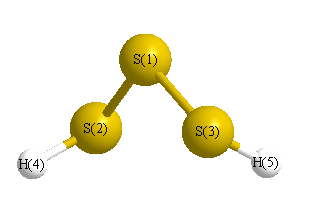 More geometry information
Calculated Bond Angles
| atom1 |
atom2 |
atom3 |
angle |
|
atom1 |
atom2 |
atom3 |
angle |
| S1 |
S2 |
H4 |
98.863 |
|
S1 |
S3 |
H5 |
98.863 |
| S2 |
S1 |
S3 |
106.996 |
|
Electronic energy levels
Charges, Dipole, Quadrupole and Polarizability
Jump to
S1C1
Energy calculated at CID/6-31G*
| | hartrees |
|---|
| Energy at 0K | -1194.034857 |
| Energy at 298.15K | -1194.037322 |
| HF Energy | -1193.683903 |
| Nuclear repulsion energy | 195.615848 |
The energy at 298.15K was derived from the energy at 0K
and an integrated heat capacity that used the calculated vibrational frequencies.
Vibrational Frequencies calculated at CID/6-31G*
| Mode Number |
Symmetry |
Frequency
(cm-1) |
Scaled Frequency
(cm-1) |
IR Intensities
(km mol-1) |
Raman Act
(Å4/u) |
Dep P |
Dep U |
|---|
| 1 |
A' |
2784 |
2572 |
27.59 |
|
|
|
| 2 |
A' |
961 |
888 |
10.05 |
|
|
|
| 3 |
A' |
520 |
480 |
0.84 |
|
|
|
| 4 |
A' |
345 |
319 |
23.85 |
|
|
|
| 5 |
A' |
221 |
204 |
0.24 |
|
|
|
| 6 |
A" |
2785 |
2572 |
2.30 |
|
|
|
| 7 |
A" |
953 |
880 |
9.33 |
|
|
|
| 8 |
A" |
536 |
495 |
16.22 |
|
|
|
| 9 |
A" |
316 |
292 |
13.64 |
|
|
|
Unscaled Zero Point Vibrational Energy (zpe) 4710.3 cm
-1
Scaled (by 0.9237) Zero Point Vibrational Energy (zpe) 4350.9 cm
-1
See section
III.C.1 List or set vibrational scaling factors
to change the scale factors used here.
See section
III.C.2
Calculate a vibrational scaling factor for a given set of molecules
to determine the least squares best scaling factor.
Geometric Data calculated at CID/6-31G*
Point Group is Cs
Cartesians (Å)
| Atom |
x (Å) |
y (Å) |
z (Å) |
|---|
| S1 |
-0.053 |
0.841 |
0.000 |
| S2 |
-0.053 |
-0.388 |
1.662 |
| S3 |
-0.053 |
-0.388 |
-1.662 |
| H4 |
1.272 |
-0.527 |
1.815 |
| H5 |
1.272 |
-0.527 |
-1.815 |
Atom - Atom Distances (Å)
| |
S1 |
S2 |
S3 |
H4 |
H5 |
| S1 | | 2.0667 | 2.0667 | 2.6311 | 2.6311 |
S2 | 2.0667 | | 3.3234 | 1.3412 | 3.7231 | S3 | 2.0667 | 3.3234 | | 3.7231 | 1.3412 | H4 | 2.6311 | 1.3412 | 3.7231 | | 3.6296 | H5 | 2.6311 | 3.7231 | 1.3412 | 3.6296 | |
More geometry information
Calculated Bond Angles
| atom1 |
atom2 |
atom3 |
angle |
|
atom1 |
atom2 |
atom3 |
angle |
| S1 |
S2 |
H4 |
98.846 |
|
S1 |
S3 |
H5 |
98.846 |
| S2 |
S1 |
S3 |
107.034 |
|
Electronic energy levels
Charges, Dipole, Quadrupole and Polarizability
