return to home page Computational Chemistry Comparison and Benchmark DataBase Release 22 (May 2022) Standard Reference Database 101 National Institute of Standards and Technology
You are here: Calculated > Energy > Optimized > Energy

All results from a given calculation for C3H5Cl (1-chloro-1-propene(Z))

using model chemistry: QCISD/6-31G*

19 10 17 12 22

States and conformations

State Conformation minimum conformation conformer description state description
1 1 yes CS 1A'
Energy calculated at QCISD/6-31G*
 hartrees
Energy at 0K-576.533220
Energy at 298.15K-576.538092
HF Energy-575.972065
Nuclear repulsion energy145.244956
The energy at 298.15K was derived from the energy at 0K and an integrated heat capacity that used the calculated vibrational frequencies.
Vibrational Frequencies calculated at QCISD/6-31G*
Mode Number Symmetry Frequency
(cm-1)
Scaled Frequency
(cm-1)
IR Intensities
(km mol-1)
Raman Act
(Å4/u)
Dep P Dep U
1 A' 3258 3102 9.90      
2 A' 3186 3034 13.26      
3 A' 3172 3021 2.50      
4 A' 3068 2922 18.95      
5 A' 1741 1658 13.93      
6 A' 1538 1464 3.65      
7 A' 1471 1401 3.16      
8 A' 1399 1332 32.70      
9 A' 1294 1232 0.78      
10 A' 1129 1075 0.55      
11 A' 967 921 16.98      
12 A' 785 748 37.37      
13 A' 574 547 0.80      
14 A' 233 222 1.00      
15 A" 3127 2978 18.90      
16 A" 1538 1464 7.27      
17 A" 1095 1043 0.82      
18 A" 950 905 0.83      
19 A" 724 690 45.97      
20 A" 401 382 1.81      
21 A" 104 99 0.04      

Unscaled Zero Point Vibrational Energy (zpe) 15876.3 cm-1
Scaled (by 0.9523) Zero Point Vibrational Energy (zpe) 15119.0 cm-1
See section III.C.1 List or set vibrational scaling factors to change the scale factors used here.
See section III.C.2 Calculate a vibrational scaling factor for a given set of molecules to determine the least squares best scaling factor.
Rotational Constants (cm-1) from geometry optimized at QCISD/6-31G*
ABC
0.47834 0.11799 0.09635

See section I.F.4 to change rotational constant units
Geometric Data calculated at QCISD/6-31G*

Point Group is Cs

Cartesians (Å)
Atom x (Å) y (Å) z (Å)
C1 0.000 0.893 0.000
C2 -1.250 0.413 0.000
C3 -1.729 -1.006 0.000
Cl4 1.491 -0.049 0.000
H5 0.173 1.969 0.000
H6 -2.036 1.171 0.000
H7 -0.910 -1.721 0.000
H8 -2.353 -1.196 0.884
H9 -2.353 -1.196 -0.884

Atom - Atom Distances (Å)
  C1 C2 C3 Cl4 H5 H6 H7 H8 H9
C11.33962.56851.76401.08922.05452.76773.26903.2690
C21.33961.49722.78032.10881.09202.16022.14172.1417
C32.56851.49723.35963.53072.19901.08701.09891.0989
Cl41.76402.78033.35962.41023.73212.92584.10864.1086
H51.08922.10883.53072.41022.34803.84494.14504.1450
H62.05451.09202.19903.73212.34803.10342.54732.5473
H72.76772.16021.08702.92583.84493.10341.77201.7720
H83.26902.14171.09894.10864.14502.54731.77201.7679
H93.26902.14171.09894.10864.14502.54731.77201.7679

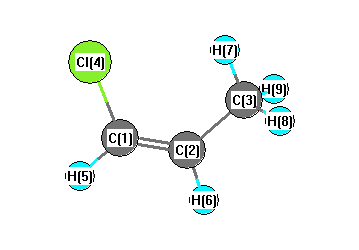
picture of 1-chloro-1-propene(Z) state 1 conformation 1
More geometry information
Calculated Bond Angles
atom1 atom2 atom3 angle atom1 atom2 atom3 angle
C1 C2 C3 129.669 C1 C2 H6 114.952
C2 C1 Cl4 126.690 C2 C1 H5 120.159
C2 C3 H7 112.457 C2 C3 H8 110.225
C2 C3 H9 110.225 C3 C2 H6 115.379
Cl4 C1 H5 113.151 H7 C3 H8 108.324
H7 C3 H9 108.324 H8 C3 H9 107.111
Electronic energy levels
Charges, Dipole, Quadrupole and Polarizability