Jump to
S1C2
Energy calculated at QCISD/6-31G*
| | hartrees |
|---|
| Energy at 0K | -2609.112260 |
| Energy at 298.15K | -2609.116158 |
| HF Energy | -2608.866596 |
| Nuclear repulsion energy | 79.891667 |
The energy at 298.15K was derived from the energy at 0K
and an integrated heat capacity that used the calculated vibrational frequencies.
Vibrational Frequencies calculated at QCISD/6-31G*
| Mode Number |
Symmetry |
Frequency
(cm-1) |
Scaled Frequency
(cm-1) |
IR Intensities
(km mol-1) |
Raman Act
(Å4/u) |
Dep P |
Dep U |
|---|
| 1 |
A' |
3211 |
3058 |
6.47 |
|
|
|
| 2 |
A' |
1429 |
1361 |
23.46 |
|
|
|
| 3 |
A' |
690 |
657 |
17.89 |
|
|
|
| 4 |
A' |
357 |
340 |
62.99 |
|
|
|
| 5 |
A" |
3359 |
3199 |
0.07 |
|
|
|
| 6 |
A" |
953 |
907 |
1.07 |
|
|
|
Unscaled Zero Point Vibrational Energy (zpe) 4999.5 cm
-1
Scaled (by 0.9523) Zero Point Vibrational Energy (zpe) 4761.0 cm
-1
See section
III.C.1 List or set vibrational scaling factors
to change the scale factors used here.
See section
III.C.2
Calculate a vibrational scaling factor for a given set of molecules
to determine the least squares best scaling factor.
Geometric Data calculated at QCISD/6-31G*
Point Group is Cs
Cartesians (Å)
| Atom |
x (Å) |
y (Å) |
z (Å) |
|---|
| C1 |
-0.007 |
1.504 |
0.000 |
| Br2 |
-0.007 |
-0.372 |
0.000 |
| H3 |
0.153 |
1.994 |
0.951 |
| H4 |
0.153 |
1.994 |
-0.951 |
Atom - Atom Distances (Å)
| |
C1 |
Br2 |
H3 |
H4 |
| C1 | | 1.8756 | 1.0822 | 1.0822 |
Br2 | 1.8756 | | 2.5551 | 2.5551 | H3 | 1.0822 | 2.5551 | | 1.9025 | H4 | 1.0822 | 2.5551 | 1.9025 | |
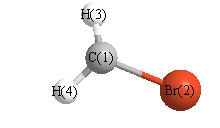 More geometry information
Calculated Bond Angles
| atom1 |
atom2 |
atom3 |
angle |
|
atom1 |
atom2 |
atom3 |
angle |
| Br2 |
C1 |
H3 |
116.947 |
|
Br2 |
C1 |
H4 |
116.947 |
| H3 |
C1 |
H4 |
123.047 |
|
Electronic energy levels
Charges, Dipole, Quadrupole and Polarizability
Jump to
S1C1
Energy calculated at QCISD/6-31G*
| | hartrees |
|---|
| Energy at 0K | -2609.112167 |
| Energy at 298.15K | |
| HF Energy | -2608.866330 |
| Nuclear repulsion energy | 79.968429 |
The energy at 298.15K was derived from the energy at 0K
and an integrated heat capacity that used the calculated vibrational frequencies.
Vibrational Frequencies calculated at QCISD/6-31G*
| Mode Number |
Symmetry |
Frequency
(cm-1) |
Scaled Frequency
(cm-1) |
IR Intensities
(km mol-1) |
Raman Act
(Å4/u) |
Dep P |
Dep U |
|---|
| 1 |
A1 |
3221 |
3067 |
4.77 |
|
|
|
| 2 |
A1 |
1427 |
1359 |
25.04 |
|
|
|
| 3 |
A1 |
693 |
660 |
16.09 |
|
|
|
| 4 |
B1 |
260i |
248i |
77.56 |
|
|
|
| 5 |
B2 |
3373 |
3212 |
0.01 |
|
|
|
| 6 |
B2 |
943 |
898 |
1.23 |
|
|
|
Unscaled Zero Point Vibrational Energy (zpe) 4698.0 cm
-1
Scaled (by 0.9523) Zero Point Vibrational Energy (zpe) 4473.9 cm
-1
See section
III.C.1 List or set vibrational scaling factors
to change the scale factors used here.
See section
III.C.2
Calculate a vibrational scaling factor for a given set of molecules
to determine the least squares best scaling factor.
Geometric Data calculated at QCISD/6-31G*
Point Group is C2v
Cartesians (Å)
| Atom |
x (Å) |
y (Å) |
z (Å) |
|---|
| C1 |
0.000 |
0.000 |
-1.500 |
| Br2 |
0.000 |
0.000 |
0.372 |
| H3 |
0.000 |
0.956 |
-2.005 |
| H4 |
0.000 |
-0.956 |
-2.005 |
Atom - Atom Distances (Å)
| |
C1 |
Br2 |
H3 |
H4 |
| C1 | | 1.8721 | 1.0812 | 1.0812 |
Br2 | 1.8721 | | 2.5620 | 2.5620 | H3 | 1.0812 | 2.5620 | | 1.9122 | H4 | 1.0812 | 2.5620 | 1.9122 | |
More geometry information
Calculated Bond Angles
| atom1 |
atom2 |
atom3 |
angle |
|
atom1 |
atom2 |
atom3 |
angle |
| Br2 |
C1 |
H3 |
117.835 |
|
Br2 |
C1 |
H4 |
117.835 |
| H3 |
C1 |
H4 |
124.330 |
|
Electronic energy levels
Charges, Dipole, Quadrupole and Polarizability
