Jump to
S1C2
Energy calculated at QCISD(TQ)/6-31G*
| | hartrees |
|---|
| Energy at 0K | -116.871141 |
| Energy at 298.15K | -116.875344 |
| HF Energy | -116.467390 |
| Nuclear repulsion energy | 64.581817 |
The energy at 298.15K was derived from the energy at 0K
and an integrated heat capacity that used the calculated vibrational frequencies.
Vibrational Frequencies calculated at QCISD(TQ)/6-31G*
| Mode Number |
Symmetry |
Frequency
(cm-1) |
Scaled Frequency
(cm-1) |
IR Intensities
(km mol-1) |
Raman Act
(Å4/u) |
Dep P |
Dep U |
|---|
| 1 |
A1 |
3261 |
3261 |
|
|
|
|
| 2 |
A1 |
3169 |
3169 |
|
|
|
|
| 3 |
A1 |
3157 |
3157 |
|
|
|
|
| 4 |
A1 |
1550 |
1550 |
|
|
|
|
| 5 |
A1 |
1291 |
1291 |
|
|
|
|
| 6 |
A1 |
1047 |
1047 |
|
|
|
|
| 7 |
A1 |
429 |
429 |
|
|
|
|
| 8 |
A2 |
746 |
746 |
|
|
|
|
| 9 |
A2 |
551 |
551 |
|
|
|
|
| 10 |
B1 |
984 |
984 |
|
|
|
|
| 11 |
B1 |
755 |
755 |
|
|
|
|
| 12 |
B1 |
528 |
528 |
|
|
|
|
| 13 |
B2 |
3258 |
3258 |
|
|
|
|
| 14 |
B2 |
3162 |
3162 |
|
|
|
|
| 15 |
B2 |
1535 |
1535 |
|
|
|
|
| 16 |
B2 |
1440 |
1440 |
|
|
|
|
| 17 |
B2 |
1208 |
1208 |
|
|
|
|
| 18 |
B2 |
953 |
953 |
|
|
|
|
Unscaled Zero Point Vibrational Energy (zpe) 14512.2 cm
-1
Scaled (by 1) Zero Point Vibrational Energy (zpe) 14512.2 cm
-1
See section
III.C.1 List or set vibrational scaling factors
to change the scale factors used here.
See section
III.C.2
Calculate a vibrational scaling factor for a given set of molecules
to determine the least squares best scaling factor.
Geometric Data calculated at QCISD(TQ)/6-31G*
Point Group is C2v
Cartesians (Å)
| Atom |
x (Å) |
y (Å) |
z (Å) |
|---|
| C1 |
0.000 |
0.000 |
0.452 |
| H2 |
0.000 |
0.000 |
1.545 |
| C3 |
0.000 |
1.232 |
-0.199 |
| C4 |
0.000 |
-1.232 |
-0.199 |
| H5 |
0.000 |
2.169 |
0.353 |
| H6 |
0.000 |
-2.169 |
0.353 |
| H7 |
0.000 |
1.292 |
-1.287 |
| H8 |
0.000 |
-1.292 |
-1.287 |
Atom - Atom Distances (Å)
| |
C1 |
H2 |
C3 |
C4 |
H5 |
H6 |
H7 |
H8 |
| C1 | | 1.0929 | 1.3930 | 1.3930 | 2.1712 | 2.1712 | 2.1662 | 2.1662 |
H2 | 1.0929 | | 2.1347 | 2.1347 | 2.4747 | 2.4747 | 3.1124 | 3.1124 | C3 | 1.3930 | 2.1347 | | 2.4634 | 1.0876 | 3.4452 | 1.0897 | 2.7484 | C4 | 1.3930 | 2.1347 | 2.4634 | | 3.4452 | 1.0876 | 2.7484 | 1.0897 | H5 | 2.1712 | 2.4747 | 1.0876 | 3.4452 | | 4.3379 | 1.8596 | 3.8300 | H6 | 2.1712 | 2.4747 | 3.4452 | 1.0876 | 4.3379 | | 3.8300 | 1.8596 | H7 | 2.1662 | 3.1124 | 1.0897 | 2.7484 | 1.8596 | 3.8300 | | 2.5844 | H8 | 2.1662 | 3.1124 | 2.7484 | 1.0897 | 3.8300 | 1.8596 | 2.5844 | |
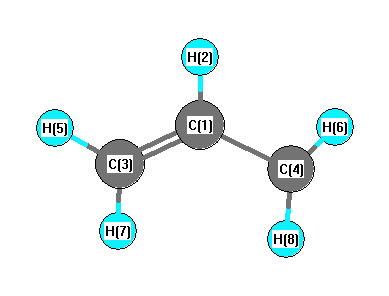 More geometry information
Calculated Bond Angles
| atom1 |
atom2 |
atom3 |
angle |
|
atom1 |
atom2 |
atom3 |
angle |
| C1 |
C3 |
H5 |
121.666 |
|
C1 |
C3 |
H7 |
121.023 |
| C1 |
C4 |
H6 |
121.666 |
|
C1 |
C4 |
H8 |
121.023 |
| H2 |
C1 |
C3 |
117.842 |
|
H2 |
C1 |
C4 |
117.842 |
| C3 |
C1 |
C4 |
124.316 |
|
H5 |
C3 |
H7 |
117.311 |
| H6 |
C4 |
H8 |
117.311 |
|
Electronic energy levels
Charges, Dipole, Quadrupole and Polarizability
Jump to
S1C1
Energy calculated at QCISD(TQ)/6-31G*
| | hartrees |
|---|
| Energy at 0K | -116.871141 |
| Energy at 298.15K | -116.875323 |
| HF Energy | -116.467390 |
| Nuclear repulsion energy | 64.578944 |
The energy at 298.15K was derived from the energy at 0K
and an integrated heat capacity that used the calculated vibrational frequencies.
Vibrational Frequencies calculated at QCISD(TQ)/6-31G*
| Mode Number |
Symmetry |
Frequency
(cm-1) |
Scaled Frequency
(cm-1) |
IR Intensities
(km mol-1) |
Raman Act
(Å4/u) |
Dep P |
Dep U |
|---|
| 1 |
A' |
3261 |
3261 |
|
|
|
|
| 2 |
A' |
3257 |
3257 |
|
|
|
|
| 3 |
A' |
3168 |
3168 |
|
|
|
|
| 4 |
A' |
3161 |
3161 |
|
|
|
|
| 5 |
A' |
3156 |
3156 |
|
|
|
|
| 6 |
A' |
1547 |
1547 |
|
|
|
|
| 7 |
A' |
1532 |
1532 |
|
|
|
|
| 8 |
A' |
1439 |
1439 |
|
|
|
|
| 9 |
A' |
1289 |
1289 |
|
|
|
|
| 10 |
A' |
1204 |
1204 |
|
|
|
|
| 11 |
A' |
1044 |
1044 |
|
|
|
|
| 12 |
A' |
946 |
946 |
|
|
|
|
| 13 |
A' |
424 |
424 |
|
|
|
|
| 14 |
A" |
979 |
979 |
|
|
|
|
| 15 |
A" |
754 |
754 |
|
|
|
|
| 16 |
A" |
740 |
740 |
|
|
|
|
| 17 |
A" |
541 |
541 |
|
|
|
|
| 18 |
A" |
523 |
523 |
|
|
|
|
Unscaled Zero Point Vibrational Energy (zpe) 14482.8 cm
-1
Scaled (by 1) Zero Point Vibrational Energy (zpe) 14482.8 cm
-1
See section
III.C.1 List or set vibrational scaling factors
to change the scale factors used here.
See section
III.C.2
Calculate a vibrational scaling factor for a given set of molecules
to determine the least squares best scaling factor.
Geometric Data calculated at QCISD(TQ)/6-31G*
Point Group is Cs
Cartesians (Å)
| Atom |
x (Å) |
y (Å) |
z (Å) |
|---|
| C1 |
0.000 |
0.452 |
0.000 |
| H2 |
0.001 |
1.545 |
0.000 |
| C3 |
-1.232 |
-0.199 |
0.000 |
| C4 |
1.232 |
-0.199 |
0.000 |
| H5 |
-2.170 |
0.352 |
0.000 |
| H6 |
2.169 |
0.352 |
0.000 |
| H7 |
-1.292 |
-1.287 |
0.000 |
| H8 |
1.292 |
-1.287 |
0.000 |
Atom - Atom Distances (Å)
| |
C1 |
H2 |
C3 |
C4 |
H5 |
H6 |
H7 |
H8 |
| C1 | | 1.0929 | 1.3930 | 1.3931 | 2.1723 | 2.1711 | 2.1660 | 2.1668 |
H2 | 1.0929 | | 2.1354 | 2.1344 | 2.4773 | 2.4741 | 3.1127 | 3.1125 | C3 | 1.3930 | 2.1354 | | 2.4631 | 1.0878 | 3.4449 | 1.0896 | 2.7487 | C4 | 1.3931 | 2.1344 | 2.4631 | | 3.4458 | 1.0876 | 2.7475 | 1.0896 | H5 | 2.1723 | 2.4773 | 1.0878 | 3.4458 | | 4.3388 | 1.8590 | 3.8306 | H6 | 2.1711 | 2.4741 | 3.4449 | 1.0876 | 4.3388 | | 3.8290 | 1.8591 | H7 | 2.1660 | 3.1127 | 1.0896 | 2.7475 | 1.8590 | 3.8290 | | 2.5840 | H8 | 2.1668 | 3.1125 | 2.7487 | 1.0896 | 3.8306 | 1.8591 | 2.5840 | |
More geometry information
Calculated Bond Angles
| atom1 |
atom2 |
atom3 |
angle |
|
atom1 |
atom2 |
atom3 |
angle |
| C1 |
C3 |
H5 |
121.753 |
|
C1 |
C3 |
H7 |
121.006 |
| C1 |
C4 |
H6 |
121.653 |
|
C1 |
C4 |
H8 |
121.076 |
| H2 |
C1 |
C3 |
117.907 |
|
H2 |
C1 |
C4 |
117.815 |
| C3 |
C1 |
C4 |
124.278 |
|
H5 |
C3 |
H7 |
117.241 |
| H6 |
C4 |
H8 |
117.271 |
|
Electronic energy levels
Charges, Dipole, Quadrupole and Polarizability
