Jump to
S1C2
Energy calculated at CCSD(T)/6-31G*
| | hartrees |
|---|
| Energy at 0K | -133.537719 |
| Energy at 298.15K | -133.543169 |
| HF Energy | -133.071090 |
| Nuclear repulsion energy | 70.466196 |
The energy at 298.15K was derived from the energy at 0K
and an integrated heat capacity that used the calculated vibrational frequencies.
Vibrational Frequencies calculated at CCSD(T)/6-31G*
| Mode Number |
Symmetry |
Frequency
(cm-1) |
Scaled Frequency
(cm-1) |
IR Intensities
(km mol-1) |
Raman Act
(Å4/u) |
Dep P |
Dep U |
|---|
| 1 |
A' |
3394 |
3265 |
|
|
|
|
| 2 |
A' |
3164 |
3044 |
|
|
|
|
| 3 |
A' |
3053 |
2937 |
|
|
|
|
| 4 |
A' |
3041 |
2926 |
|
|
|
|
| 5 |
A' |
1718 |
1652 |
|
|
|
|
| 6 |
A' |
1521 |
1463 |
|
|
|
|
| 7 |
A' |
1466 |
1411 |
|
|
|
|
| 8 |
A' |
1429 |
1375 |
|
|
|
|
| 9 |
A' |
1305 |
1255 |
|
|
|
|
| 10 |
A' |
1084 |
1043 |
|
|
|
|
| 11 |
A' |
948 |
912 |
|
|
|
|
| 12 |
A' |
490 |
471 |
|
|
|
|
| 13 |
A" |
3114 |
2996 |
|
|
|
|
| 14 |
A" |
1522 |
1464 |
|
|
|
|
| 15 |
A" |
1124 |
1081 |
|
|
|
|
| 16 |
A" |
1097 |
1056 |
|
|
|
|
| 17 |
A" |
686 |
660 |
|
|
|
|
| 18 |
A" |
180 |
173 |
|
|
|
|
Unscaled Zero Point Vibrational Energy (zpe) 15168.2 cm
-1
Scaled (by 0.9621) Zero Point Vibrational Energy (zpe) 14593.4 cm
-1
See section
III.C.1 List or set vibrational scaling factors
to change the scale factors used here.
See section
III.C.2
Calculate a vibrational scaling factor for a given set of molecules
to determine the least squares best scaling factor.
Geometric Data calculated at CCSD(T)/6-31G*
Point Group is Cs
Cartesians (Å)
| Atom |
x (Å) |
y (Å) |
z (Å) |
|---|
| C1 |
-1.045 |
-0.623 |
0.000 |
| C2 |
0.000 |
0.456 |
0.000 |
| N3 |
1.253 |
0.165 |
0.000 |
| H4 |
-0.556 |
-1.604 |
0.000 |
| H5 |
-1.690 |
-0.536 |
0.886 |
| H6 |
-1.690 |
-0.536 |
-0.886 |
| H7 |
-0.377 |
1.492 |
0.000 |
| H8 |
1.809 |
1.032 |
0.000 |
Atom - Atom Distances (Å)
| |
C1 |
C2 |
N3 |
H4 |
H5 |
H6 |
H7 |
H8 |
| C1 | | 1.5023 | 2.4290 | 1.0951 | 1.0994 | 1.0994 | 2.2186 | 3.2992 |
C2 | 1.5023 | | 1.2865 | 2.1339 | 2.1508 | 2.1508 | 1.1024 | 1.8986 | N3 | 2.4290 | 1.2865 | | 2.5300 | 3.1524 | 3.1524 | 2.1022 | 1.0303 | H4 | 1.0951 | 2.1339 | 2.5300 | | 1.7915 | 1.7915 | 3.1012 | 3.5415 | H5 | 1.0994 | 2.1508 | 3.1524 | 1.7915 | | 1.7710 | 2.5737 | 3.9357 | H6 | 1.0994 | 2.1508 | 3.1524 | 1.7915 | 1.7710 | | 2.5737 | 3.9357 | H7 | 2.2186 | 1.1024 | 2.1022 | 3.1012 | 2.5737 | 2.5737 | | 2.2342 | H8 | 3.2992 | 1.8986 | 1.0303 | 3.5415 | 3.9357 | 3.9357 | 2.2342 | |
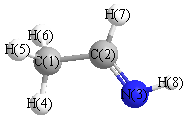 More geometry information
Calculated Bond Angles
| atom1 |
atom2 |
atom3 |
angle |
|
atom1 |
atom2 |
atom3 |
angle |
| C1 |
C2 |
N3 |
120.944 |
|
C1 |
C2 |
H7 |
115.961 |
| C2 |
C1 |
H4 |
109.476 |
|
C2 |
C1 |
H5 |
110.567 |
| C2 |
C1 |
H6 |
110.567 |
|
C2 |
N3 |
H8 |
109.576 |
| N3 |
C2 |
H7 |
123.095 |
|
H4 |
C1 |
H5 |
109.442 |
| H4 |
C1 |
H6 |
109.442 |
|
H5 |
C1 |
H6 |
107.313 |
Electronic energy levels
Charges, Dipole, Quadrupole and Polarizability
Jump to
S1C1
Energy calculated at CCSD(T)/6-31G*
| | hartrees |
|---|
| Energy at 0K | -133.536871 |
| Energy at 298.15K | -133.542299 |
| HF Energy | -133.070068 |
| Nuclear repulsion energy | 70.375265 |
The energy at 298.15K was derived from the energy at 0K
and an integrated heat capacity that used the calculated vibrational frequencies.
Vibrational Frequencies calculated at CCSD(T)/6-31G*
| Mode Number |
Symmetry |
Frequency
(cm-1) |
Scaled Frequency
(cm-1) |
IR Intensities
(km mol-1) |
Raman Act
(Å4/u) |
Dep P |
Dep U |
|---|
| 1 |
A' |
3353 |
3226 |
|
|
|
|
| 2 |
A' |
3137 |
3018 |
|
|
|
|
| 3 |
A' |
3112 |
2994 |
|
|
|
|
| 4 |
A' |
3045 |
2929 |
|
|
|
|
| 5 |
A' |
1714 |
1649 |
|
|
|
|
| 6 |
A' |
1527 |
1469 |
|
|
|
|
| 7 |
A' |
1457 |
1401 |
|
|
|
|
| 8 |
A' |
1438 |
1384 |
|
|
|
|
| 9 |
A' |
1310 |
1260 |
|
|
|
|
| 10 |
A' |
1088 |
1046 |
|
|
|
|
| 11 |
A' |
930 |
895 |
|
|
|
|
| 12 |
A' |
496 |
477 |
|
|
|
|
| 13 |
A" |
3117 |
2999 |
|
|
|
|
| 14 |
A" |
1516 |
1458 |
|
|
|
|
| 15 |
A" |
1150 |
1106 |
|
|
|
|
| 16 |
A" |
1094 |
1053 |
|
|
|
|
| 17 |
A" |
686 |
660 |
|
|
|
|
| 18 |
A" |
164 |
158 |
|
|
|
|
Unscaled Zero Point Vibrational Energy (zpe) 15165.3 cm
-1
Scaled (by 0.9621) Zero Point Vibrational Energy (zpe) 14590.5 cm
-1
See section
III.C.1 List or set vibrational scaling factors
to change the scale factors used here.
See section
III.C.2
Calculate a vibrational scaling factor for a given set of molecules
to determine the least squares best scaling factor.
Geometric Data calculated at CCSD(T)/6-31G*
Point Group is Cs
Cartesians (Å)
| Atom |
x (Å) |
y (Å) |
z (Å) |
|---|
| C1 |
-1.032 |
-0.615 |
0.000 |
| C2 |
0.000 |
0.486 |
0.000 |
| N3 |
1.280 |
0.368 |
0.000 |
| H4 |
-0.554 |
-1.604 |
0.000 |
| H5 |
-1.678 |
-0.534 |
0.885 |
| H6 |
-1.678 |
-0.534 |
-0.885 |
| H7 |
-0.394 |
1.510 |
0.000 |
| H8 |
1.533 |
-0.634 |
0.000 |
Atom - Atom Distances (Å)
| |
C1 |
C2 |
N3 |
H4 |
H5 |
H6 |
H7 |
H8 |
| C1 | | 1.5089 | 2.5121 | 1.0980 | 1.0993 | 1.0993 | 2.2192 | 2.5649 |
C2 | 1.5089 | | 1.2856 | 2.1617 | 2.1542 | 2.1542 | 1.0975 | 1.8985 | N3 | 2.5121 | 1.2856 | | 2.6925 | 3.2171 | 3.2171 | 2.0266 | 1.0332 | H4 | 1.0980 | 2.1617 | 2.6925 | | 1.7869 | 1.7869 | 3.1182 | 2.3011 | H5 | 1.0993 | 2.1542 | 3.2171 | 1.7869 | | 1.7705 | 2.5716 | 3.3328 | H6 | 1.0993 | 2.1542 | 3.2171 | 1.7869 | 1.7705 | | 2.5716 | 3.3328 | H7 | 2.2192 | 1.0975 | 2.0266 | 3.1182 | 2.5716 | 2.5716 | | 2.8828 | H8 | 2.5649 | 1.8985 | 1.0332 | 2.3011 | 3.3328 | 3.3328 | 2.8828 | |
More geometry information
Calculated Bond Angles
| atom1 |
atom2 |
atom3 |
angle |
|
atom1 |
atom2 |
atom3 |
angle |
| C1 |
C2 |
N3 |
127.869 |
|
C1 |
C2 |
H7 |
115.844 |
| C2 |
C1 |
H4 |
111.056 |
|
C2 |
C1 |
H5 |
110.384 |
| C2 |
C1 |
H6 |
110.384 |
|
C2 |
N3 |
H8 |
109.444 |
| N3 |
C2 |
H7 |
116.288 |
|
H4 |
C1 |
H5 |
108.821 |
| H4 |
C1 |
H6 |
108.821 |
|
H5 |
C1 |
H6 |
107.275 |
Electronic energy levels
Charges, Dipole, Quadrupole and Polarizability
