return to home page Computational Chemistry Comparison and Benchmark DataBase Release 22 (May 2022) Standard Reference Database 101 National Institute of Standards and Technology
You are here: Calculated > Energy > Optimized > Energy

All results from a given calculation for C3H7 (n-Propyl radical)

using model chemistry: QCISD/6-31G*

19 10 17 12 22

States and conformations

State Conformation minimum conformation conformer description state description
1 1 yes C1 2A"
Energy calculated at QCISD/6-31G*
 hartrees
Energy at 0K-118.045973
Energy at 298.15K 
HF Energy-117.630978
Nuclear repulsion energy75.652415
The energy at 298.15K was derived from the energy at 0K and an integrated heat capacity that used the calculated vibrational frequencies.
Vibrational Frequencies calculated at QCISD/6-31G*
Mode Number Symmetry Frequency
(cm-1)
Scaled Frequency
(cm-1)
IR Intensities
(km mol-1)
Raman Act
(Å4/u)
Dep P Dep U
1 A 3274 3118 18.56      
2 A 3174 3023 15.18      
3 A 3143 2993 32.78      
4 A 3137 2988 39.32      
5 A 3068 2922 23.03      
6 A 3064 2917 24.09      
7 A 2989 2847 35.15      
8 A 1555 1481 3.43      
9 A 1548 1474 5.25      
10 A 1534 1460 0.84      
11 A 1511 1439 0.78      
12 A 1464 1394 2.17      
13 A 1407 1339 2.04      
14 A 1311 1249 0.21      
15 A 1211 1153 0.54      
16 A 1119 1066 0.04      
17 A 1093 1041 1.15      
18 A 946 900 1.41      
19 A 911 868 0.12      
20 A 779 742 0.92      
21 A 468 446 41.41      
22 A 375 357 5.27      
23 A 259 247 0.11      
24 A 140 133 0.49      

Unscaled Zero Point Vibrational Energy (zpe) 19739.8 cm-1
Scaled (by 0.9523) Zero Point Vibrational Energy (zpe) 18798.2 cm-1
See section III.C.1 List or set vibrational scaling factors to change the scale factors used here.
See section III.C.2 Calculate a vibrational scaling factor for a given set of molecules to determine the least squares best scaling factor.
Rotational Constants (cm-1) from geometry optimized at QCISD/6-31G*
ABC
1.08445 0.29871 0.25918

See section I.F.4 to change rotational constant units
Geometric Data calculated at QCISD/6-31G*

Point Group is C1

Cartesians (Å)
Atom x (Å) y (Å) z (Å)
C1 1.301 -0.295 -0.039
C2 0.076 0.559 0.058
C3 -1.223 -0.247 -0.041
H4 -2.102 0.405 0.033
H5 -1.276 -0.784 -0.996
H6 -1.284 -0.990 0.765
H7 0.078 1.120 1.011
H8 0.099 1.325 -0.731
H9 2.261 0.130 -0.323
H10 1.301 -1.304 0.369

Atom - Atom Distances (Å)
  C1 C2 C3 H4 H5 H6 H7 H8 H9 H10
C11.49682.52533.47562.79282.79532.14522.13341.08711.0881
C21.49681.53252.18382.17782.17931.10591.10022.25872.2514
C32.52531.53251.09701.09691.09772.16062.16763.51582.7676
H43.47562.18381.09701.77631.77522.49362.50504.38603.8234
H52.79282.17781.09691.77631.77373.07982.53173.71452.9631
H62.79532.17931.09771.77521.77372.52293.08423.87352.6345
H72.14521.10592.16062.49363.07982.52291.75432.74332.7899
H82.13341.10022.16762.50502.53173.08421.75432.50383.0935
H91.08712.25873.51584.38603.71453.87352.74332.50381.8588
H101.08812.25142.76763.82342.96312.63452.78993.09351.8588

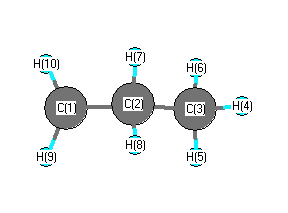
picture of n-Propyl radical state 1 conformation 1
More geometry information
Calculated Bond Angles
atom1 atom2 atom3 angle atom1 atom2 atom3 angle
C1 C2 C3 112.940 C1 C2 H7 110.117
C1 C2 H8 109.528 C2 C1 H9 121.073
C2 C1 H10 120.323 C2 C3 H4 111.215
C2 C3 H5 110.746 C2 C3 H6 110.815
C3 C2 H7 108.877 C3 C2 H8 109.751
H4 C3 H5 108.124 H4 C3 H6 107.969
H5 C3 H6 107.842 H7 C2 H8 105.348
H9 C1 H10 117.418
Electronic energy levels
Charges, Dipole, Quadrupole and Polarizability