Jump to
S2C1
Energy calculated at CID/6-31G*
| | hartrees |
|---|
| Energy at 0K | -76.994645 |
| Energy at 298.15K | -76.994482 |
| HF Energy | -76.763111 |
| Nuclear repulsion energy | 23.780935 |
The energy at 298.15K was derived from the energy at 0K
and an integrated heat capacity that used the calculated vibrational frequencies.
Vibrational Frequencies calculated at CID/6-31G*
| Mode Number |
Symmetry |
Frequency
(cm-1) |
Scaled Frequency
(cm-1) |
IR Intensities
(km mol-1) |
Raman Act
(Å4/u) |
Dep P |
Dep U |
|---|
| 1 |
A1 |
3226 |
2980 |
30.56 |
|
|
|
| 2 |
A1 |
1752 |
1618 |
71.66 |
|
|
|
| 3 |
A1 |
1306 |
1206 |
16.22 |
|
|
|
| 4 |
B1 |
818 |
756 |
95.26 |
|
|
|
| 5 |
B2 |
3312 |
3059 |
8.87 |
|
|
|
| 6 |
B2 |
469 |
433 |
5.13 |
|
|
|
Unscaled Zero Point Vibrational Energy (zpe) 5441.4 cm
-1
Scaled (by 0.9237) Zero Point Vibrational Energy (zpe) 5026.2 cm
-1
See section
III.C.1 List or set vibrational scaling factors
to change the scale factors used here.
See section
III.C.2
Calculate a vibrational scaling factor for a given set of molecules
to determine the least squares best scaling factor.
Geometric Data calculated at CID/6-31G*
Point Group is C2v
Cartesians (Å)
| Atom |
x (Å) |
y (Å) |
z (Å) |
|---|
| C1 |
0.000 |
0.000 |
-0.480 |
| C2 |
0.000 |
0.000 |
0.825 |
| H3 |
0.000 |
0.936 |
-1.032 |
| H4 |
0.000 |
-0.936 |
-1.032 |
Atom - Atom Distances (Å)
| |
C1 |
C2 |
H3 |
H4 |
| C1 | | 1.3050 | 1.0862 | 1.0862 |
C2 | 1.3050 | | 2.0792 | 2.0792 | H3 | 1.0862 | 2.0792 | | 1.8712 | H4 | 1.0862 | 2.0792 | 1.8712 | |
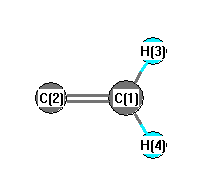 More geometry information
Calculated Bond Angles
| atom1 |
atom2 |
atom3 |
angle |
|
atom1 |
atom2 |
atom3 |
angle |
| C2 |
C1 |
H3 |
120.530 |
|
C2 |
C1 |
H4 |
120.530 |
| H3 |
C1 |
H4 |
118.939 |
|
Electronic energy levels
Charges, Dipole, Quadrupole and Polarizability
Jump to
S1C1
Energy calculated at CID/6-31G*
| | hartrees |
|---|
| Energy at 0K | -76.925645 |
| Energy at 298.15K | -76.925764 |
| HF Energy | -76.733627 |
| Nuclear repulsion energy | 23.645046 |
The energy at 298.15K was derived from the energy at 0K
and an integrated heat capacity that used the calculated vibrational frequencies.
Vibrational Frequencies calculated at CID/6-31G*
| Mode Number |
Symmetry |
Frequency
(cm-1) |
Scaled Frequency
(cm-1) |
IR Intensities
(km mol-1) |
Raman Act
(Å4/u) |
Dep P |
Dep U |
|---|
| 1 |
A1 |
3167 |
2925 |
4.62 |
|
|
|
| 2 |
A1 |
1610 |
1487 |
3.01 |
|
|
|
| 3 |
A1 |
1466 |
1354 |
5.84 |
|
|
|
| 4 |
B1 |
933 |
862 |
35.68 |
|
|
|
| 5 |
B2 |
3246 |
2998 |
8.07 |
|
|
|
| 6 |
B2 |
1056 |
975 |
2.00 |
|
|
|
Unscaled Zero Point Vibrational Energy (zpe) 5738.6 cm
-1
Scaled (by 0.9237) Zero Point Vibrational Energy (zpe) 5300.7 cm
-1
See section
III.C.1 List or set vibrational scaling factors
to change the scale factors used here.
See section
III.C.2
Calculate a vibrational scaling factor for a given set of molecules
to determine the least squares best scaling factor.
Geometric Data calculated at CID/6-31G*
Point Group is C2v
Cartesians (Å)
| Atom |
x (Å) |
y (Å) |
z (Å) |
|---|
| C1 |
0.000 |
0.000 |
-0.482 |
| C2 |
0.000 |
0.000 |
0.832 |
| H3 |
0.000 |
0.929 |
-1.050 |
| H4 |
0.000 |
-0.929 |
-1.050 |
Atom - Atom Distances (Å)
| |
C1 |
C2 |
H3 |
H4 |
| C1 | | 1.3136 | 1.0889 | 1.0889 |
C2 | 1.3136 | | 2.0984 | 2.0984 | H3 | 1.0889 | 2.0984 | | 1.8582 | H4 | 1.0889 | 2.0984 | 1.8582 | |
More geometry information
Electronic energy levels
Charges, Dipole, Quadrupole and Polarizability
