return to home page Computational Chemistry Comparison and Benchmark DataBase Release 22 (May 2022) Standard Reference Database 101 National Institute of Standards and Technology
You are here: Calculated > Energy > Optimized > Energy

All results from a given calculation for C4H4N (pyrrolide radical)

using model chemistry: CID/6-31G*

19 10 17 12 22

States and conformations

State Conformation minimum conformation conformer description state description
1 1 yes C2V 2A2
Energy calculated at CID/6-31G*
 hartrees
Energy at 0K-208.758777
Energy at 298.15K-208.763589
HF Energy-208.197954
Nuclear repulsion energy151.822069
The energy at 298.15K was derived from the energy at 0K and an integrated heat capacity that used the calculated vibrational frequencies.
Vibrational Frequencies calculated at CID/6-31G*
Mode Number Symmetry Frequency
(cm-1)
Scaled Frequency
(cm-1)
IR Intensities
(km mol-1)
Raman Act
(Å4/u)
Dep P Dep U
1 A1 3382 3124 1.11      
2 A1 3345 3090 2.62      
3 A1 1674 1546 0.99      
4 A1 1553 1434 28.22      
5 A1 1279 1181 3.99      
6 A1 1161 1073 36.94      
7 A1 1106 1022 0.25      
8 A1 924 854 12.52      
9 A2 935 864 0.00      
10 A2 883 815 0.00      
11 A2 530 490 0.00      
12 B1 879 812 0.83      
13 B1 757 700 66.92      
14 B1 583 539 24.39      
15 B2 4818 4451 67156.38      
16 B2 3354 3098 126.67      
17 B2 3335 3080 228.89      
18 B2 1395 1289 80.77      
19 B2 1355 1251 65.55      
20 B2 1075 993 0.01      
21 B2 925 854 1.13      

Unscaled Zero Point Vibrational Energy (zpe) 17622.9 cm-1
Scaled (by 0.9237) Zero Point Vibrational Energy (zpe) 16278.3 cm-1
See section III.C.1 List or set vibrational scaling factors to change the scale factors used here.
See section III.C.2 Calculate a vibrational scaling factor for a given set of molecules to determine the least squares best scaling factor.
Rotational Constants (cm-1) from geometry optimized at CID/6-31G*
ABC
0.33755 0.29718 0.15804

See section I.F.4 to change rotational constant units
Geometric Data calculated at CID/6-31G*

Point Group is C2v

Cartesians (Å)
Atom x (Å) y (Å) z (Å)
N1 0.000 0.000 1.239
C2 0.000 1.056 0.423
C3 0.000 -1.056 0.423
C4 0.000 0.676 -0.979
C5 0.000 -0.676 -0.979
H6 0.000 2.061 0.815
H7 0.000 -2.061 0.815
H8 0.000 1.349 -1.819
H9 0.000 -1.349 -1.819

Atom - Atom Distances (Å)
  N1 C2 C3 C4 C5 H6 H7 H8 H9
N11.33391.33392.31812.31812.10442.10443.34243.3424
C21.33392.11121.45242.22791.07943.14152.26183.2879
C31.33392.11122.22791.45243.14151.07943.28792.2618
C42.31811.45242.22791.35192.26653.27271.07682.1922
C52.31812.22791.45241.35193.27272.26652.19221.0768
H62.10441.07943.14152.26653.27274.12272.72954.3092
H72.10443.14151.07943.27272.26654.12274.30922.7295
H83.34242.26183.28791.07682.19222.72954.30922.6971
H93.34243.28792.26182.19221.07684.30922.72952.6971

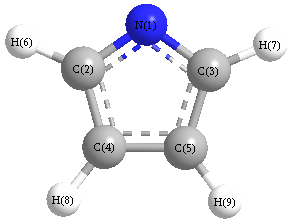
picture of pyrrolide radical state 1 conformation 1
More geometry information
Calculated Bond Angles
atom1 atom2 atom3 angle atom1 atom2 atom3 angle
N1 C2 C4 112.534 N1 C2 H6 121.019
N1 C3 C5 112.534 N1 C3 H7 121.019
C2 N1 C3 104.625 C2 C4 C5 105.153
C2 C4 H8 126.193 C3 C5 C4 105.153
C3 C5 H9 126.193 C4 C2 H6 126.446
C4 C5 H9 128.654 C5 C3 H7 126.446
C5 C4 H8 128.654
Electronic energy levels
Charges, Dipole, Quadrupole and Polarizability