Jump to
S1C2
Energy calculated at QCISD(T)=FULL/6-31G*
| | hartrees |
|---|
| Energy at 0K | -100.087009 |
| Energy at 298.15K | -100.086078 |
| HF Energy | -99.769264 |
| Nuclear repulsion energy | 27.285362 |
The energy at 298.15K was derived from the energy at 0K
and an integrated heat capacity that used the calculated vibrational frequencies.
Geometric Data calculated at QCISD(T)=FULL/6-31G*
Point Group is C∞v
Cartesians (Å)
| Atom |
x (Å) |
y (Å) |
z (Å) |
|---|
| Li1 |
0.000 |
0.000 |
-2.086 |
| C2 |
0.000 |
0.000 |
-0.156 |
| N3 |
0.000 |
0.000 |
1.027 |
Atom - Atom Distances (Å)
| |
Li1 |
C2 |
N3 |
| Li1 | | 1.9301 | 3.1132 |
C2 | 1.9301 | | 1.1831 | N3 | 3.1132 | 1.1831 | |
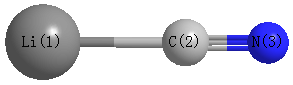 More geometry information
Calculated Bond Angles
| atom1 |
atom2 |
atom3 |
angle |
|
atom1 |
atom2 |
atom3 |
angle |
| Li1 |
C2 |
N3 |
180.000 |
|
Li1 |
N3 |
C2 |
0.000 |
| C2 |
Li1 |
N3 |
0.000 |
|
Electronic energy levels
Charges, Dipole, Quadrupole and Polarizability
Jump to
S1C1
Energy calculated at QCISD(T)=FULL/6-31G*
| | hartrees |
|---|
| Energy at 0K | -100.092723 |
| Energy at 298.15K | -100.092005 |
| HF Energy | -99.777205 |
| Nuclear repulsion energy | 28.905496 |
The energy at 298.15K was derived from the energy at 0K
and an integrated heat capacity that used the calculated vibrational frequencies.
Geometric Data calculated at QCISD(T)=FULL/6-31G*
Point Group is Cs
Cartesians (Å)
| Atom |
x (Å) |
y (Å) |
z (Å) |
|---|
| Li1 |
1.427 |
-0.636 |
0.000 |
| C2 |
-0.714 |
-0.370 |
0.000 |
| N3 |
0.000 |
0.590 |
0.000 |
Atom - Atom Distances (Å)
| |
Li1 |
C2 |
N3 |
| Li1 | | 2.1572 | 1.8815 |
C2 | 2.1572 | | 1.1961 | N3 | 1.8815 | 1.1961 | |
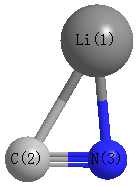 More geometry information
Calculated Bond Angles
| atom1 |
atom2 |
atom3 |
angle |
|
atom1 |
atom2 |
atom3 |
angle |
| Li1 |
C2 |
N3 |
60.464 |
|
Li1 |
N3 |
C2 |
85.956 |
| C2 |
Li1 |
N3 |
33.580 |
|
Electronic energy levels
Charges, Dipole, Quadrupole and Polarizability
