Jump to
S1C2
Energy calculated at PBE1PBE/6-31G*
| | hartrees |
|---|
| Energy at 0K | -188.887060 |
| Energy at 298.15K | -188.888171 |
| HF Energy | -188.887060 |
| Nuclear repulsion energy | 63.214939 |
The energy at 298.15K was derived from the energy at 0K
and an integrated heat capacity that used the calculated vibrational frequencies.
Vibrational Frequencies calculated at PBE1PBE/6-31G*
| Mode Number |
Symmetry |
Frequency
(cm-1) |
Scaled Frequency
(cm-1) |
IR Intensities
(km mol-1) |
Raman Act
(Å4/u) |
Dep P |
Dep U |
|---|
| 1 |
A' |
3592 |
3414 |
19.33 |
|
|
|
| 2 |
A' |
1929 |
1833 |
305.46 |
|
|
|
| 3 |
A' |
1327 |
1261 |
0.00 |
|
|
|
| 4 |
A' |
1130 |
1074 |
160.57 |
|
|
|
| 5 |
A' |
603 |
573 |
37.97 |
|
|
|
| 6 |
A" |
625 |
594 |
128.29 |
|
|
|
Unscaled Zero Point Vibrational Energy (zpe) 4602.8 cm
-1
Scaled (by 0.9503) Zero Point Vibrational Energy (zpe) 4374.0 cm
-1
See section
III.C.1 List or set vibrational scaling factors
to change the scale factors used here.
See section
III.C.2
Calculate a vibrational scaling factor for a given set of molecules
to determine the least squares best scaling factor.
Geometric Data calculated at PBE1PBE/6-31G*
Point Group is Cs
Cartesians (Å)
| Atom |
x (Å) |
y (Å) |
z (Å) |
|---|
| C1 |
0.000 |
0.444 |
0.000 |
| O2 |
-1.062 |
-0.345 |
0.000 |
| O3 |
1.157 |
0.172 |
0.000 |
| H4 |
-0.762 |
-1.278 |
0.000 |
Atom - Atom Distances (Å)
| |
C1 |
O2 |
O3 |
H4 |
| C1 | | 1.3226 | 1.1882 | 1.8827 |
O2 | 1.3226 | | 2.2781 | 0.9799 | O3 | 1.1882 | 2.2781 | | 2.4051 | H4 | 1.8827 | 0.9799 | 2.4051 | |
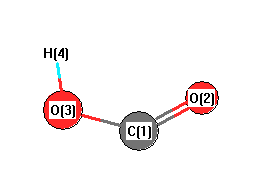 More geometry information
Calculated Bond Angles
| atom1 |
atom2 |
atom3 |
angle |
|
atom1 |
atom2 |
atom3 |
angle |
| C1 |
O2 |
H4 |
108.788 |
|
O2 |
C1 |
O3 |
130.187 |
Electronic energy levels
Charges, Dipole, Quadrupole and Polarizability
Charges from optimized geometry at PBE1PBE/6-31G*
Charges (e)
| Number |
Element |
Mulliken |
CHELPG |
AIM |
ESP |
| 1 |
C |
0.445 |
|
|
|
| 2 |
O |
-0.521 |
|
|
|
| 3 |
O |
-0.348 |
|
|
|
| 4 |
H |
0.424 |
|
|
|
Electric dipole moments
Electric dipole components in Debye
(What's a Debye? See section
VII.A.3)
| |
x |
y |
z |
Total |
| |
-1.004 |
-1.735 |
0.000 |
2.005 |
| CHELPG |
|
|
|
|
| AIM |
|
|
|
|
| ESP |
|
|
|
|
Electric Quadrupole moment
Quadrupole components in D Å
| Primitive |
|---|
| | x | y | z |
|---|
| x |
-19.875 |
0.686 |
0.000 |
| y |
0.686 |
-13.431 |
0.000 |
| z |
0.000 |
0.000 |
-15.808 |
|
| Traceless |
|---|
| | x | y | z |
|---|
| x |
-5.255 |
0.686 |
0.000 |
| y |
0.686 |
4.411 |
0.000 |
| z |
0.000 |
0.000 |
0.844 |
|
| Polar |
|---|
| 3z2-r2 | 1.689 |
|---|
| x2-y2 | -6.444 |
|---|
| xy | 0.686 |
|---|
| xz | 0.000 |
|---|
| yz | 0.000 |
|---|
|
Polarizabilities
Components of the polarizability tensor.
Units are
Å
3 (Angstrom cubed)
Change units.
| |
x |
y |
z |
| x |
3.047 |
0.227 |
0.000 |
| y |
0.227 |
2.412 |
0.000 |
| z |
0.000 |
0.000 |
1.377 |
<r2> (average value of r
2) Å
2
| <r2> |
34.534 |
| (<r2>)1/2 |
5.877 |
Jump to
S1C1
Energy calculated at PBE1PBE/6-31G*
| | hartrees |
|---|
| Energy at 0K | -188.888604 |
| Energy at 298.15K | -188.889687 |
| HF Energy | -188.888604 |
| Nuclear repulsion energy | 62.931149 |
The energy at 298.15K was derived from the energy at 0K
and an integrated heat capacity that used the calculated vibrational frequencies.
Vibrational Frequencies calculated at PBE1PBE/6-31G*
| Mode Number |
Symmetry |
Frequency
(cm-1) |
Scaled Frequency
(cm-1) |
IR Intensities
(km mol-1) |
Raman Act
(Å4/u) |
Dep P |
Dep U |
|---|
| 1 |
A' |
3807 |
3618 |
109.38 |
|
|
|
| 2 |
A' |
1960 |
1863 |
208.23 |
|
|
|
| 3 |
A' |
1277 |
1213 |
291.58 |
|
|
|
| 4 |
A' |
1140 |
1083 |
33.66 |
|
|
|
| 5 |
A' |
623 |
592 |
4.11 |
|
|
|
| 6 |
A" |
564 |
536 |
99.35 |
|
|
|
Unscaled Zero Point Vibrational Energy (zpe) 4685.4 cm
-1
Scaled (by 0.9503) Zero Point Vibrational Energy (zpe) 4452.5 cm
-1
See section
III.C.1 List or set vibrational scaling factors
to change the scale factors used here.
See section
III.C.2
Calculate a vibrational scaling factor for a given set of molecules
to determine the least squares best scaling factor.
Geometric Data calculated at PBE1PBE/6-31G*
Point Group is Cs
Cartesians (Å)
| Atom |
x (Å) |
y (Å) |
z (Å) |
|---|
| C1 |
0.000 |
0.411 |
0.000 |
| O2 |
-0.945 |
-0.537 |
0.000 |
| O3 |
1.171 |
0.241 |
0.000 |
| H4 |
-1.809 |
-0.099 |
0.000 |
Atom - Atom Distances (Å)
| |
C1 |
O2 |
O3 |
H4 |
| C1 | | 1.3382 | 1.1836 | 1.8796 |
O2 | 1.3382 | | 2.2551 | 0.9685 | O3 | 1.1836 | 2.2551 | | 3.0000 | H4 | 1.8796 | 0.9685 | 3.0000 | |
More geometry information
Calculated Bond Angles
| atom1 |
atom2 |
atom3 |
angle |
|
atom1 |
atom2 |
atom3 |
angle |
| C1 |
O2 |
H4 |
108.072 |
|
O2 |
C1 |
O3 |
126.712 |
Electronic energy levels
Charges, Dipole, Quadrupole and Polarizability
Charges from optimized geometry at PBE1PBE/6-31G*
Charges (e)
| Number |
Element |
Mulliken |
CHELPG |
AIM |
ESP |
| 1 |
C |
0.401 |
|
|
|
| 2 |
O |
-0.517 |
|
|
|
| 3 |
O |
-0.331 |
|
|
|
| 4 |
H |
0.447 |
|
|
|
Electric dipole moments
Electric dipole components in Debye
(What's a Debye? See section
VII.A.3)
| |
x |
y |
z |
Total |
| |
-3.100 |
0.449 |
0.000 |
3.132 |
| CHELPG |
|
|
|
|
| AIM |
|
|
|
|
| ESP |
|
|
|
|
Electric Quadrupole moment
Quadrupole components in D Å
| Primitive |
|---|
| | x | y | z |
|---|
| x |
-13.430 |
-1.149 |
0.000 |
| y |
-1.149 |
-17.443 |
0.000 |
| z |
0.000 |
0.000 |
-15.836 |
|
| Traceless |
|---|
| | x | y | z |
|---|
| x |
3.210 |
-1.149 |
0.000 |
| y |
-1.149 |
-2.811 |
0.000 |
| z |
0.000 |
0.000 |
-0.399 |
|
| Polar |
|---|
| 3z2-r2 | -0.798 |
|---|
| x2-y2 | 4.014 |
|---|
| xy | -1.149 |
|---|
| xz | 0.000 |
|---|
| yz | 0.000 |
|---|
|
Polarizabilities
Components of the polarizability tensor.
Units are
Å
3 (Angstrom cubed)
Change units.
| |
x |
y |
z |
| x |
3.543 |
0.175 |
0.000 |
| y |
0.175 |
1.875 |
0.000 |
| z |
0.000 |
0.000 |
1.397 |
<r2> (average value of r
2) Å
2
| <r2> |
34.914 |
| (<r2>)1/2 |
5.909 |
