Jump to
S1C2
S2C1
S2C2
Energy calculated at B3PW91/6-31G*
| | hartrees |
|---|
| Energy at 0K | -131.365270 |
| Energy at 298.15K | -131.364604 |
| HF Energy | -131.365270 |
| Nuclear repulsion energy | 47.225207 |
The energy at 298.15K was derived from the energy at 0K
and an integrated heat capacity that used the calculated vibrational frequencies.
Vibrational Frequencies calculated at B3PW91/6-31G*
| Mode Number |
Symmetry |
Frequency
(cm-1) |
Scaled Frequency
(cm-1) |
IR Intensities
(km mol-1) |
Raman Act
(Å4/u) |
Dep P |
Dep U |
|---|
| 1 |
A' |
3409 |
3261 |
31.43 |
|
|
|
| 2 |
A' |
1829 |
1750 |
33.02 |
|
|
|
| 3 |
A' |
1237 |
1184 |
7.57 |
|
|
|
| 4 |
A' |
498 |
476 |
32.78 |
|
|
|
| 5 |
A' |
397 |
380 |
16.54 |
|
|
|
| 6 |
A" |
449 |
430 |
2.03 |
|
|
|
Unscaled Zero Point Vibrational Energy (zpe) 3909.3 cm
-1
Scaled (by 0.9567) Zero Point Vibrational Energy (zpe) 3740.1 cm
-1
See section
III.C.1 List or set vibrational scaling factors
to change the scale factors used here.
See section
III.C.2
Calculate a vibrational scaling factor for a given set of molecules
to determine the least squares best scaling factor.
Geometric Data calculated at B3PW91/6-31G*
Point Group is Cs
Cartesians (Å)
| Atom |
x (Å) |
y (Å) |
z (Å) |
|---|
| C1 |
0.070 |
-1.225 |
0.000 |
| C2 |
0.000 |
0.087 |
0.000 |
| N3 |
-0.152 |
1.280 |
0.000 |
| H4 |
0.646 |
-2.129 |
0.000 |
Atom - Atom Distances (Å)
| |
C1 |
C2 |
N3 |
H4 |
| C1 | | 1.3129 | 2.5139 | 1.0726 |
C2 | 1.3129 | | 1.2027 | 2.3080 | N3 | 2.5139 | 1.2027 | | 3.5009 | H4 | 1.0726 | 2.3080 | 3.5009 | |
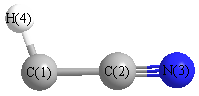 More geometry information
Calculated Bond Angles
| atom1 |
atom2 |
atom3 |
angle |
|
atom1 |
atom2 |
atom3 |
angle |
| C1 |
C2 |
N3 |
175.781 |
|
C2 |
C1 |
H4 |
150.553 |
Electronic energy levels
Charges, Dipole, Quadrupole and Polarizability
Jump to
S1C1
S2C1
S2C2
Energy calculated at B3PW91/6-31G*
| | hartrees |
|---|
| Energy at 0K | -131.364499 |
| Energy at 298.15K | |
| HF Energy | -131.364499 |
| Nuclear repulsion energy | 47.286675 |
The energy at 298.15K was derived from the energy at 0K
and an integrated heat capacity that used the calculated vibrational frequencies.
Vibrational Frequencies calculated at B3PW91/6-31G*
| Mode Number |
Symmetry |
Frequency
(cm-1) |
Scaled Frequency
(cm-1) |
IR Intensities
(km mol-1) |
Raman Act
(Å4/u) |
Dep P |
Dep U |
|---|
| 1 |
Σ |
3470 |
3320 |
63.17 |
|
|
|
| 2 |
Σ |
1760 |
1684 |
36.40 |
|
|
|
| 3 |
Σ |
1282 |
1226 |
5.24 |
|
|
|
| 4 |
Π |
452 |
432 |
0.91 |
|
|
|
| 4 |
Π |
452 |
432 |
0.91 |
|
|
|
| 5 |
Π |
308i |
295i |
52.33 |
|
|
|
| 5 |
Π |
308i |
295i |
52.33 |
|
|
|
Unscaled Zero Point Vibrational Energy (zpe) 3399.7 cm
-1
Scaled (by 0.9567) Zero Point Vibrational Energy (zpe) 3252.5 cm
-1
See section
III.C.1 List or set vibrational scaling factors
to change the scale factors used here.
See section
III.C.2
Calculate a vibrational scaling factor for a given set of molecules
to determine the least squares best scaling factor.
Geometric Data calculated at B3PW91/6-31G*
Point Group is C∞v
Cartesians (Å)
| Atom |
x (Å) |
y (Å) |
z (Å) |
|---|
| C1 |
0.000 |
0.000 |
-1.212 |
| C2 |
0.000 |
0.000 |
0.082 |
| N3 |
0.000 |
0.000 |
1.294 |
| H4 |
0.000 |
0.000 |
-2.280 |
Atom - Atom Distances (Å)
| |
C1 |
C2 |
N3 |
H4 |
| C1 | | 1.2938 | 2.5058 | 1.0677 |
C2 | 1.2938 | | 1.2120 | 2.3615 | N3 | 2.5058 | 1.2120 | | 3.5735 | H4 | 1.0677 | 2.3615 | 3.5735 | |
More geometry information
Calculated Bond Angles
| atom1 |
atom2 |
atom3 |
angle |
|
atom1 |
atom2 |
atom3 |
angle |
| C1 |
C2 |
N3 |
180.000 |
|
C2 |
C1 |
H4 |
180.000 |
Electronic energy levels
Charges, Dipole, Quadrupole and Polarizability
Charges from optimized geometry at B3PW91/6-31G*
Charges (e)
| Number |
Element |
Mulliken |
CHELPG |
AIM |
ESP |
| 1 |
C |
-0.087 |
|
|
|
| 2 |
C |
0.297 |
|
|
|
| 3 |
N |
-0.482 |
|
|
|
| 4 |
H |
0.271 |
|
|
|
Electric dipole moments
Electric dipole components in Debye
(What's a Debye? See section
VII.A.3)
| |
x |
y |
z |
Total |
| |
0.000 |
0.000 |
-3.305 |
3.305 |
| CHELPG |
|
|
|
|
| AIM |
|
|
|
|
| ESP |
|
|
|
|
Electric Quadrupole moment
Quadrupole components in D Å
| Primitive |
|---|
| | x | y | z |
|---|
| x |
-16.880 |
0.000 |
0.000 |
| y |
0.000 |
-16.880 |
0.000 |
| z |
0.000 |
0.000 |
-15.061 |
|
| Traceless |
|---|
| | x | y | z |
|---|
| x |
-0.909 |
0.000 |
0.000 |
| y |
0.000 |
-0.909 |
0.000 |
| z |
0.000 |
0.000 |
1.819 |
|
| Polar |
|---|
| 3z2-r2 | 3.638 |
|---|
| x2-y2 | 0.000 |
|---|
| xy | 0.000 |
|---|
| xz | 0.000 |
|---|
| yz | 0.000 |
|---|
|
Polarizabilities
Components of the polarizability tensor.
Units are
Å
3 (Angstrom cubed)
Change units.
| |
x |
y |
z |
| x |
1.630 |
0.000 |
0.000 |
| y |
0.000 |
1.630 |
0.000 |
| z |
0.000 |
0.000 |
6.144 |
<r2> (average value of r
2) Å
2
| <r2> |
35.933 |
| (<r2>)1/2 |
5.994 |
Jump to
S1C1
S1C2
S2C2
Energy calculated at B3PW91/6-31G*
| | hartrees |
|---|
| Energy at 0K | -131.334154 |
| Energy at 298.15K | -131.333588 |
| HF Energy | -131.334154 |
| Nuclear repulsion energy | 46.918739 |
The energy at 298.15K was derived from the energy at 0K
and an integrated heat capacity that used the calculated vibrational frequencies.
Vibrational Frequencies calculated at B3PW91/6-31G*
| Mode Number |
Symmetry |
Frequency
(cm-1) |
Scaled Frequency
(cm-1) |
IR Intensities
(km mol-1) |
Raman Act
(Å4/u) |
Dep P |
Dep U |
|---|
| 1 |
A' |
3093 |
2959 |
13.32 |
|
|
|
| 2 |
A' |
2114 |
2023 |
17.66 |
|
|
|
| 3 |
A' |
1106 |
1058 |
34.85 |
|
|
|
| 4 |
A' |
933 |
893 |
54.51 |
|
|
|
| 5 |
A' |
445 |
426 |
22.85 |
|
|
|
| 6 |
A" |
319 |
305 |
9.68 |
|
|
|
Unscaled Zero Point Vibrational Energy (zpe) 4005.1 cm
-1
Scaled (by 0.9567) Zero Point Vibrational Energy (zpe) 3831.7 cm
-1
See section
III.C.1 List or set vibrational scaling factors
to change the scale factors used here.
See section
III.C.2
Calculate a vibrational scaling factor for a given set of molecules
to determine the least squares best scaling factor.
Geometric Data calculated at B3PW91/6-31G*
Point Group is Cs
Cartesians (Å)
| Atom |
x (Å) |
y (Å) |
z (Å) |
|---|
| C1 |
0.143 |
-1.275 |
0.000 |
| C2 |
0.000 |
0.092 |
0.000 |
| N3 |
-0.295 |
1.239 |
0.000 |
| H4 |
1.203 |
-1.573 |
0.000 |
Atom - Atom Distances (Å)
| |
C1 |
C2 |
N3 |
H4 |
| C1 | | 1.3744 | 2.5524 | 1.1010 |
C2 | 1.3744 | | 1.1849 | 2.0540 | N3 | 2.5524 | 1.1849 | | 3.1864 | H4 | 1.1010 | 2.0540 | 3.1864 | |
More geometry information
Electronic energy levels
Charges, Dipole, Quadrupole and Polarizability
Charges from optimized geometry at B3PW91/6-31G*
Charges (e)
| Number |
Element |
Mulliken |
CHELPG |
AIM |
ESP |
| 1 |
C |
-0.132 |
|
|
|
| 2 |
C |
0.333 |
|
|
|
| 3 |
N |
-0.414 |
|
|
|
| 4 |
H |
0.214 |
|
|
|
Electric dipole moments
Electric dipole components in Debye
(What's a Debye? See section
VII.A.3)
| |
x |
y |
z |
Total |
| |
1.848 |
-1.317 |
0.000 |
2.270 |
| CHELPG |
|
|
|
|
| AIM |
|
|
|
|
| ESP |
|
|
|
|
Electric Quadrupole moment
Quadrupole components in D Å
| Primitive |
|---|
| | x | y | z |
|---|
| x |
-16.397 |
-2.164 |
0.000 |
| y |
-2.164 |
-20.824 |
0.000 |
| z |
0.000 |
0.000 |
-15.535 |
|
| Traceless |
|---|
| | x | y | z |
|---|
| x |
1.782 |
-2.164 |
0.000 |
| y |
-2.164 |
-4.858 |
0.000 |
| z |
0.000 |
0.000 |
3.076 |
|
| Polar |
|---|
| 3z2-r2 | 6.152 |
|---|
| x2-y2 | 4.426 |
|---|
| xy | -2.164 |
|---|
| xz | 0.000 |
|---|
| yz | 0.000 |
|---|
|
Polarizabilities
Components of the polarizability tensor.
Units are
Å
3 (Angstrom cubed)
Change units.
| |
x |
y |
z |
| x |
2.478 |
-0.979 |
0.000 |
| y |
-0.979 |
6.040 |
0.000 |
| z |
0.000 |
0.000 |
2.182 |
<r2> (average value of r
2) Å
2
| <r2> |
36.195 |
| (<r2>)1/2 |
6.016 |
Jump to
S1C1
S1C2
S2C1
Energy calculated at B3PW91/6-31G*
| | hartrees |
|---|
| Energy at 0K | -131.334154 |
| Energy at 298.15K | -131.333588 |
| HF Energy | -131.334154 |
| Nuclear repulsion energy | 46.918739 |
The energy at 298.15K was derived from the energy at 0K
and an integrated heat capacity that used the calculated vibrational frequencies.
Vibrational Frequencies calculated at B3PW91/6-31G*
Geometric Data calculated at B3PW91/6-31G*
Point Group is Cs
Electronic energy levels
Charges, Dipole, Quadrupole and Polarizability
