Jump to
S1C2
S2C1
S2C2
Energy calculated at QCISD/6-31G*
| | hartrees |
|---|
| Energy at 0K | -131.048552 |
| Energy at 298.15K | -131.047953 |
| HF Energy | -130.680247 |
| Nuclear repulsion energy | 46.871372 |
The energy at 298.15K was derived from the energy at 0K
and an integrated heat capacity that used the calculated vibrational frequencies.
Vibrational Frequencies calculated at QCISD/6-31G*
| Mode Number |
Symmetry |
Frequency
(cm-1) |
Scaled Frequency
(cm-1) |
IR Intensities
(km mol-1) |
Raman Act
(Å4/u) |
Dep P |
Dep U |
|---|
| 1 |
A' |
3371 |
3210 |
17.35 |
|
|
|
| 2 |
A' |
1851 |
1762 |
37.78 |
|
|
|
| 3 |
A' |
1167 |
1112 |
10.06 |
|
|
|
| 4 |
A' |
659 |
628 |
30.46 |
|
|
|
| 5 |
A' |
392 |
373 |
3.12 |
|
|
|
| 6 |
A" |
423 |
403 |
1.78 |
|
|
|
Unscaled Zero Point Vibrational Energy (zpe) 3931.3 cm
-1
Scaled (by 0.9523) Zero Point Vibrational Energy (zpe) 3743.8 cm
-1
See section
III.C.1 List or set vibrational scaling factors
to change the scale factors used here.
See section
III.C.2
Calculate a vibrational scaling factor for a given set of molecules
to determine the least squares best scaling factor.
Geometric Data calculated at QCISD/6-31G*
Point Group is Cs
Cartesians (Å)
| Atom |
x (Å) |
y (Å) |
z (Å) |
|---|
| C1 |
0.053 |
-1.245 |
0.000 |
| C2 |
0.000 |
0.093 |
0.000 |
| N3 |
-0.151 |
1.285 |
0.000 |
| H4 |
0.737 |
-2.078 |
0.000 |
Atom - Atom Distances (Å)
| |
C1 |
C2 |
N3 |
H4 |
| C1 | | 1.3390 | 2.5386 | 1.0770 |
C2 | 1.3390 | | 1.2020 | 2.2921 | N3 | 2.5386 | 1.2020 | | 3.4781 | H4 | 1.0770 | 2.2921 | 3.4781 | |
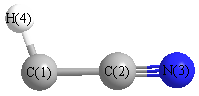 More geometry information
Calculated Bond Angles
| atom1 |
atom2 |
atom3 |
angle |
|
atom1 |
atom2 |
atom3 |
angle |
| C1 |
C2 |
N3 |
175.069 |
|
C2 |
C1 |
H4 |
142.917 |
Electronic energy levels
Charges, Dipole, Quadrupole and Polarizability
Jump to
S1C1
S2C1
S2C2
Energy calculated at QCISD/6-31G*
| | hartrees |
|---|
| Energy at 0K | -131.045654 |
| Energy at 298.15K | |
| HF Energy | -130.677854 |
| Nuclear repulsion energy | 47.014265 |
The energy at 298.15K was derived from the energy at 0K
and an integrated heat capacity that used the calculated vibrational frequencies.
Vibrational Frequencies calculated at QCISD/6-31G*
| Mode Number |
Symmetry |
Frequency
(cm-1) |
Scaled Frequency
(cm-1) |
IR Intensities
(km mol-1) |
Raman Act
(Å4/u) |
Dep P |
Dep U |
|---|
| 1 |
Σ |
3451 |
3286 |
60.91 |
|
|
|
| 2 |
Σ |
1689 |
1608 |
45.25 |
|
|
|
| 3 |
Σ |
1250 |
1190 |
5.47 |
|
|
|
| 4 |
Π |
423 |
403 |
0.06 |
|
|
|
| 4 |
Π |
423 |
403 |
0.06 |
|
|
|
| 5 |
Π |
515i |
491i |
55.79 |
|
|
|
| 5 |
Π |
515i |
491i |
55.79 |
|
|
|
Unscaled Zero Point Vibrational Energy (zpe) 3102.3 cm
-1
Scaled (by 0.9523) Zero Point Vibrational Energy (zpe) 2954.3 cm
-1
See section
III.C.1 List or set vibrational scaling factors
to change the scale factors used here.
See section
III.C.2
Calculate a vibrational scaling factor for a given set of molecules
to determine the least squares best scaling factor.
Geometric Data calculated at QCISD/6-31G*
Point Group is C∞v
Cartesians (Å)
| Atom |
x (Å) |
y (Å) |
z (Å) |
|---|
| C1 |
0.000 |
0.000 |
-1.220 |
| C2 |
0.000 |
0.000 |
0.084 |
| N3 |
0.000 |
0.000 |
1.301 |
| H4 |
0.000 |
0.000 |
-2.290 |
Atom - Atom Distances (Å)
| |
C1 |
C2 |
N3 |
H4 |
| C1 | | 1.3039 | 2.5215 | 1.0702 |
C2 | 1.3039 | | 1.2175 | 2.3742 | N3 | 2.5215 | 1.2175 | | 3.5917 | H4 | 1.0702 | 2.3742 | 3.5917 | |
More geometry information
Calculated Bond Angles
| atom1 |
atom2 |
atom3 |
angle |
|
atom1 |
atom2 |
atom3 |
angle |
| C1 |
C2 |
N3 |
180.000 |
|
C2 |
C1 |
H4 |
180.000 |
Electronic energy levels
Charges, Dipole, Quadrupole and Polarizability
Charges from optimized geometry at QCISD/6-31G*
Charges (e)
| Number |
Element |
Mulliken |
CHELPG |
AIM |
ESP |
| 1 |
C |
-0.143 |
|
|
|
| 2 |
C |
0.221 |
|
|
|
| 3 |
N |
-0.369 |
|
|
|
| 4 |
H |
0.291 |
|
|
|
Electric dipole moments
Electric dipole components in Debye
(What's a Debye? See section
VII.A.3)
| |
x |
y |
z |
Total |
| |
0.000 |
0.000 |
-3.323 |
3.323 |
| CHELPG |
|
|
|
|
| AIM |
|
|
|
|
| ESP |
|
|
|
|
Electric Quadrupole moment
Quadrupole components in D Å
Polarizabilities
Components of the polarizability tensor.
Units are
Å
3 (Angstrom cubed)
Change units.
| |
x |
y |
z |
| x |
0.000 |
0.000 |
0.000 |
| y |
0.000 |
0.000 |
0.000 |
| z |
0.000 |
0.000 |
0.000 |
<r2> (average value of r
2) Å
2
| <r2> |
36.409 |
| (<r2>)1/2 |
6.034 |
Jump to
S1C1
S1C2
S2C2
Energy calculated at QCISD/6-31G*
| | hartrees |
|---|
| Energy at 0K | -131.019772 |
| Energy at 298.15K | -131.019149 |
| HF Energy | -130.614805 |
| Nuclear repulsion energy | 46.503747 |
The energy at 298.15K was derived from the energy at 0K
and an integrated heat capacity that used the calculated vibrational frequencies.
Vibrational Frequencies calculated at QCISD/6-31G*
| Mode Number |
Symmetry |
Frequency
(cm-1) |
Scaled Frequency
(cm-1) |
IR Intensities
(km mol-1) |
Raman Act
(Å4/u) |
Dep P |
Dep U |
|---|
| 1 |
A' |
3059 |
2913 |
24.41 |
|
|
|
| 2 |
A' |
2120 |
2019 |
37.51 |
|
|
|
| 3 |
A' |
1066 |
1015 |
73.30 |
|
|
|
| 4 |
A' |
982 |
935 |
1.73 |
|
|
|
| 5 |
A' |
404 |
385 |
17.22 |
|
|
|
| 6 |
A" |
300 |
285 |
8.56 |
|
|
|
Unscaled Zero Point Vibrational Energy (zpe) 3964.6 cm
-1
Scaled (by 0.9523) Zero Point Vibrational Energy (zpe) 3775.5 cm
-1
See section
III.C.1 List or set vibrational scaling factors
to change the scale factors used here.
See section
III.C.2
Calculate a vibrational scaling factor for a given set of molecules
to determine the least squares best scaling factor.
Geometric Data calculated at QCISD/6-31G*
Point Group is Cs
Cartesians (Å)
| Atom |
x (Å) |
y (Å) |
z (Å) |
|---|
| C1 |
0.076 |
-1.305 |
0.000 |
| C2 |
0.000 |
0.099 |
0.000 |
| N3 |
-0.228 |
1.262 |
0.000 |
| H4 |
1.141 |
-1.599 |
0.000 |
Atom - Atom Distances (Å)
| |
C1 |
C2 |
N3 |
H4 |
| C1 | | 1.4062 | 2.5844 | 1.1051 |
C2 | 1.4062 | | 1.1845 | 2.0461 | N3 | 2.5844 | 1.1845 | | 3.1715 | H4 | 1.1051 | 2.0461 | 3.1715 | |
More geometry information
Electronic energy levels
Charges, Dipole, Quadrupole and Polarizability
Jump to
S1C1
S1C2
S2C1
Energy calculated at QCISD/6-31G*
| | hartrees |
|---|
| Energy at 0K | -131.019772 |
| Energy at 298.15K | -131.019149 |
| HF Energy | -130.614805 |
| Nuclear repulsion energy | 46.503747 |
The energy at 298.15K was derived from the energy at 0K
and an integrated heat capacity that used the calculated vibrational frequencies.
Vibrational Frequencies calculated at QCISD/6-31G*
Geometric Data calculated at QCISD/6-31G*
Point Group is Cs
Electronic energy levels
Charges, Dipole, Quadrupole and Polarizability
