Jump to
S1C2
S2C1
S2C2
Energy calculated at B2PLYP/6-31G*
| | hartrees |
|---|
| Energy at 0K | -131.285535 |
| Energy at 298.15K | -131.284957 |
| HF Energy | -131.168209 |
| Nuclear repulsion energy | 47.201482 |
The energy at 298.15K was derived from the energy at 0K
and an integrated heat capacity that used the calculated vibrational frequencies.
Vibrational Frequencies calculated at B2PLYP/6-31G*
| Mode Number |
Symmetry |
Frequency
(cm-1) |
Scaled Frequency
(cm-1) |
IR Intensities
(km mol-1) |
Raman Act
(Å4/u) |
Dep P |
Dep U |
|---|
| 1 |
A' |
3399 |
3227 |
24.72 |
|
|
|
| 2 |
A' |
1903 |
1807 |
19.14 |
|
|
|
| 3 |
A' |
1189 |
1128 |
13.54 |
|
|
|
| 4 |
A' |
606 |
575 |
36.68 |
|
|
|
| 5 |
A' |
409 |
388 |
7.11 |
|
|
|
| 6 |
A" |
458 |
435 |
3.29 |
|
|
|
Unscaled Zero Point Vibrational Energy (zpe) 3981.6 cm
-1
Scaled (by 0.9492) Zero Point Vibrational Energy (zpe) 3779.4 cm
-1
See section
III.C.1 List or set vibrational scaling factors
to change the scale factors used here.
See section
III.C.2
Calculate a vibrational scaling factor for a given set of molecules
to determine the least squares best scaling factor.
Geometric Data calculated at B2PLYP/6-31G*
Point Group is Cs
Cartesians (Å)
| Atom |
x (Å) |
y (Å) |
z (Å) |
|---|
| C1 |
0.005 |
-1.236 |
0.000 |
| C2 |
0.000 |
0.092 |
0.000 |
| N3 |
-0.093 |
1.282 |
0.000 |
| H4 |
0.623 |
-2.112 |
0.000 |
Atom - Atom Distances (Å)
| |
C1 |
C2 |
N3 |
H4 |
| C1 | | 1.3281 | 2.5198 | 1.0727 |
C2 | 1.3281 | | 1.1934 | 2.2911 | N3 | 2.5198 | 1.1934 | | 3.4692 | H4 | 1.0727 | 2.2911 | 3.4692 | |
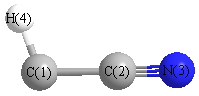 More geometry information
Calculated Bond Angles
| atom1 |
atom2 |
atom3 |
angle |
|
atom1 |
atom2 |
atom3 |
angle |
| C1 |
C2 |
N3 |
175.731 |
|
C2 |
C1 |
H4 |
145.004 |
Electronic energy levels
Charges, Dipole, Quadrupole and Polarizability
Jump to
S1C1
S2C1
S2C2
Energy calculated at B2PLYP/6-31G*
| | hartrees |
|---|
| Energy at 0K | -131.283781 |
| Energy at 298.15K | |
| HF Energy | -131.167241 |
| Nuclear repulsion energy | 47.331121 |
The energy at 298.15K was derived from the energy at 0K
and an integrated heat capacity that used the calculated vibrational frequencies.
Vibrational Frequencies calculated at B2PLYP/6-31G*
| Mode Number |
Symmetry |
Frequency
(cm-1) |
Scaled Frequency
(cm-1) |
IR Intensities
(km mol-1) |
Raman Act
(Å4/u) |
Dep P |
Dep U |
|---|
| 1 |
Σ |
3486 |
3309 |
69.30 |
|
|
|
| 2 |
Σ |
1725 |
1637 |
30.48 |
|
|
|
| 3 |
Σ |
1277 |
1212 |
10.05 |
|
|
|
| 4 |
Π |
459 |
435 |
0.81 |
|
|
|
| 4 |
Π |
459 |
435 |
0.81 |
|
|
|
| 5 |
Π |
404i |
384i |
54.62 |
|
|
|
| 5 |
Π |
404i |
384i |
54.62 |
|
|
|
Unscaled Zero Point Vibrational Energy (zpe) 3298.6 cm
-1
Scaled (by 0.9492) Zero Point Vibrational Energy (zpe) 3131.0 cm
-1
See section
III.C.1 List or set vibrational scaling factors
to change the scale factors used here.
See section
III.C.2
Calculate a vibrational scaling factor for a given set of molecules
to determine the least squares best scaling factor.
Geometric Data calculated at B2PLYP/6-31G*
Point Group is C∞v
Cartesians (Å)
| Atom |
x (Å) |
y (Å) |
z (Å) |
|---|
| C1 |
0.000 |
0.000 |
-1.212 |
| C2 |
0.000 |
0.000 |
0.084 |
| N3 |
0.000 |
0.000 |
1.292 |
| H4 |
0.000 |
0.000 |
-2.278 |
Atom - Atom Distances (Å)
| |
C1 |
C2 |
N3 |
H4 |
| C1 | | 1.2960 | 2.5042 | 1.0657 |
C2 | 1.2960 | | 1.2082 | 2.3617 | N3 | 2.5042 | 1.2082 | | 3.5699 | H4 | 1.0657 | 2.3617 | 3.5699 | |
More geometry information
Calculated Bond Angles
| atom1 |
atom2 |
atom3 |
angle |
|
atom1 |
atom2 |
atom3 |
angle |
| C1 |
C2 |
N3 |
180.000 |
|
C2 |
C1 |
H4 |
180.000 |
Electronic energy levels
Charges, Dipole, Quadrupole and Polarizability
Charges from optimized geometry at B2PLYP/6-31G*
Charges (e)
| Number |
Element |
Mulliken |
CHELPG |
AIM |
ESP |
| 1 |
C |
-0.107 |
|
|
|
| 2 |
C |
0.278 |
|
|
|
| 3 |
N |
-0.436 |
|
|
|
| 4 |
H |
0.264 |
|
|
|
Electric dipole moments
Electric dipole components in Debye
(What's a Debye? See section
VII.A.3)
| |
x |
y |
z |
Total |
| |
0.000 |
0.000 |
-3.382 |
3.382 |
| CHELPG |
|
|
|
|
| AIM |
|
|
|
|
| ESP |
|
|
|
|
Electric Quadrupole moment
Quadrupole components in D Å
| Primitive |
|---|
| | x | y | z |
|---|
| x |
-16.969 |
0.000 |
0.000 |
| y |
0.000 |
-16.969 |
0.000 |
| z |
0.000 |
0.000 |
-15.306 |
|
| Traceless |
|---|
| | x | y | z |
|---|
| x |
-0.831 |
0.000 |
0.000 |
| y |
0.000 |
-0.831 |
0.000 |
| z |
0.000 |
0.000 |
1.663 |
|
| Polar |
|---|
| 3z2-r2 | 3.326 |
|---|
| x2-y2 | 0.000 |
|---|
| xy | 0.000 |
|---|
| xz | 0.000 |
|---|
| yz | 0.000 |
|---|
|
Polarizabilities
Components of the polarizability tensor.
Units are
Å
3 (Angstrom cubed)
Change units.
| |
x |
y |
z |
| x |
1.610 |
0.000 |
0.000 |
| y |
0.000 |
1.610 |
0.000 |
| z |
0.000 |
0.000 |
6.073 |
<r2> (average value of r
2) Å
2
| <r2> |
35.985 |
| (<r2>)1/2 |
5.999 |
Jump to
S1C1
S1C2
S2C2
Energy calculated at B2PLYP/6-31G*
| | hartrees |
|---|
| Energy at 0K | -131.263668 |
| Energy at 298.15K | -131.263096 |
| HF Energy | -131.130757 |
| Nuclear repulsion energy | 46.733120 |
The energy at 298.15K was derived from the energy at 0K
and an integrated heat capacity that used the calculated vibrational frequencies.
Vibrational Frequencies calculated at B2PLYP/6-31G*
| Mode Number |
Symmetry |
Frequency
(cm-1) |
Scaled Frequency
(cm-1) |
IR Intensities
(km mol-1) |
Raman Act
(Å4/u) |
Dep P |
Dep U |
|---|
| 1 |
A' |
3110 |
2952 |
15.70 |
|
|
|
| 2 |
A' |
2097 |
1991 |
21.42 |
|
|
|
| 3 |
A' |
1089 |
1033 |
44.96 |
|
|
|
| 4 |
A' |
959 |
910 |
38.27 |
|
|
|
| 5 |
A' |
427 |
406 |
20.27 |
|
|
|
| 6 |
A" |
325 |
308 |
10.13 |
|
|
|
Unscaled Zero Point Vibrational Energy (zpe) 4003.1 cm
-1
Scaled (by 0.9492) Zero Point Vibrational Energy (zpe) 3799.7 cm
-1
See section
III.C.1 List or set vibrational scaling factors
to change the scale factors used here.
See section
III.C.2
Calculate a vibrational scaling factor for a given set of molecules
to determine the least squares best scaling factor.
Geometric Data calculated at B2PLYP/6-31G*
Point Group is Cs
Cartesians (Å)
| Atom |
x (Å) |
y (Å) |
z (Å) |
|---|
| C1 |
0.150 |
-1.282 |
0.000 |
| C2 |
0.000 |
0.092 |
0.000 |
| N3 |
-0.301 |
1.243 |
0.000 |
| H4 |
1.212 |
-1.564 |
0.000 |
Atom - Atom Distances (Å)
| |
C1 |
C2 |
N3 |
H4 |
| C1 | | 1.3822 | 2.5647 | 1.0988 |
C2 | 1.3822 | | 1.1894 | 2.0522 | N3 | 2.5647 | 1.1894 | | 3.1888 | H4 | 1.0988 | 2.0522 | 3.1888 | |
More geometry information
Electronic energy levels
Charges, Dipole, Quadrupole and Polarizability
Charges from optimized geometry at B2PLYP/6-31G*
Charges (e)
| Number |
Element |
Mulliken |
CHELPG |
AIM |
ESP |
| 1 |
C |
-0.111 |
|
|
|
| 2 |
C |
0.279 |
|
|
|
| 3 |
N |
-0.367 |
|
|
|
| 4 |
H |
0.198 |
|
|
|
Electric dipole moments
Electric dipole components in Debye
(What's a Debye? See section
VII.A.3)
| |
x |
y |
z |
Total |
| |
1.841 |
-1.296 |
0.000 |
2.252 |
| CHELPG |
|
|
|
|
| AIM |
|
|
|
|
| ESP |
|
|
|
|
Electric Quadrupole moment
Quadrupole components in D Å
| Primitive |
|---|
| | x | y | z |
|---|
| x |
-16.525 |
-2.089 |
0.000 |
| y |
-2.089 |
-21.180 |
0.000 |
| z |
0.000 |
0.000 |
-15.593 |
|
| Traceless |
|---|
| | x | y | z |
|---|
| x |
1.861 |
-2.089 |
0.000 |
| y |
-2.089 |
-5.120 |
0.000 |
| z |
0.000 |
0.000 |
3.259 |
|
| Polar |
|---|
| 3z2-r2 | 6.519 |
|---|
| x2-y2 | 4.654 |
|---|
| xy | -2.089 |
|---|
| xz | 0.000 |
|---|
| yz | 0.000 |
|---|
|
Polarizabilities
Components of the polarizability tensor.
Units are
Å
3 (Angstrom cubed)
Change units.
| |
x |
y |
z |
| x |
2.483 |
-0.990 |
0.000 |
| y |
-0.990 |
5.917 |
0.000 |
| z |
0.000 |
0.000 |
2.157 |
<r2> (average value of r
2) Å
2
| <r2> |
36.503 |
| (<r2>)1/2 |
6.042 |
Jump to
S1C1
S1C2
S2C1
Energy calculated at B2PLYP/6-31G*
| | hartrees |
|---|
| Energy at 0K | -131.263668 |
| Energy at 298.15K | -131.263096 |
| HF Energy | -131.130757 |
| Nuclear repulsion energy | 46.733120 |
The energy at 298.15K was derived from the energy at 0K
and an integrated heat capacity that used the calculated vibrational frequencies.
Vibrational Frequencies calculated at B2PLYP/6-31G*
Geometric Data calculated at B2PLYP/6-31G*
Point Group is Cs
Electronic energy levels
Charges, Dipole, Quadrupole and Polarizability
