Jump to
S1C2
S2C1
S2C2
Energy calculated at QCISD(T)=FULL/6-31G*
| | hartrees |
|---|
| Energy at 0K | -131.075240 |
| Energy at 298.15K | -131.074641 |
| HF Energy | -130.680189 |
| Nuclear repulsion energy | 46.832515 |
The energy at 298.15K was derived from the energy at 0K
and an integrated heat capacity that used the calculated vibrational frequencies.
Vibrational Frequencies calculated at QCISD(T)=FULL/6-31G*
| Mode Number |
Symmetry |
Frequency
(cm-1) |
Scaled Frequency
(cm-1) |
IR Intensities
(km mol-1) |
Raman Act
(Å4/u) |
Dep P |
Dep U |
|---|
| 1 |
A' |
3355 |
3355 |
|
|
|
|
| 2 |
A' |
1845 |
1845 |
|
|
|
|
| 3 |
A' |
1164 |
1164 |
|
|
|
|
| 4 |
A' |
654 |
654 |
|
|
|
|
| 5 |
A' |
392 |
392 |
|
|
|
|
| 6 |
A" |
426 |
426 |
|
|
|
|
Unscaled Zero Point Vibrational Energy (zpe) 3917.4 cm
-1
Scaled (by 1) Zero Point Vibrational Energy (zpe) 3917.4 cm
-1
See section
III.C.1 List or set vibrational scaling factors
to change the scale factors used here.
See section
III.C.2
Calculate a vibrational scaling factor for a given set of molecules
to determine the least squares best scaling factor.
Geometric Data calculated at QCISD(T)=FULL/6-31G*
Point Group is Cs
Cartesians (Å)
| Atom |
x (Å) |
y (Å) |
z (Å) |
|---|
| C1 |
0.043 |
-1.246 |
0.000 |
| C2 |
0.000 |
0.091 |
0.000 |
| N3 |
-0.140 |
1.288 |
0.000 |
| H4 |
0.722 |
-2.084 |
0.000 |
Atom - Atom Distances (Å)
| |
C1 |
C2 |
N3 |
H4 |
| C1 | | 1.3382 | 2.5404 | 1.0780 |
C2 | 1.3382 | | 1.2045 | 2.2917 | N3 | 2.5404 | 1.2045 | | 3.4797 | H4 | 1.0780 | 2.2917 | 3.4797 | |
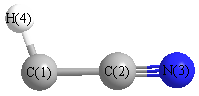 More geometry information
Calculated Bond Angles
| atom1 |
atom2 |
atom3 |
angle |
|
atom1 |
atom2 |
atom3 |
angle |
| C1 |
C2 |
N3 |
175.169 |
|
C2 |
C1 |
H4 |
142.828 |
Electronic energy levels
Charges, Dipole, Quadrupole and Polarizability
Jump to
S1C1
S2C1
S2C2
Energy calculated at QCISD(T)=FULL/6-31G*
| | hartrees |
|---|
| Energy at 0K | -131.072498 |
| Energy at 298.15K | |
| HF Energy | -130.677808 |
| Nuclear repulsion energy | 46.972342 |
The energy at 298.15K was derived from the energy at 0K
and an integrated heat capacity that used the calculated vibrational frequencies.
Vibrational Frequencies calculated at QCISD(T)=FULL/6-31G*
| Mode Number |
Symmetry |
Frequency
(cm-1) |
Scaled Frequency
(cm-1) |
IR Intensities
(km mol-1) |
Raman Act
(Å4/u) |
Dep P |
Dep U |
|---|
| 1 |
Σ |
3439 |
3439 |
|
|
|
|
| 2 |
Σ |
1694 |
1694 |
|
|
|
|
| 3 |
Σ |
1246 |
1246 |
|
|
|
|
| 4 |
Π |
431 |
431 |
|
|
|
|
| 4 |
Π |
431 |
431 |
|
|
|
|
| 5 |
Π |
495i |
495i |
|
|
|
|
| 5 |
Π |
495i |
495i |
|
|
|
|
Unscaled Zero Point Vibrational Energy (zpe) 3126.3 cm
-1
Scaled (by 1) Zero Point Vibrational Energy (zpe) 3126.3 cm
-1
See section
III.C.1 List or set vibrational scaling factors
to change the scale factors used here.
See section
III.C.2
Calculate a vibrational scaling factor for a given set of molecules
to determine the least squares best scaling factor.
Geometric Data calculated at QCISD(T)=FULL/6-31G*
Point Group is C∞v
Cartesians (Å)
| Atom |
x (Å) |
y (Å) |
z (Å) |
|---|
| C1 |
0.000 |
0.000 |
-1.221 |
| C2 |
0.000 |
0.000 |
0.083 |
| N3 |
0.000 |
0.000 |
1.303 |
| H4 |
0.000 |
0.000 |
-2.292 |
Atom - Atom Distances (Å)
| |
C1 |
C2 |
N3 |
H4 |
| C1 | | 1.3036 | 2.5234 | 1.0710 |
C2 | 1.3036 | | 1.2198 | 2.3746 | N3 | 2.5234 | 1.2198 | | 3.5945 | H4 | 1.0710 | 2.3746 | 3.5945 | |
More geometry information
Calculated Bond Angles
| atom1 |
atom2 |
atom3 |
angle |
|
atom1 |
atom2 |
atom3 |
angle |
| C1 |
C2 |
N3 |
180.000 |
|
C2 |
C1 |
H4 |
180.000 |
Electronic energy levels
Charges, Dipole, Quadrupole and Polarizability
Charges from optimized geometry at QCISD(T)=FULL/6-31G*
Charges (e)
| Number |
Element |
Mulliken |
CHELPG |
AIM |
ESP |
| 1 |
C |
-0.142 |
|
|
|
| 2 |
C |
0.229 |
|
|
|
| 3 |
N |
-0.411 |
|
|
|
| 4 |
H |
0.324 |
|
|
|
Electric dipole moments
Electric Quadrupole moment
Quadrupole components in D Å
Polarizabilities
Components of the polarizability tensor.
Units are
Å
3 (Angstrom cubed)
Change units.
| |
x |
y |
z |
| x |
0.000 |
0.000 |
0.000 |
| y |
0.000 |
0.000 |
0.000 |
| z |
0.000 |
0.000 |
0.000 |
<r2> (average value of r
2) Å
2
| <r2> |
36.500 |
| (<r2>)1/2 |
6.042 |
Jump to
S1C1
S1C2
S2C2
Energy calculated at QCISD(T)=FULL/6-31G*
| | hartrees |
|---|
| Energy at 0K | -131.050288 |
| Energy at 298.15K | -131.049661 |
| HF Energy | -130.613506 |
| Nuclear repulsion energy | 46.437587 |
The energy at 298.15K was derived from the energy at 0K
and an integrated heat capacity that used the calculated vibrational frequencies.
Vibrational Frequencies calculated at QCISD(T)=FULL/6-31G*
| Mode Number |
Symmetry |
Frequency
(cm-1) |
Scaled Frequency
(cm-1) |
IR Intensities
(km mol-1) |
Raman Act
(Å4/u) |
Dep P |
Dep U |
|---|
| 1 |
A' |
3047 |
3047 |
|
|
|
|
| 2 |
A' |
2068 |
2068 |
|
|
|
|
| 3 |
A' |
1059 |
1059 |
|
|
|
|
| 4 |
A' |
969 |
969 |
|
|
|
|
| 5 |
A' |
400 |
400 |
|
|
|
|
| 6 |
A" |
302 |
302 |
|
|
|
|
Unscaled Zero Point Vibrational Energy (zpe) 3922.2 cm
-1
Scaled (by 1) Zero Point Vibrational Energy (zpe) 3922.2 cm
-1
See section
III.C.1 List or set vibrational scaling factors
to change the scale factors used here.
See section
III.C.2
Calculate a vibrational scaling factor for a given set of molecules
to determine the least squares best scaling factor.
Geometric Data calculated at QCISD(T)=FULL/6-31G*
Point Group is Cs
Cartesians (Å)
| Atom |
x (Å) |
y (Å) |
z (Å) |
|---|
| C1 |
0.190 |
-1.290 |
0.000 |
| C2 |
0.000 |
0.097 |
0.000 |
| N3 |
-0.345 |
1.238 |
0.000 |
| H4 |
1.273 |
-1.511 |
0.000 |
Atom - Atom Distances (Å)
| |
C1 |
C2 |
N3 |
H4 |
| C1 | | 1.3998 | 2.5838 | 1.1055 |
C2 | 1.3998 | | 1.1920 | 2.0514 | N3 | 2.5838 | 1.1920 | | 3.1902 | H4 | 1.1055 | 2.0514 | 3.1902 | |
More geometry information
Electronic energy levels
Charges, Dipole, Quadrupole and Polarizability
Jump to
S1C1
S1C2
S2C1
Energy calculated at QCISD(T)=FULL/6-31G*
| | hartrees |
|---|
| Energy at 0K | -131.050288 |
| Energy at 298.15K | -131.049661 |
| HF Energy | -130.613506 |
| Nuclear repulsion energy | 46.437587 |
The energy at 298.15K was derived from the energy at 0K
and an integrated heat capacity that used the calculated vibrational frequencies.
Vibrational Frequencies calculated at QCISD(T)=FULL/6-31G*
Geometric Data calculated at QCISD(T)=FULL/6-31G*
Point Group is Cs
Electronic energy levels
Charges, Dipole, Quadrupole and Polarizability
