Jump to
S1C2
S2C1
S2C2
Energy calculated at B3LYP/6-31G*
| | hartrees |
|---|
| Energy at 0K | -131.421176 |
| Energy at 298.15K | -131.420492 |
| HF Energy | -131.421176 |
| Nuclear repulsion energy | 47.231042 |
The energy at 298.15K was derived from the energy at 0K
and an integrated heat capacity that used the calculated vibrational frequencies.
Vibrational Frequencies calculated at B3LYP/6-31G*
| Mode Number |
Symmetry |
Frequency
(cm-1) |
Scaled Frequency
(cm-1) |
IR Intensities
(km mol-1) |
Raman Act
(Å4/u) |
Dep P |
Dep U |
|---|
| 1 |
A' |
3405 |
3270 |
35.00 |
|
|
|
| 2 |
A' |
1801 |
1730 |
29.76 |
|
|
|
| 3 |
A' |
1247 |
1198 |
6.07 |
|
|
|
| 4 |
A' |
478 |
459 |
28.18 |
|
|
|
| 5 |
A' |
391 |
376 |
26.46 |
|
|
|
| 6 |
A" |
452 |
434 |
2.28 |
|
|
|
Unscaled Zero Point Vibrational Energy (zpe) 3887.2 cm
-1
Scaled (by 0.9603) Zero Point Vibrational Energy (zpe) 3732.9 cm
-1
See section
III.C.1 List or set vibrational scaling factors
to change the scale factors used here.
See section
III.C.2
Calculate a vibrational scaling factor for a given set of molecules
to determine the least squares best scaling factor.
Geometric Data calculated at B3LYP/6-31G*
Point Group is Cs
Cartesians (Å)
| Atom |
x (Å) |
y (Å) |
z (Å) |
|---|
| C1 |
0.074 |
-1.222 |
0.000 |
| C2 |
0.000 |
0.084 |
0.000 |
| N3 |
-0.153 |
1.281 |
0.000 |
| H4 |
0.629 |
-2.139 |
0.000 |
Atom - Atom Distances (Å)
| |
C1 |
C2 |
N3 |
H4 |
| C1 | | 1.3077 | 2.5125 | 1.0718 |
C2 | 1.3077 | | 1.2063 | 2.3098 | N3 | 2.5125 | 1.2063 | | 3.5075 | H4 | 1.0718 | 2.3098 | 3.5075 | |
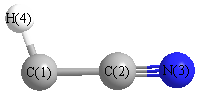 More geometry information
Calculated Bond Angles
| atom1 |
atom2 |
atom3 |
angle |
|
atom1 |
atom2 |
atom3 |
angle |
| C1 |
C2 |
N3 |
175.946 |
|
C2 |
C1 |
H4 |
152.064 |
Electronic energy levels
Charges, Dipole, Quadrupole and Polarizability
Jump to
S1C1
S2C1
S2C2
Energy calculated at B3LYP/6-31G*
| | hartrees |
|---|
| Energy at 0K | -131.420570 |
| Energy at 298.15K | |
| HF Energy | -131.420570 |
| Nuclear repulsion energy | 47.286498 |
The energy at 298.15K was derived from the energy at 0K
and an integrated heat capacity that used the calculated vibrational frequencies.
Vibrational Frequencies calculated at B3LYP/6-31G*
| Mode Number |
Symmetry |
Frequency
(cm-1) |
Scaled Frequency
(cm-1) |
IR Intensities
(km mol-1) |
Raman Act
(Å4/u) |
Dep P |
Dep U |
|---|
| 1 |
Σ |
3464 |
3326 |
65.91 |
|
|
|
| 2 |
Σ |
1747 |
1678 |
32.20 |
|
|
|
| 3 |
Σ |
1286 |
1235 |
4.02 |
|
|
|
| 4 |
Π |
454 |
436 |
1.00 |
|
|
|
| 4 |
Π |
454 |
436 |
1.00 |
|
|
|
| 5 |
Π |
291i |
279i |
50.72 |
|
|
|
| 5 |
Π |
291i |
279i |
50.72 |
|
|
|
Unscaled Zero Point Vibrational Energy (zpe) 3411.9 cm
-1
Scaled (by 0.9603) Zero Point Vibrational Energy (zpe) 3276.5 cm
-1
See section
III.C.1 List or set vibrational scaling factors
to change the scale factors used here.
See section
III.C.2
Calculate a vibrational scaling factor for a given set of molecules
to determine the least squares best scaling factor.
Geometric Data calculated at B3LYP/6-31G*
Point Group is C∞v
Cartesians (Å)
| Atom |
x (Å) |
y (Å) |
z (Å) |
|---|
| C1 |
0.000 |
0.000 |
-1.211 |
| C2 |
0.000 |
0.000 |
0.080 |
| N3 |
0.000 |
0.000 |
1.295 |
| H4 |
0.000 |
0.000 |
-2.278 |
Atom - Atom Distances (Å)
| |
C1 |
C2 |
N3 |
H4 |
| C1 | | 1.2903 | 2.5054 | 1.0670 |
C2 | 1.2903 | | 1.2151 | 2.3572 | N3 | 2.5054 | 1.2151 | | 3.5723 | H4 | 1.0670 | 2.3572 | 3.5723 | |
More geometry information
Calculated Bond Angles
| atom1 |
atom2 |
atom3 |
angle |
|
atom1 |
atom2 |
atom3 |
angle |
| C1 |
C2 |
N3 |
180.000 |
|
C2 |
C1 |
H4 |
180.000 |
Electronic energy levels
Charges, Dipole, Quadrupole and Polarizability
Charges from optimized geometry at B3LYP/6-31G*
Charges (e)
| Number |
Element |
Mulliken |
CHELPG |
AIM |
ESP |
| 1 |
C |
-0.079 |
|
|
|
| 2 |
C |
0.313 |
|
|
|
| 3 |
N |
-0.471 |
|
|
|
| 4 |
H |
0.238 |
|
|
|
Electric dipole moments
Electric dipole components in Debye
(What's a Debye? See section
VII.A.3)
| |
x |
y |
z |
Total |
| |
0.000 |
0.000 |
-3.263 |
3.263 |
| CHELPG |
|
|
|
|
| AIM |
|
|
|
|
| ESP |
|
|
|
|
Electric Quadrupole moment
Quadrupole components in D Å
| Primitive |
|---|
| | x | y | z |
|---|
| x |
-16.869 |
0.000 |
0.000 |
| y |
0.000 |
-16.869 |
0.000 |
| z |
0.000 |
0.000 |
-15.233 |
|
| Traceless |
|---|
| | x | y | z |
|---|
| x |
-0.818 |
0.000 |
0.000 |
| y |
0.000 |
-0.818 |
0.000 |
| z |
0.000 |
0.000 |
1.635 |
|
| Polar |
|---|
| 3z2-r2 | 3.270 |
|---|
| x2-y2 | 0.000 |
|---|
| xy | 0.000 |
|---|
| xz | 0.000 |
|---|
| yz | 0.000 |
|---|
|
Polarizabilities
Components of the polarizability tensor.
Units are
Å
3 (Angstrom cubed)
Change units.
| |
x |
y |
z |
| x |
1.621 |
0.000 |
0.000 |
| y |
0.000 |
1.621 |
0.000 |
| z |
0.000 |
0.000 |
6.152 |
<r2> (average value of r
2) Å
2
| <r2> |
35.949 |
| (<r2>)1/2 |
5.996 |
Jump to
S1C1
S1C2
S2C2
Energy calculated at B3LYP/6-31G*
| | hartrees |
|---|
| Energy at 0K | -131.395175 |
| Energy at 298.15K | -131.394615 |
| HF Energy | -131.395175 |
| Nuclear repulsion energy | 46.894506 |
The energy at 298.15K was derived from the energy at 0K
and an integrated heat capacity that used the calculated vibrational frequencies.
Vibrational Frequencies calculated at B3LYP/6-31G*
| Mode Number |
Symmetry |
Frequency
(cm-1) |
Scaled Frequency
(cm-1) |
IR Intensities
(km mol-1) |
Raman Act
(Å4/u) |
Dep P |
Dep U |
|---|
| 1 |
A' |
3080 |
2958 |
14.07 |
|
|
|
| 2 |
A' |
2105 |
2021 |
17.57 |
|
|
|
| 3 |
A' |
1100 |
1056 |
38.26 |
|
|
|
| 4 |
A' |
940 |
902 |
48.37 |
|
|
|
| 5 |
A' |
443 |
426 |
22.16 |
|
|
|
| 6 |
A" |
325 |
312 |
10.05 |
|
|
|
Unscaled Zero Point Vibrational Energy (zpe) 3996.4 cm
-1
Scaled (by 0.9603) Zero Point Vibrational Energy (zpe) 3837.7 cm
-1
See section
III.C.1 List or set vibrational scaling factors
to change the scale factors used here.
See section
III.C.2
Calculate a vibrational scaling factor for a given set of molecules
to determine the least squares best scaling factor.
Geometric Data calculated at B3LYP/6-31G*
Point Group is Cs
Cartesians (Å)
| Atom |
x (Å) |
y (Å) |
z (Å) |
|---|
| C1 |
0.130 |
-1.278 |
0.000 |
| C2 |
0.000 |
0.092 |
0.000 |
| N3 |
-0.281 |
1.243 |
0.000 |
| H4 |
1.187 |
-1.586 |
0.000 |
Atom - Atom Distances (Å)
| |
C1 |
C2 |
N3 |
H4 |
| C1 | | 1.3761 | 2.5543 | 1.1008 |
C2 | 1.3761 | | 1.1848 | 2.0552 | N3 | 2.5543 | 1.1848 | | 3.1870 | H4 | 1.1008 | 2.0552 | 3.1870 | |
More geometry information
Electronic energy levels
Charges, Dipole, Quadrupole and Polarizability
Charges from optimized geometry at B3LYP/6-31G*
Charges (e)
| Number |
Element |
Mulliken |
CHELPG |
AIM |
ESP |
| 1 |
C |
-0.122 |
|
|
|
| 2 |
C |
0.331 |
|
|
|
| 3 |
N |
-0.404 |
|
|
|
| 4 |
H |
0.195 |
|
|
|
Electric dipole moments
Electric dipole components in Debye
(What's a Debye? See section
VII.A.3)
| |
x |
y |
z |
Total |
| |
1.802 |
-1.324 |
0.000 |
2.236 |
| CHELPG |
|
|
|
|
| AIM |
|
|
|
|
| ESP |
|
|
|
|
Electric Quadrupole moment
Quadrupole components in D Å
| Primitive |
|---|
| | x | y | z |
|---|
| x |
-16.486 |
-2.136 |
0.000 |
| y |
-2.136 |
-20.899 |
0.000 |
| z |
0.000 |
0.000 |
-15.527 |
|
| Traceless |
|---|
| | x | y | z |
|---|
| x |
1.727 |
-2.136 |
0.000 |
| y |
-2.136 |
-4.892 |
0.000 |
| z |
0.000 |
0.000 |
3.165 |
|
| Polar |
|---|
| 3z2-r2 | 6.331 |
|---|
| x2-y2 | 4.412 |
|---|
| xy | -2.136 |
|---|
| xz | 0.000 |
|---|
| yz | 0.000 |
|---|
|
Polarizabilities
Components of the polarizability tensor.
Units are
Å
3 (Angstrom cubed)
Change units.
| |
x |
y |
z |
| x |
2.447 |
-0.945 |
0.000 |
| y |
-0.945 |
6.011 |
0.000 |
| z |
0.000 |
0.000 |
2.170 |
<r2> (average value of r
2) Å
2
| <r2> |
36.259 |
| (<r2>)1/2 |
6.022 |
Jump to
S1C1
S1C2
S2C1
Energy calculated at B3LYP/6-31G*
| | hartrees |
|---|
| Energy at 0K | -131.395175 |
| Energy at 298.15K | -131.394615 |
| HF Energy | -131.395175 |
| Nuclear repulsion energy | 46.894506 |
The energy at 298.15K was derived from the energy at 0K
and an integrated heat capacity that used the calculated vibrational frequencies.
Vibrational Frequencies calculated at B3LYP/6-31G*
Geometric Data calculated at B3LYP/6-31G*
Point Group is Cs
Electronic energy levels
Charges, Dipole, Quadrupole and Polarizability
